
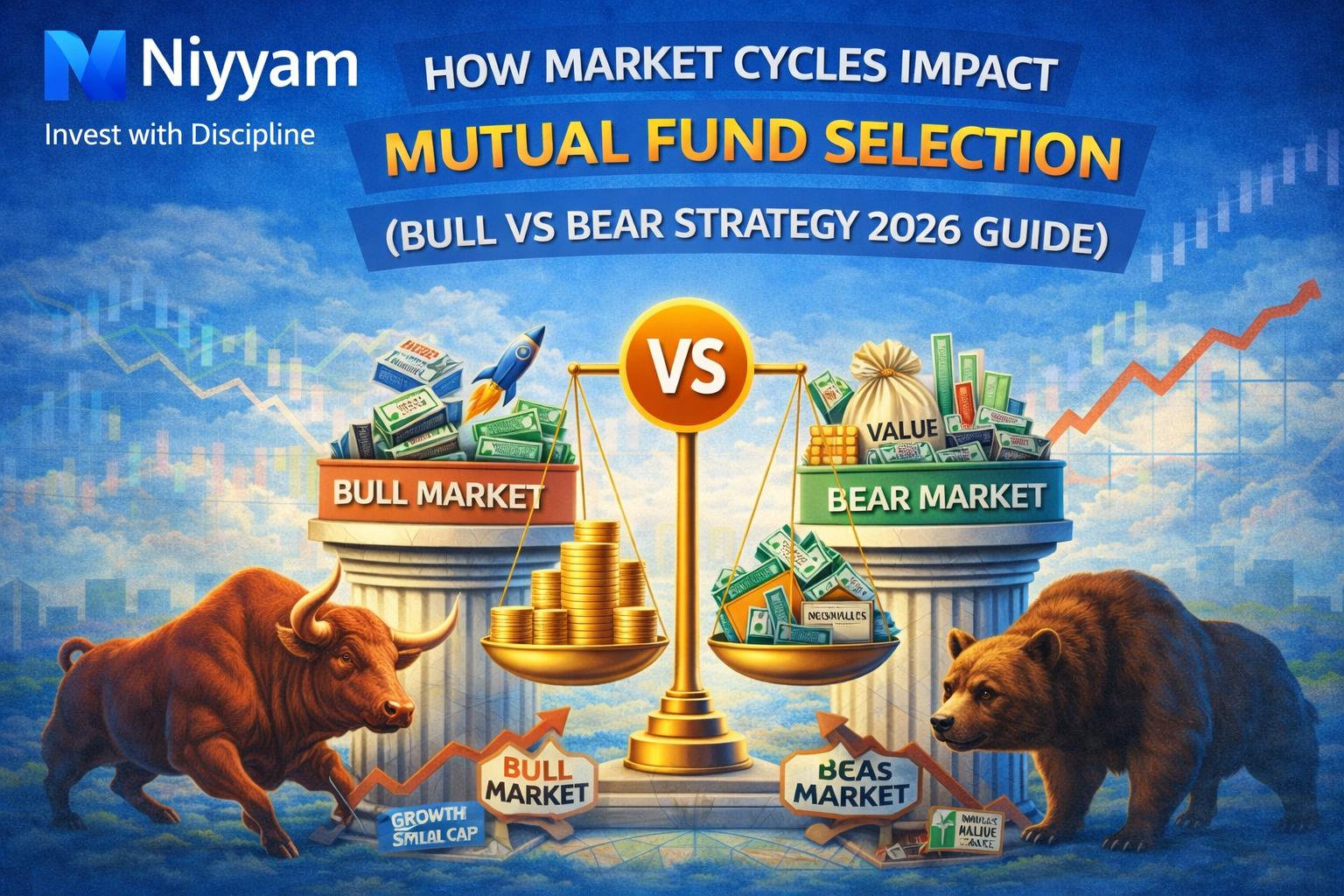
By Ashok Prasad, Founder, Niyyam
Published: April 2026
Introduction
How market cycles impact mutual fund selection is one of the most critical yet overlooked aspects of investing.
Most investors focus only on past returns, fund rankings, or recommendations. But markets do not move in a straight line — they go through cycles. A fund that performs well in one phase can significantly underperform in another.
This is where most investors go wrong. They enter at the wrong time, exit at the wrong time, and blame the fund instead of understanding the cycle.
If you truly want to invest intelligently in 2026, you must understand how market cycles work and how they influence your mutual fund choices.
💡 Key Takeaways
- Market cycles determine which mutual funds perform best at different times
- Growth funds outperform in bull markets, while value funds perform better in recovery phases
- Ignoring market cycles leads to poor timing and lower returns
- Smart investors adjust allocation instead of reacting emotionally
- Long-term success comes from understanding cycles, not predicting them
Direct Answer
How market cycles impact mutual fund selection is simple: different types of funds perform better at different market phases. Growth-oriented funds tend to perform well in bull markets, while value and defensive funds perform better during bear markets and recovery phases. Investors should align their fund selection with the current market cycle rather than relying solely on past performance.
Understanding Market Cycles
Market cycles represent the natural movement of the stock market through different phases over time.
A complete cycle includes:
- Expansion (Bull Phase)
- Peak
- Contraction (Bear Phase)
- Recovery
Each phase has different characteristics — and each favors different types of mutual funds.
Bull Market (Expansion Phase)
This is the most optimistic phase.
Characteristics:
- Rising stock prices
- High investor confidence
- Strong economic growth
- Increased liquidity
Funds that perform well:
- Growth mutual funds
- Mid-cap and small-cap funds
- Sectoral funds
This is when aggressive strategies deliver strong returns.
Market Peak (Overvaluation Phase)
This phase is often misunderstood.
Characteristics:
- Overvalued stocks
- High optimism
- Strong inflows
This is where investors make mistakes by entering aggressively.
To understand this better, you should read how to decide between growth vs value mutual funds india, because growth funds are usually expensive in this phase.
Bear Market (Decline Phase)
This is the most difficult phase emotionally.
Characteristics:
- Falling markets
- Fear and uncertainty
- High volatility
Funds that perform relatively better:
- Value funds
- Hybrid funds
- Defensive strategies
Recovery Phase (Opportunity Phase)
This is the most powerful phase for wealth creation.
Characteristics:
- Market stabilizes
- Undervalued stocks rise
- Confidence returns slowly
Funds that perform well:
- Value funds
- Cyclical funds
Why Market Cycles Matter More in 2026
Markets are evolving faster.
In 2026:
- Faster corrections
- Faster recoveries
- Higher participation
Investors who ignore how market cycles impact mutual fund selection often:
- Buy at peak
- Sell at the bottom
- Switch funds frequently
Understanding cycles gives a long-term advantage.
Step-by-Step Framework to Use Market Cycles
Step 1: Identify Market Phase
Ask:
- Is the market rising continuously?
- Is it overvalued?
- Is there fear or panic?
You don’t need perfection — just awareness.
Step 2: Align Fund Type
- Bull → Growth funds
- Peak → Reduce risk
- Bear → Defensive funds
- Recovery → Value funds
Step 3: Focus on Consistency
Instead of chasing returns, analyze consistency.
To do this properly, understand how to evaluate consistency in mutual funds, so you select funds that perform across cycles.
Step 4: Identify Hidden Risks
Risk is not visible in bull markets.
You must understand how to identify hidden risk in mutual funds to avoid unexpected losses during downturns.
Step 5: Control Your Behavior
Even the best strategy fails without discipline.
For a deeper understanding of how investor behavior and emotional reactions impact decision-making during different market phases, refer to Common Mutual Fund Mistakes and Smart Investor Strategies (2026 Guide). It provides a structured approach to maintaining discipline and avoiding costly mistakes across market cycles.
To improve this, learn how to build conviction in mutual fund investing so you don’t panic during volatility.
Real-Life Scenarios
Investor A (No Cycle Understanding)
- Invests at peak
- Market falls
- Exits in panic
Outcome: Losses
Investor B (Cycle-Aware Investor)
- Invests gradually
- Stays invested
- Adds more during correction
Outcome: Strong long-term returns
Key Insight
The difference is not knowledge — it is discipline and timing awareness.
What to Do in Each Market Phase
During the Bull Market
- Continue SIP
- Avoid over-risk
- Don’t chase returns
During Peak
- Rebalance portfolio
- Avoid a lump sum
- Reduce risk
During the Bear Market
- Stay invested
- Continue SIP
- Avoid panic selling
During Recovery
- Increase allocation gradually
- Focus on value
- Stay patient
Common Mistakes to Avoid
1. Chasing Returns
2. Ignoring Valuations
3. Panic Selling
4. Overconfidence
5. No Strategy
To understand these mistakes in depth along with practical strategies to avoid them, refer to Common Mutual Fund Mistakes and Smart Investor Strategies (2026 Guide). This guide explains how behavioral errors such as panic selling, return chasing, and poor decision-making across market cycles can reduce long-term investment returns.
Pro Tips for Smart Investors
1. Follow Asset Allocation
Use a mutual fund portfolio allocation strategy to maintain balance.
2. Stay Consistent
SIPs help smooth volatility.
3. Invest More During Corrections
Best opportunities come in downturns.
4. Think Long-Term
Short-term noise is irrelevant.
5. Avoid Perfect Timing
Focus on consistency, not perfection.
Quick Summary: Strategy by Market Phase
| Market Phase | Strategy |
|---|---|
| Bull | Growth, Mid-cap |
| Peak | Reduce exposure |
| Bear | Defensive, Hybrid |
| Recovery | Value, Cyclical |
Conclusion
Understanding how market cycles impact mutual fund selection is one of the most powerful skills in investing.
Markets will always move in cycles. You cannot control them — but you can control your behavior.
A disciplined investor:
- Understands cycles
- Adjusts strategy
- Stays consistent
This leads to better long-term results.
Frequently Asked Questions (FAQs)
What are market cycles?
Phases like bull, bear, and recovery.
Which funds work in bull markets?
Growth and mid-cap funds.
What to do in a crash?
Stay invested and continue SIP.
Should I switch funds?
Not frequently — adjust allocation instead.
Can cycles be predicted?
Not exactly, but broadly understood.
Disclaimer
This content is for educational purposes only and does not constitute investment advice.
Mutual fund investments are subject to market risks. Investors should read all scheme-related documents carefully before investing and consider their financial goals, risk tolerance, and investment horizon.
Share this guide with your friends, family, and colleagues to help them make better financial decisions.
If this article helped you, share it with at least one person who needs this guidance.
Leave a Reply