
By Ashok Prasad, Founder, Niyyam
Published: April 2026
Introduction
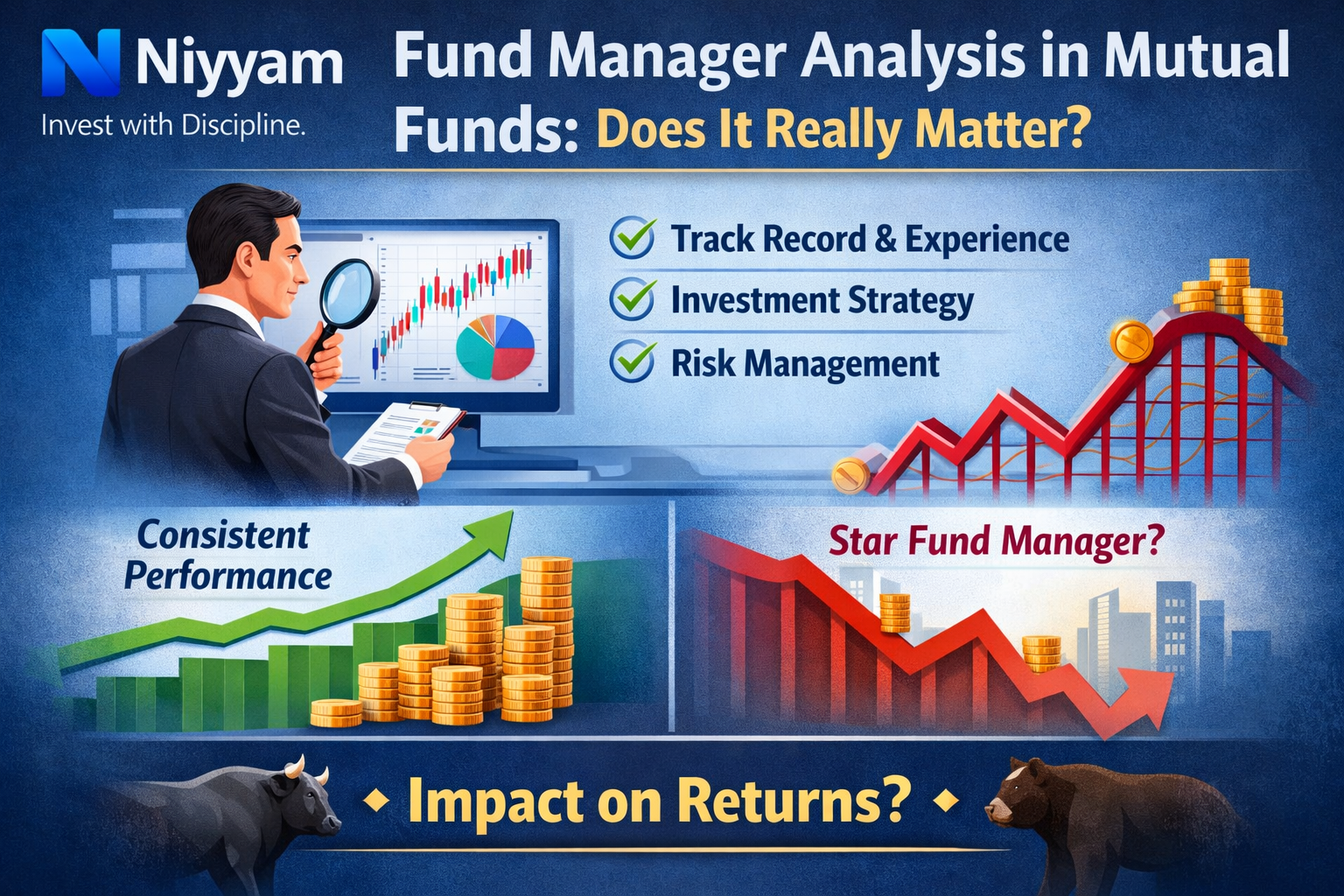
Fund manager analysis in mutual funds is important—but most investors misunderstand its real impact on returns.
Many people either blindly follow star fund managers or ignore them completely, which leads to poor investment decisions.
Understanding how fund managers actually influence performance can help you make smarter investment choices.
Proper fund manager analysis in mutual funds helps investors evaluate long-term consistency rather than short-term performance.
When you invest in a mutual fund, you are trusting someone to manage your money. The fund manager decides which stocks to buy, when to buy or sell, how much risk to take, and how to navigate market conditions.
But the key question is — does the fund manager really make a difference, or are returns mainly driven by market movements?
Understanding this properly in 2026 is critical because markets are more competitive, and consistent outperformance is becoming harder.
💡 Key Takeaways
- Fund managers play a major role in actively managed funds
- Strategy and discipline matter more than short-term returns
- Not all fund managers can outperform consistently
- Fund manager changes can significantly impact performance
- Investors should focus on process, not popularity
Direct Answer
Fund manager analysis in mutual funds matters because the fund manager’s decisions directly influence returns, risk management, and consistency. However, investors should evaluate long-term track record, strategy, and performance across market cycles rather than relying only on reputation or short-term results.
What Does a Fund Manager Actually Do?
A fund manager is responsible for managing the portfolio of a mutual fund.
Their responsibilities include:
- Selecting stocks or securities
- Allocating capital across sectors
- Managing portfolio risk
- Rebalancing investments
- Deciding cash exposure
In simple terms, the fund manager controls how your money is invested and managed.
Types of Fund Managers in Mutual Funds (Growth, Value, Blend Explained)
Different fund managers follow different styles.
| Type | Strategy | Risk Level |
|---|---|---|
| Growth-Oriented | Focus on high-growth companies | High |
| Value-Oriented | Invest in undervalued stocks | Moderate |
| Blend Strategy | Mix of growth and value | Balanced |
| Contrarian | Invest against market sentiment | High |
To understand these styles better, refer to how to decide between growth vs value mutual funds india.
How Fund Manager Decisions Impact Returns
Fund performance depends heavily on three core decisions.
Stock Selection
Choosing the right stocks determines returns.
- Good selection leads to outperformance
- Poor selection leads to underperformance
Sector Allocation
Allocating money across sectors impacts both risk and return.
Example:
- Overweight IT → gains in tech rally
- Overweight cyclical → gains in recovery
Cash Holding Strategy
Some managers hold cash during uncertainty.
- Reduces downside risk
- May limit upside
When Fund Manager Matters the Most
Actively Managed Funds
- High importance
- Decisions directly impact returns
Passive Funds (Index Funds)
- Low importance
- Performance follows index
Comparison Table
| Fund Type | Manager Importance |
|---|---|
| Active Funds | High |
| Index Funds | Low |
| Hybrid Funds | Moderate |
How to Evaluate a Fund Manager (Step-by-Step)
Step 1: Check Long-Term Track Record
| Period | Importance |
|---|---|
| 1 Year | Low |
| 3 Years | Medium |
| 5+ Years | High |
Focus on long-term performance.
Step 2: Analyze Performance Across Cycles
A good manager should:
- Perform well in bull markets
- Protect capital in bear markets
To understand this, refer to how market cycles impact mutual fund selection.
Step 3: Evaluate Consistency
Consistency matters more than peak returns.
Use how to evaluate consistency in mutual funds to analyze stability.
Step 4: Understand Investment Philosophy
Is the manager:
- Growth-focused
- Value-focused
- Balanced
Strategy alignment is critical.
Step 5: Evaluate Risk Management
Check:
- Drawdowns
- Volatility
- Recovery speed
Step 6: Check Portfolio Stability
Frequent portfolio changes may indicate a lack of discipline.
Step 7: Identify Hidden Risks
Some funds carry hidden risks like:
- Sector concentration
- Stock concentration
Learn how to identify hidden risk in mutual funds to avoid surprises.
What Happens When a Fund Manager Changes?
This is one of the most critical but ignored factors.
When a fund manager changes:
- Strategy may change
- Portfolio allocation may shift
- Risk profile may change
Impact Table
| Situation | Impact |
|---|---|
| Strategy unchanged | Low impact |
| Strategy changes | High impact |
| New inexperienced manager | High risk |
Should You Exit If Fund Manager Changes?
Do not react immediately.
Use this framework:
| Factor | Action |
|---|---|
| Strong new manager | Hold |
| Same strategy continues | Hold |
| Strategy changes significantly | Review |
| Performance declines | Consider exit |
Real-Life Scenario
Investor A (Star Manager Follower)
- Invests based on popularity
- Manager exits
- Performance drops
- Panic selling
Investor B (Process-Based Investor)
- Understands strategy
- Focuses on consistency
- Reviews before reacting
Key Insight
The following process is more reliable than following individuals.
When Fund Manager Analysis Can Be Misleading
1. Over-Reliance on Reputation
2. Ignoring Market Conditions
3. Short-Term Performance Bias
To handle this better, investors must understand how to build conviction in mutual fund investing.
Behavioral Mistakes Investors Make
1. Blind Trust in Star Managers
2. Panic During Underperformance
3. Frequent Fund Switching
4. Overconfidence in Bull Markets
Pro Tips for Smart Investors
1. Focus on Process, Not Personality
2. Combine Strategy with Allocation
Use a mutual fund portfolio allocation strategy for balance.
3. Avoid Over-Diversification
4. Think Long-Term
5. Monitor, Don’t React
Can a Good Fund Manager Underperform?
Yes — and this is where most investors get confused.
Even a highly skilled fund manager can underperform due to:
- Market cycles
- Sector rotation
- Short-term economic factors
For example:
- A value manager may underperform in a strong bull market
- A growth manager may struggle during corrections
This is why judging performance based only on short-term results is a mistake.
To understand this better, refer to how market cycles impact mutual fund selection.
Key insight:
- Good managers underperform temporarily
- Poor managers underperform consistently
Quick Summary: Good vs Poor Fund Manager
| Factor | Good Manager | Poor Manager |
|---|---|---|
| Strategy | Clear | Unclear |
| Consistency | Stable | Volatile |
| Risk Control | Strong | Weak |
| Discipline | High | Low |
Final Checklist Before Investing
Ask:
- Does the manager have a strong track record?
- Is performance consistent across cycles?
- Is risk controlled?
- Is the strategy clear?
Conclusion
Fund manager analysis in mutual funds does matter — but not in the way most investors think.
A smart investor understands that:
- Performance fluctuates
- Strategy takes time to work
- Consistency matters more than rankings
Instead of chasing star managers:
- Focus on process
- Evaluate long-term performance
- Stay disciplined
This approach leads to better decisions and long-term wealth creation.
Frequently Asked Questions (FAQs)
Does a fund manager matter in mutual funds?
Yes, especially in active funds.
Should I exit if the fund manager changes?
No, evaluate before deciding.
Can fund managers outperform consistently?
Few can, but not always.
Are index funds better?
Depends on your strategy.
How to evaluate a fund manager?
Track record, consistency, and strategy.
Disclaimer
This content is for educational purposes only and does not constitute investment advice.
Mutual fund investments are subject to market risks. Investors should read all scheme-related documents carefully before investing and consider their financial goals, risk tolerance, and investment horizon.
Share this guide with your friends, family, and colleagues to help them make better financial decisions.
If this article helped you, share it with at least one person who needs this guidance.
Leave a Reply