
By Ashok Prasad, Founder, Niyyam
Published: April 2026
Introduction
How cash levels in mutual funds impact your returns is a concept most investors overlook.
When you invest in a mutual fund, you assume your entire money is working in the market. However, fund managers often keep a portion of the portfolio in cash or liquid instruments.
This seemingly small allocation can significantly influence your returns — sometimes protecting your capital, and sometimes reducing your upside.
In 2026, with dynamic market cycles and increased volatility, understanding cash levels is essential for evaluating mutual funds correctly and making informed decisions.
💡 Key Takeaways
- Cash levels directly impact mutual fund returns
- High cash reduces returns in bull markets
- Cash protects capital during market corrections
- Fund manager strategy determines cash allocation
- Long-term compounding is affected by persistent high cash
Direct Answer
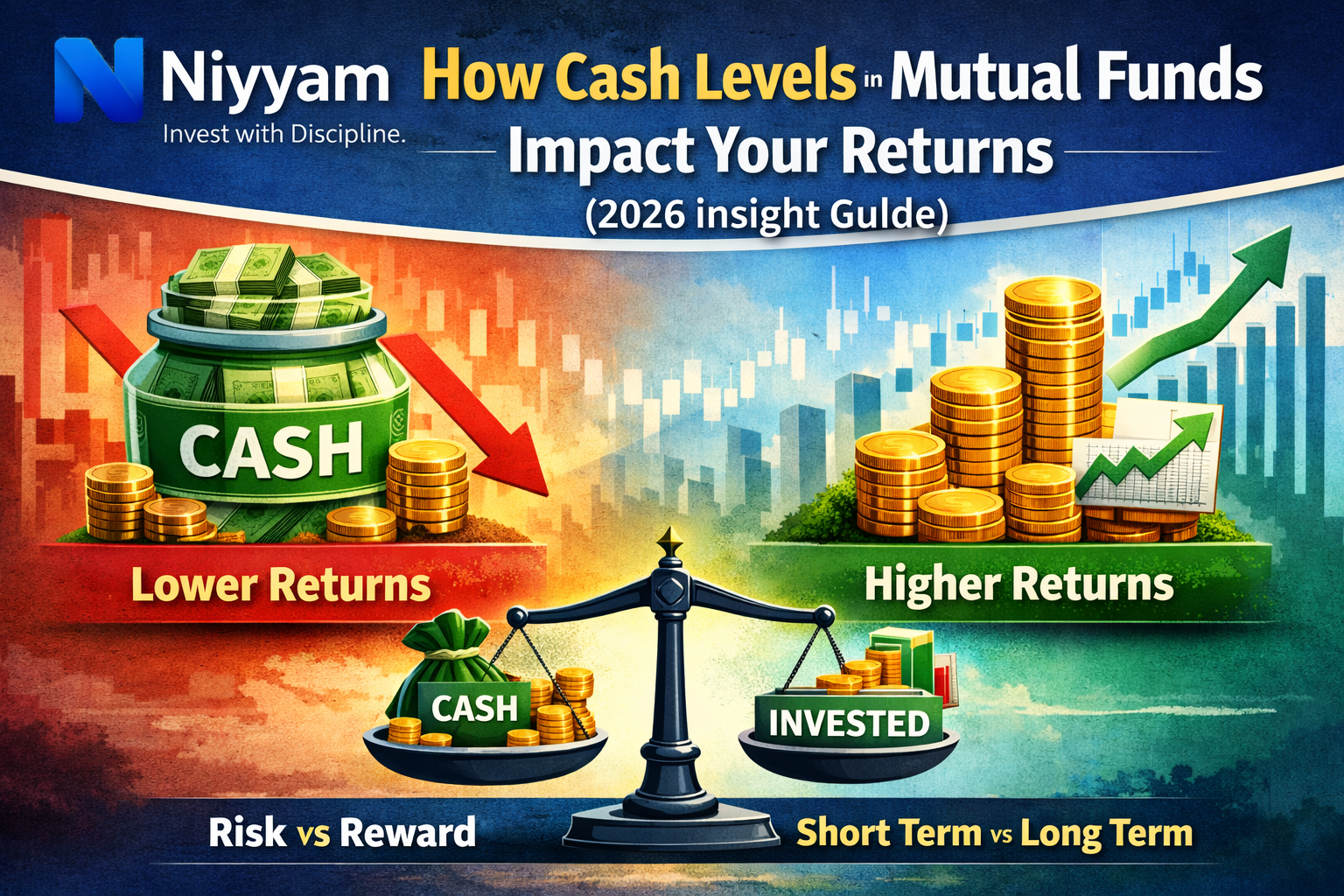
How cash levels in mutual funds impact your returns depends on market conditions. Higher cash levels reduce returns during bull markets but protect capital during downturns. Lower cash levels maximize gains in rising markets but increase downside risk. Investors should analyze cash allocation to understand the fund’s strategy and its long-term impact.
What Are Cash Levels in Mutual Funds?
Cash levels refer to the portion of a mutual fund’s portfolio that is not invested in equities or bonds.
This includes:
- Cash
- Liquid instruments
- Short-term securities
Example
If a fund has:
- 92% invested in equities
- 8% in cash
Cash level = 8%
Why Do Fund Managers Hold Cash?
1. Market Uncertainty
To reduce risk during volatile conditions
2. Tactical Opportunities
To invest when markets fall
3. Liquidity Needs
To manage investor redemptions
4. Valuation Concerns
When markets appear overvalued
How Cash Levels Impact Returns
In Bull Markets
- High cash → Lower returns
- Low cash → Higher returns
In Bear Markets
- High cash → Lower losses
- Low cash → Higher losses
Summary Table
| Market Condition | High Cash | Low Cash |
|---|---|---|
| Bull Market | Lower returns | Higher returns |
| Bear Market | Lower losses | Higher losses |
Expanded Real-Life Example
Fund A (High Cash Strategy)
- Cash: 15%
- Market return: 20%
- Fund return: ~17%
Fund B (Low Cash Strategy)
- Cash: 2%
- Market return: 20%
- Fund return: ~19.5%
Bear Market Scenario
- Fund A falls ~12%
- Fund B falls ~20%
Key Insight
Cash acts as both a cushion (downside protection) and a drag (reduced upside).
How to Interpret Cash Levels
Low Cash (0–5%)
- Aggressive strategy
- Higher return potential
- Higher volatility
Moderate Cash (5–10%)
- Balanced approach
- Controlled risk
High Cash (10%+)
- Defensive strategy
- Lower volatility
- Lower returns
When High Cash Levels Are Beneficial
1. Overvalued Markets
2. Market Corrections
Refer to how market cycles impact mutual fund selection
3. Economic Uncertainty
When High Cash Levels Hurt Returns
1. Strong Bull Markets
2. Long-Term Investing
3. Persistent High Cash Strategy
Cash Levels vs Fund Performance
| Fund Type | Cash Level | Outcome |
|---|---|---|
| Aggressive | Low | High return, high risk |
| Balanced | Moderate | Stable performance |
| Defensive | High | Lower return, lower risk |
How Fund Manager Strategy Impacts Cash
Cash allocation depends heavily on fund manager decisions.
Refer to the fund manager analysis in mutual funds
Manager Types
- Fully invested managers (long-term focus)
- Tactical managers (timing-based approach)
Can Cash Levels Indicate Market Timing?
Yes — but imperfectly.
- Timing markets consistently is difficult
- Even experienced managers make errors
When Fund Managers Get Cash Calls Wrong
Scenario 1
Manager increases cash, expecting correction → Market rises → Underperformance
Scenario 2
Manager stays fully invested → Market crashes → Losses
Key Insight
Cash allocation is always a trade-off between protection and performance.
Behavioral Impact of Cash Levels
Investor Mistake
- Sees underperformance in the bull market
- Assumes the fund is weak
- Exits prematurely
Reality
- The fund may be following a defensive strategy
Key Insight
Understanding cash strategy helps avoid emotional investing decisions.
Hidden Risk of Cash Mismanagement
- Missed opportunities
- Lower long-term returns
- Strategy mismatch
Refer to how to identify hidden risk in mutual funds
Ideal Investor Approach
Beginners
- Prefer low to moderate cash exposure
Advanced Investors
- Combine aggressive and defensive funds
Common Mistakes to Avoid
1. Ignoring Cash Levels
2. Misinterpreting Strategy
3. Chasing Fully Invested Funds
4. Overreacting to Short-Term Performance
5. Not Reviewing Portfolio
Pro Tips for Smart Investors
1. Track Cash Allocation Over Time
2. Align with Market Conditions
3. Focus on Asset Allocation
Refer to the mutual fund portfolio allocation strategy
4. Evaluate Consistency
Refer to how to evaluate consistency in mutual funds
5. Stay Disciplined
When Cash Levels Can Be Misleading (Important Insight)
Not all cash levels should be interpreted the same way.
Sometimes:
- High cash is temporary (due to inflows)
- Low cash may reflect a lack of attractive opportunities
Investors often make the mistake of judging funds based on a single snapshot.
Instead:
- Track cash levels over time
- Understand the reason behind changes
- Evaluate the consistency of the strategy
This leads to better decision-making.
How Cash Levels Affect Long-Term Compounding (Critical Insight)
Over long periods, even small differences in cash allocation can significantly impact wealth creation.
For example:
- A fund with consistently high cash levels may generate slightly lower returns every year
- Over 10–15 years, this difference compounds into a significantly lower final corpus
Even a 1–2% lower annual return can reduce long-term wealth by a large margin.
This is why investors should:
- Avoid funds with consistently high idle cash
- Prefer disciplined and strategic cash allocation
Key insight:
Cash helps in the short term, but excessive cash can hurt long-term compounding.
Does Cash Level Consistency Matter Over Time?
Yes — consistency in cash allocation is as important as the level itself.
A fund that frequently shifts from low cash to high cash may indicate:
- Lack of a clear strategy
- Attempt to time the market
On the other hand, a fund with a consistent approach reflects:
- Strong investment philosophy
- Better predictability
Key insight:
Consistency in cash strategy is a sign of disciplined fund management.
When Should You Pay Attention to Cash Levels?
You should analyze cash levels when:
- Selecting a new fund
- Reviewing your portfolio
- Market conditions change
Final Checklist Before Investing
Ask:
- What is the current cash level?
- Is it temporary or consistent?
- Does it match my risk profile?
- Is the fund strategy clear?
Conclusion
Understanding how cash levels in mutual funds impact your returns provides deeper insight into fund strategy and performance.
A disciplined investor focuses not only on returns but also on how those returns are generated.
Smart investors:
- Analyze cash allocation
- Understand fund behavior
- Avoid emotional reactions
A smart investor also focuses on understanding the “why” behind fund decisions, not just the outcome.
Long-term investors should ensure that cash levels are aligned with their investment horizon and do not unnecessarily reduce compounding potential.
Because:
- Returns are visible
- But strategy drives long-term outcomes
Frequently Asked Questions ( FAQs)
What are cash levels in mutual funds?
The portion of the fund held in cash or liquid assets.
Do high cash levels reduce returns?
Yes, especially during bull markets.
Are high cash funds safer?
Generally, yes, but with lower return potential.
Should I avoid high cash funds?
Depends on market conditions and strategy.
How to check cash levels?
Through fund factsheets.
Disclaimer
This content is for educational purposes only and does not constitute investment advice.
Mutual fund investments are subject to market risks. Investors should read all scheme-related documents carefully before investing and consider their financial goals, risk tolerance, and investment horizon.
Share this guide with your friends, family, and colleagues to help them make better financial decisions.
If this article helped you, share it with at least one person who needs this guidance.
Leave a Reply