
By Ashok Prasad, Founder, Niyyam
Published: April 2026
Introduction
Why do some mutual funds give lower returns even when the market performs well?
One hidden reason is the portfolio turnover ratio — a factor most investors ignore, but that directly impacts your actual returns.
Most mutual fund investors in India focus only on visible factors like past returns, fund category, and expense ratio. However, they often ignore how frequently a fund buys and sells stocks, which directly impacts cost, consistency, and long-term performance.
A fund that frequently churns its portfolio may incur higher transaction costs and take unnecessary risks. On the other hand, a fund with a stable portfolio reflects discipline and long-term conviction.
To truly understand its impact, you must first understand how mutual funds generate returns for investors, because frequent buying and selling directly influences how those returns are created.
💡 Key Takeaways
- Portfolio turnover ratio measures how frequently a fund trades
- High turnover leads to higher hidden costs
- Low turnover reflects long-term investing discipline
- It impacts returns, consistency, and tax efficiency
- Should always be evaluated along with alpha and beta
- Not all high turnover funds are bad — context matters
Direct Answer
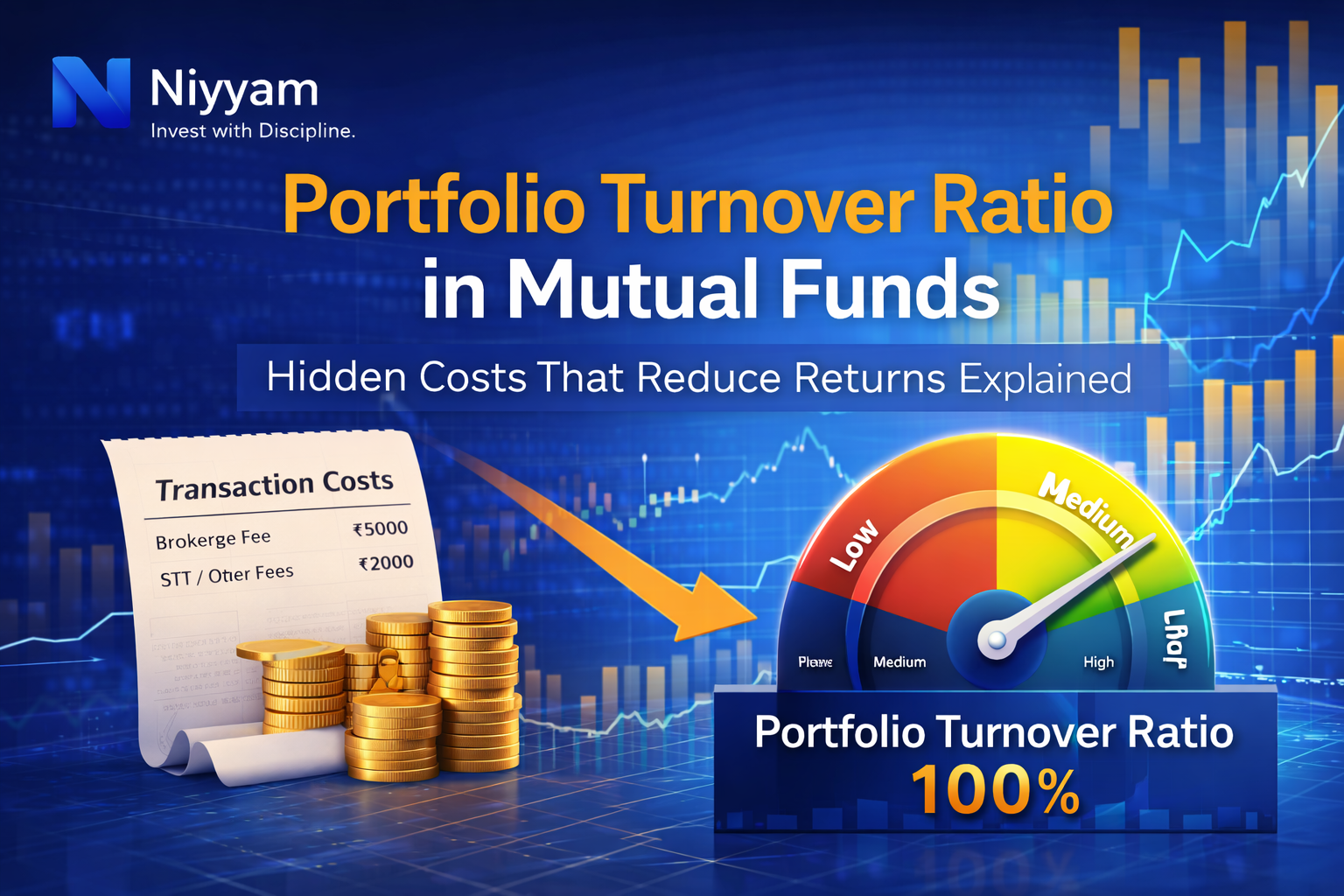
Portfolio turnover ratio in mutual funds measures how frequently securities in a fund are bought and sold within a year. A high turnover ratio indicates frequent trading, which can increase costs and reduce returns, while a low turnover ratio reflects a long-term investment strategy with better consistency.
Why does the portfolio turnover ratio matter?
Portfolio turnover ratio shows how frequently a mutual fund buys and sells stocks. A higher turnover means more trading, higher hidden costs, and potentially lower returns for investors.
What is a Portfolio Turnover Ratio?
Portfolio turnover ratio indicates the percentage of a fund’s holdings that have been replaced over a year.
Simple Interpretation
- 100% turnover = Entire portfolio replaced once
- 50% turnover = Half the portfolio changed
- 20% turnover = Mostly stable portfolio
Example
| Turnover Ratio | Meaning |
|---|---|
| 20% | Long-term investing style |
| 70% | Moderately active |
| 120% | Highly active trading |
Why Portfolio Turnover Ratio Matters
1. Hidden Cost That Reduces Returns
Every buy and sell transaction involves:
- Brokerage charges
- Impact cost
- Other transaction fees
These are not always directly visible but reduce your final returns.
A fund with high turnover:
- Trades frequently
- Incurs more costs
- Delivers lower net returns (in many cases)
2. Impact on Consistency
Funds with high turnover often:
- React to market movements
- Chase short-term opportunities
This leads to inconsistent performance.
To avoid such funds, it is important to understand how to identify consistent mutual funds (not just top performers), because consistency is a key factor in long-term wealth creation.
3. Tax Efficiency
Frequent buying and selling can:
- Trigger short-term capital gains
- Increase tax liability indirectly
This reduces your post-tax returns.
4. Indicates Fund Strategy
Turnover ratio reflects the fund manager’s style.
| Turnover Level | Strategy |
|---|---|
| Low | Buy and hold |
| Medium | Balanced |
| High | Active trading |
High vs Low Turnover – What Should You Prefer?
Comparison Table
| Factor | Low Turnover | High Turnover |
|---|---|---|
| Investment Style | Long-term | Active |
| Cost | Lower | Higher |
| Stability | High | Variable |
| Risk | Moderate | Higher |
When High Turnover is Acceptable
High turnover can work well in:
- Small-cap funds
- Sector funds
- Tactical strategies
However, it must result in better performance.
This is where alpha and beta in mutual funds become important, because high turnover should ideally generate higher alpha without excessive beta.
When High Turnover is a Warning Sign
Be cautious if:
- Turnover is high, but returns are average
- Fund shows inconsistent performance
- Risk is not justified by returns
Real-Life Case Study
Investor A – Ignoring Turnover
Ravi invests in a mid-cap fund because it delivered 25% returns in the last year.
He does not check:
- Turnover ratio
- Risk metrics
The fund has:
- Turnover ratio of 130%
- High volatility
After market correction:
- Fund drops sharply
- Ravi exits in panic
Investor B – Understanding Turnover
Amit evaluates:
- Turnover ratio
- Alpha consistency
- Risk level
He chooses a fund with:
- Turnover ratio of 45%
- Stable long-term performance
Result:
- Less volatility
- Better long-term returns
Portfolio Turnover vs Expense Ratio
Most investors only look at the expense ratio, but turnover adds a hidden cost.
| Metric | Type of Cost |
|---|---|
| Expense Ratio | Fixed |
| Turnover Ratio | Variable |
To understand cost impact better, refer to what is expense ratio in mutual funds and how it affects returns, because both together determine actual cost.
How to Use Portfolio Turnover Ratio (Practical Framework)
Step 1: Understand Fund Category
- Large cap → Lower turnover
- Small cap → Higher turnover
Step 2: Compare Within Category
Do not compare:
- Large cap vs small cap
Always compare similar funds.
Step 3: Check Performance Justification
If turnover is high:
- Is alpha high?
- Is performance consistent?
Step 4: Align With Investment Style
If you are a long-term investor:
- Prefer low to moderate turnover
If you are aggressive:
- Moderate to high turnover may be acceptable
To build a proper strategy, refer to how to choose the right mutual fund in India (beginner’s practical guide).
Advanced Insights
1. Turnover Reflects Conviction
Low turnover:
- High conviction
- Long-term strategy
High turnover:
- Frequent decision-making
- Lower conviction in holdings
2. Impact During Market Cycles
In volatile markets:
- Turnover may increase
But consistently high turnover indicates:
- Overactive management
3. Relationship with Risk
High turnover often correlates with:
- Higher beta
- Higher volatility
To understand risk differences, refer to large cap vs mid cap vs small cap funds: where should you invest.
4. Turnover and Fund Manager Style
Two funds in the same category may behave differently:
- One may hold stocks for years
- Another may frequently trade
Turnover ratio helps you identify this difference.
Who Should Focus on Portfolio Turnover Ratio?
This is an important addition for clarity.
You should focus on the turnover ratio if:
- You are a long-term investor
- You want stable returns
- You want to reduce hidden costs
You may give less importance if:
- You are investing in tactical or sector funds
- You understand high-risk strategies
Common Mistakes Investors Make
- Ignoring turnover ratio completely
- Assuming high turnover = better performance
- Not checking consistency
- Comparing across different categories
- Focusing only on returns
Pro Tips
- Always check turnover before investing
- Combine with alpha and consistency
- Avoid extremely high turnover funds without strong returns
- Review periodically
To strengthen your evaluation, also learn how to track mutual fund performance like a pro.
Conclusion
Portfolio turnover ratio is one of the most overlooked yet powerful indicators in mutual fund investing.
It gives you insight into how a fund is managed, how much cost it incurs, and how consistent its strategy is.
A high turnover ratio is not always bad, but it must be justified by strong and consistent performance. A low turnover ratio reflects discipline but may not always deliver high returns.
The key is to understand the balance and use the turnover ratio along with other metrics like alpha, beta, and expense ratio.
Smart investing is not about chasing returns, but about understanding how those returns are generated.
Frequently Asked Questions (FAQs)
What is a good portfolio turnover ratio?
Lower turnover is generally better for long-term investors.
Does high turnover reduce returns?
Yes, due to higher transaction costs and inefficiencies.
Is turnover important for beginners?
Yes, it helps understand fund management style.
Should I avoid high-turnover funds?
Not always, but ensure performance justifies it.
Where can I find the turnover ratio?
In mutual fund fact sheets.
Disclaimer
This content is for educational purposes only and does not constitute investment advice.
Mutual fund investments are subject to market risks. Investors should read all scheme-related documents carefully before investing and consider their financial goals, risk tolerance, and investment horizon.
Share this guide with your friends, family, and colleagues to help them make better financial decisions.
If this article helped you, share it with at least one person who needs this guidance.
Leave a Reply