
By Ashok Prasad, Founder, Niyyam
Published: April 2026
Introduction
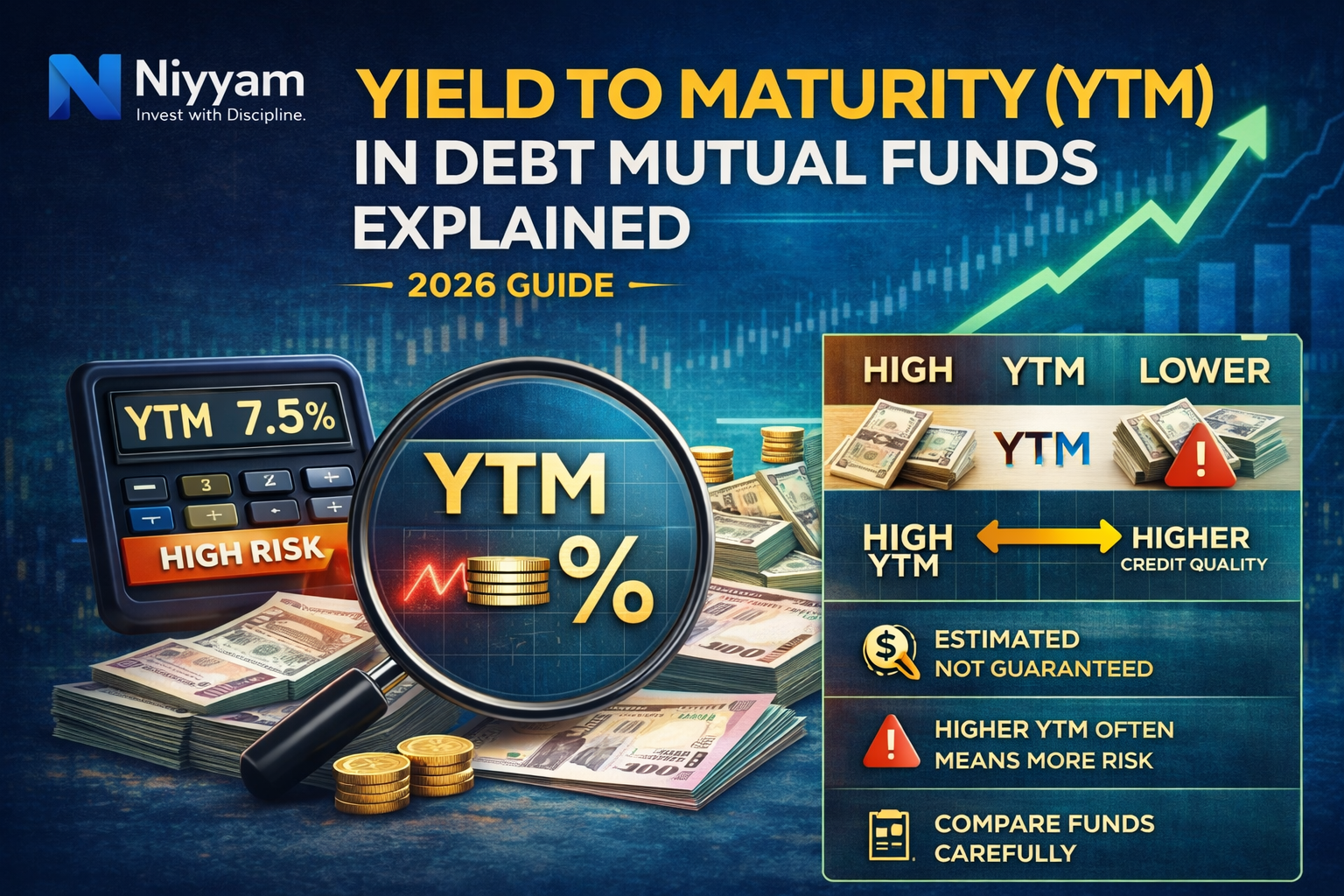
Yield to maturity in debt mutual funds is one of the most important metrics for investors seeking stable and predictable returns, yet it is often misunderstood.
Many investors in India treat debt mutual funds like fixed deposits and assume that the returns are predictable and safe. However, unlike fixed deposits, debt mutual funds do not offer guaranteed returns. Their performance depends on interest rates, credit quality, and bond market dynamics.
YTM helps investors estimate the return potential of a debt fund based on the current portfolio of bonds. But it is only an estimate, not a guarantee.
Understanding YTM becomes even more important when comparing different debt funds and evaluating risk.
To build a strong foundation, you should first understand how mutual funds generate returns for investors, because YTM directly impacts how debt funds deliver returns over time.
💡 Key Takeaways
- YTM represents expected returns from a debt fund
- It is not a guaranteed return
- Higher YTM often indicates higher risk
- Must be evaluated with credit quality
- Interest rate changes impact actual returns
- Helps compare debt mutual funds effectively
Direct Answer
Yield to Maturity (YTM) in debt mutual funds represents the expected annual return if all bonds in the portfolio are held until maturity. It considers interest income, bond prices, and time to maturity, but actual returns may vary depending on interest rate movements, credit risk, and fund management decisions.
What is Yield to Maturity (YTM)?
YTM is the total return expected from a bond if it is held until maturity.
In the context of mutual funds:
- It represents the weighted average yield of all bonds held in the portfolio
Simple Example
| Bond Price | Coupon Rate | YTM |
|---|---|---|
| ₹1,000 | 7% | 7% |
| ₹950 | 7% | ~8% |
| ₹1,050 | 7% | ~6% |
Key Insight
When bond prices fall, YTM increases.
When bond prices rise, YTM decreases.
Why YTM Matters in Debt Mutual Funds
1. Indicator of Expected Returns
YTM gives an estimate of:
- Potential returns
- Income generation
However, it should not be treated as guaranteed.
2. Helps Compare Debt Funds
Investors can compare:
- Funds within the same category
- Risk-return profiles
3. Reflects Underlying Risk
Higher YTM may indicate:
- Lower-rated bonds
- Higher credit risk
YTM vs Actual Returns
This is where most investors make mistakes.
Comparison Table
| Factor | YTM | Actual Returns |
|---|---|---|
| Nature | Estimate | Real |
| Guarantee | No | No |
| Influenced by | Bond yields | Market conditions |
Key Insight
YTM is only an estimate — not a promise.
Factors That Affect YTM
1. Interest Rate Movements
When interest rates:
- Rise → bond prices fall → YTM increases
- Fall → bond prices rise → YTM decreases
2. Credit Quality
Lower-rated bonds:
- Offer higher YTM
- Carry a higher default risk
3. Duration of Bonds
Long-duration bonds:
- More sensitive to interest rate changes
- More volatile
High YTM vs Low YTM – What Should You Choose?
Comparison Table
| Feature | High YTM | Low YTM |
|---|---|---|
| Return Potential | Higher | Lower |
| Risk | Higher | Lower |
| Stability | Lower | Higher |
Key Insight
Higher YTM often comes with higher risk. It is not always better.
YTM and Credit Quality (Critical Understanding)
YTM should always be evaluated along with credit quality.
Example
| Fund | YTM | Credit Quality |
|---|---|---|
| Fund A | 9% | Low |
| Fund B | 7% | High |
Key Insight
A lower YTM fund with high-quality bonds can be safer and more consistent.
YTM and Interest Rate Cycles
Debt fund performance depends heavily on interest rate movements.
Rising Interest Rate Scenario
- Bond prices fall
- YTM increases
Falling Interest Rate Scenario
- Bond prices rise
- YTM decreases
YTM vs Fixed Deposit (FD)
Comparison Table
| Feature | Debt Funds | Fixed Deposits |
|---|---|---|
| Returns | Market-linked | Fixed |
| Risk | Moderate | Low |
| YTM | Estimate | Not applicable |
Key Insight
YTM should not be compared directly with FD interest rates.
YTM vs Expense Ratio
Expense ratio reduces returns.
To understand its impact, refer to what is expense ratio in mutual funds and how it affects returns.
YTM vs AUM
Fund size can affect liquidity and execution.
Refer to how AUM affects mutual fund performance.
YTM and Portfolio Turnover
Frequent trading:
- Impacts actual return realization
Refer to what is portfolio turnover ratio in mutual funds.
Real-Life Case Study
Investor A – Chasing High YTM
Rahul invests in a fund with:
- YTM of 9.5%
He ignores:
- Credit quality
Result:
- Fund faces credit downgrade
- Returns decline sharply
Investor B – Balanced Approach
Suresh selects:
- Moderate YTM fund
- Strong credit quality
Result:
- Stable and predictable returns
When YTM Can Be Misleading
1. Credit Risk Trap
Higher YTM often comes from:
- Lower-rated bonds
- Riskier issuers
2. Interest Rate Changes
YTM assumes:
- Bonds held till maturity
But:
- Market conditions change
3. Active Fund Management
Fund managers:
- Buy and sell bonds
So YTM may not fully materialize.
4. Duration Risk
Long-duration funds:
- Highly sensitive
- Volatile
YTM vs Duration vs Credit Risk
| Factor | YTM | Duration | Credit Risk |
|---|---|---|---|
| Meaning | Expected return | Interest sensitivity | Default risk |
| Risk Level | Moderate | High | High |
Decision Framework
Step 1: Check YTM
Understand expected returns
Step 2: Check Credit Quality
Avoid low-quality bonds
Step 3: Check Duration
Align with time horizon
Step 4: Compare Similar Funds
Step 5: Evaluate Consistency
Refer to how to identify consistent mutual funds.
Advanced Insights
1. YTM Reflects Market Conditions
It changes with:
- Interest rates
- Market sentiment
2. Higher YTM is Not Always Better
Often indicates:
- Higher risk
- Lower stability
3. Role of Fund Manager
Execution matters:
- Determines actual returns
4. Long-Term Stability Matters
Consistency is more important than high yield.
Common Mistakes Investors Make
- Chasing high YTM blindly
- Ignoring credit quality
- Comparing across categories
- Assuming YTM is guaranteed
Pro Tips
- Combine YTM with credit quality
- Avoid very high YTM funds
- Match duration with goals
- Focus on stability
To build a better strategy, refer to how to choose the right mutual fund in India (beginner’s practical guide).
Conclusion
Yield to Maturity (YTM) is a powerful metric that helps investors estimate returns in debt mutual funds, but it must be used carefully.
It is not a guaranteed return and should always be evaluated along with credit quality, duration, and fund strategy.
Smart investors do not chase high yields blindly. Instead, they focus on balanced, risk-adjusted returns that provide stability and long-term growth.
Frequently Asked Questions (FAQs)
What is YTM in debt mutual funds?
It is the expected return if bonds are held till maturity.
Is YTM guaranteed?
No, it is only an estimate.
Is a higher YTM better?
Not always, as it may indicate a higher risk.
How to use YTM?
Combine it with credit quality and duration.
Where can I check YTM?
In mutual fund fact sheets.
Disclaimer
This content is for educational purposes only and does not constitute investment advice.
Mutual fund investments are subject to market risks. Investors should read all scheme-related documents carefully before investing and consider their financial goals, risk tolerance, and investment horizon.
Share this guide with your friends, family, and colleagues to help them make better financial decisions.
If this article helped you, share it with at least one person who needs this guidance.
Leave a Reply