
By Ashok Prasad, Founder, Niyyam
Published: April 2026
Introduction
Interest rates impact on debt mutual funds is one of the most critical concepts every investor must understand before investing in fixed-income instruments.
Many investors in India assume that debt mutual funds behave like fixed deposits and provide stable, predictable returns. However, debt mutual funds are directly affected by interest rate movements, which influence bond prices and ultimately impact fund returns.
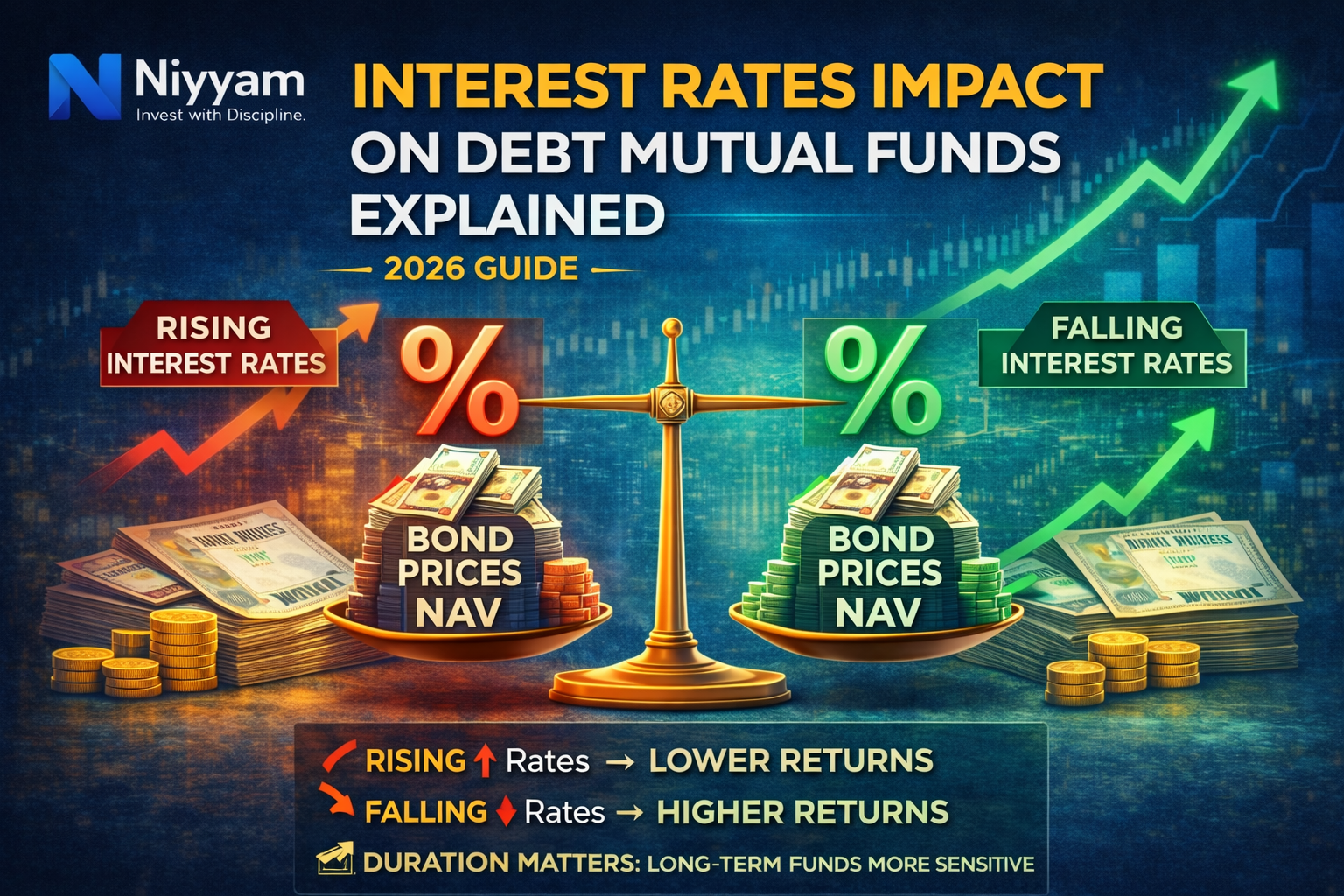
When interest rates change, bond prices move in the opposite direction. Since debt mutual funds invest in bonds, their Net Asset Value (NAV) fluctuates accordingly.
Understanding this relationship helps investors avoid panic, make informed decisions, and align investments with market cycles.
To build a strong foundation, you should first understand yield to maturity in debt mutual funds, because interest rate changes directly influence YTM and expected returns.
💡 Key Takeaways
- Interest rates and bond prices have an inverse relationship
- Rising interest rates reduce NAV in the short term
- Falling interest rates increase debt fund returns
- Long-duration funds are highly sensitive to interest rate changes
- Short-duration funds offer better stability during rate hikes
- Understanding interest rate cycles improves investment decisions
Direct Answer
Interest rates impact on debt mutual funds is significant because bond prices move inversely to interest rates. When interest rates rise, bond prices fall, causing a decline in fund NAV. When interest rates fall, bond prices rise, leading to higher returns. The impact varies based on fund duration and type.
Understanding the Relationship Between Interest Rates and Bonds
Inverse Relationship Explained
Interest rates and bond prices move in opposite directions:
- Interest rates increase → Bond prices fall
- Interest rates decrease → Bond prices rise
Why This Happens
When new bonds are issued at higher interest rates:
- Existing bonds with lower rates become less attractive
- Their prices decline
Similarly:
- When interest rates fall, older bonds offering higher rates become more valuable
- Their prices increase
How Debt Mutual Funds Are Affected
Debt mutual funds invest in:
- Government securities
- Corporate bonds
- Money market instruments
When bond prices change:
- The fund’s NAV changes
Impact of Rising Interest Rates
1. Short-Term NAV Decline
When interest rates rise:
- Existing bonds lose value
- Debt fund NAV falls
2. Better Future Returns
New investments are made at:
- Higher yields
- Improved return potential
3. Higher Impact on Long-Duration Funds
Funds with longer maturity:
- Are more sensitive
- Experience higher volatility
Impact of Falling Interest Rates
1. NAV Increases
When interest rates fall:
- Bond prices rise
- Fund NAV increases
2. Capital Appreciation
Investors benefit from:
- Price gains
- Higher short-term returns
3. Lower Future Yields
New bonds:
- Offer lower interest rates
- Reduce future income potential
Comparison Table – Rising vs Falling Interest Rates
| Factor | Rising Rates | Falling Rates |
|---|---|---|
| Bond Prices | Fall | Rise |
| NAV | Decreases | Increases |
| Short-Term Returns | Lower | Higher |
| Long-Term Returns | Improve | Reduce |
Role of Duration in Interest Rate Impact
What is Duration
Duration measures:
- Sensitivity of a bond to interest rate changes
Impact Based on Duration
| Duration Type | Impact |
|---|---|
| Short Duration | Low sensitivity |
| Medium Duration | Moderate impact |
| Long Duration | High sensitivity |
Key Insight
Longer duration = higher volatility
Shorter duration = more stability
Impact on Different Types of Debt Funds
1. Liquid Funds
- Minimal impact
- Highly stable
2. Short Duration Funds
- Moderate impact
- Suitable for conservative investors
3. Long Duration Funds
- High impact
- Suitable for experienced investors
4. Gilt Funds
- Highly sensitive to interest rates
- No credit risk but high volatility
Real-Life Scenario
Investor A – Lack of Understanding
Rohit invests in a long-duration fund.
Interest rates rise.
- NAV falls
- He exits due to panic
Result:
- Books losses
Investor B – Informed Decision
Suresh understands:
- Interest rate cycles
He stays invested.
Result:
- Recovers losses
- Benefits from higher yields
How YTM Changes with Interest Rates
Interest rate movements directly affect YTM:
- Rising rates → YTM increases
- Falling rates → YTM decreases
To understand this clearly, refer to yield to maturity in debt mutual funds.
How to Invest Based on Interest Rate Scenarios
1. Strategy During Rising Interest Rates
When interest rates are increasing:
- Prefer short-duration funds
- Avoid long-duration exposure
- Invest gradually
Why This Works
Short-duration funds:
- Are less sensitive
- Provide stability
2. Strategy During Falling Interest Rates
When interest rates are declining:
- Invest in long-duration funds
- Capture capital gains
- Lock in higher yields
Why This Works
Bond prices rise:
- Leading to higher returns
3. Strategy During Uncertain Interest Rate Environment
When direction is unclear:
- Use dynamic bond funds
- Maintain balanced allocation
- Avoid aggressive positioning
4. SIP Strategy in Debt Funds
SIP helps:
- Average interest rate cycles
- Reduce timing risk
5. Long-Term Investor Approach
Long-term investors should:
- Ignore short-term fluctuations
- Focus on stability
- Stay invested
To build consistency, refer to how to identify consistent mutual funds.
Advanced Insights
1. Interest Rate Risk is Unavoidable
All debt funds:
- Carry interest rate risk
- Even low-risk funds
2. Market Timing is Difficult
Predicting interest rate movements:
- Is complex
- Requires macro understanding
3. Fund Manager Role
Fund managers:
- Adjust duration
- Manage portfolio actively
4. Behavior Matters More Than Timing
Investor discipline:
- Has a bigger impact than timing
Common Mistakes Investors Make
- Treating debt funds like fixed deposits
- Panicking during the NAV decline
- Ignoring duration
- Chasing short-term returns
- Not understanding interest cycles
Pro Tips
- Match duration with investment horizon
- Avoid panic during rate hikes
- Use SIP for stability
- Focus on long-term strategy
To improve fund selection, refer to how to choose the right mutual fund in India (beginner’s practical guide).
Decision Framework
Step 1: Identify Interest Rate Trend
Rising or falling
Step 2: Choose Fund Type
Short vs long duration
Step 3: Evaluate YTM
Step 4: Assess Risk
Step 5: Stay Disciplined
Conclusion
Interest rates play a crucial role in determining the performance of debt mutual funds. Understanding how rising and falling interest rates impact bond prices and fund NAV helps investors make informed decisions.
Instead of reacting emotionally to short-term fluctuations, investors should align their strategy with interest rate cycles and focus on long-term stability.
Smart investors use interest rate movements as an opportunity rather than a risk.
Frequently Asked Questions (FAQs)
What happens when interest rates rise?
Bond prices fall, reducing NAV in the short term.
What happens when interest rates fall?
Bond prices rise, increasing returns.
Which funds are most affected?
Long-duration and gilt funds.
Are debt funds safe during rate hikes?
They may see short-term volatility but stabilize over time.
Should I stop investing during rising rates?
No, long-term investors should continue investing.
Disclaimer
This content is for educational purposes only and does not constitute investment advice. Mutual fund investments are subject to market risks. Investors should read all scheme-related documents carefully before investing and consider their financial goals, risk tolerance, and investment horizon.
Share this guide with your friends, family, and colleagues to help them make better financial decisions.
If this article helped you, share it with at least one person who needs this guidance.
Leave a Reply