
By Ashok Prasad, Founder, Niyyam
Published: April 2026
Introduction
Mutual fund ratings India are one of the most commonly used tools by investors to select funds, especially beginners who rely heavily on star ratings and rankings.
Many investors assume that a 5-star-rated mutual fund is always the best investment option. However, this assumption can be misleading because mutual fund ratings are based on past performance, not future potential.
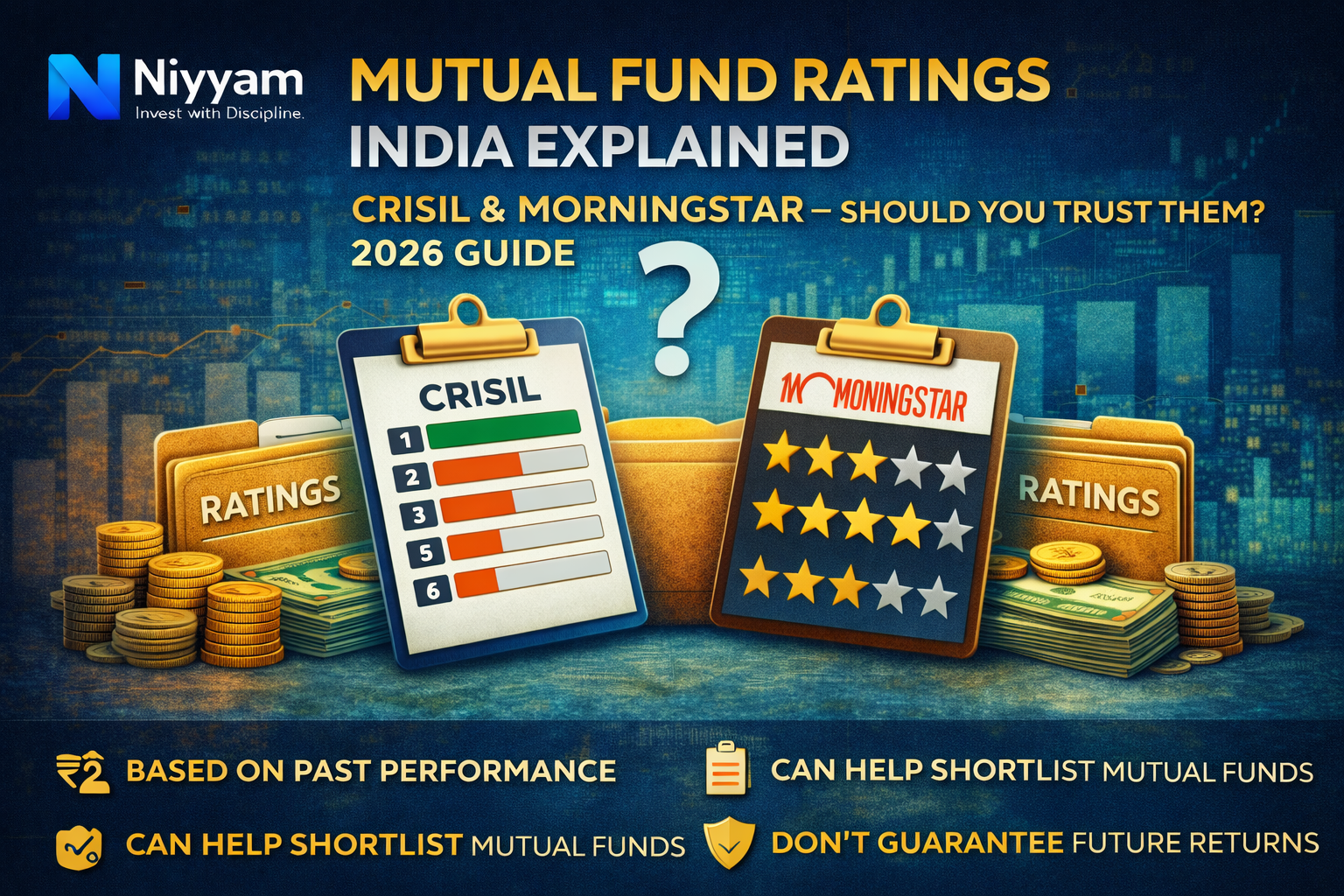
In India, agencies like CRISIL and Morningstar evaluate mutual funds based on risk-adjusted returns, consistency, and peer comparison. While these ratings simplify decision-making, blindly trusting them can lead to poor investment choices.
Understanding how mutual fund ratings in India actually work is essential if you want to make smarter, more informed investment decisions.
To build a strong foundation, you should first understand how to choose the right mutual fund in India (beginner’s practical guide), because ratings are only one part of the decision-making process.
💡 Key Takeaways
- Mutual fund ratings in India are based on past performance, not future returns
- CRISIL and Morningstar use risk-adjusted metrics to rank funds
- Ratings compare funds within the same category only
- A 5-star rating does not guarantee future performance
- Ratings should be used only for shortlisting, not final decisions
- Combining ratings with deeper analysis improves outcomes
Direct Answer
Mutual fund ratings in India are assigned by agencies like CRISIL and Morningstar based on past performance, risk-adjusted returns, and peer comparison. While they help investors shortlist funds, they should not be relied upon entirely, as they do not guarantee future performance.
What Are Mutual Fund Ratings
Mutual fund ratings are evaluation scores given to funds based on:
- Historical performance
- Risk-adjusted returns
- Consistency over time
Purpose of Ratings
Ratings help investors:
- Compare similar funds
- Identify strong performers
- Simplify decision-making
How Mutual Fund Ratings Work in India
1. Category-Based Comparison
Funds are compared within the same category:
- Large-cap vs large-cap
- Debt vs debt
2. Risk-Adjusted Returns
Ratings consider:
- Returns generated
- Volatility
- Downside risk
3. Time Period Analysis
Performance is evaluated over:
- 3-year
- 5-year
- Long-term consistency
CRISIL Mutual Fund Ratings
Overview
CRISIL is a leading Indian rating agency that evaluates mutual funds based on performance and risk.
Ranking System
CRISIL ranks funds from:
- Rank 1 (best)
- Rank 5 (lowest)
Key Features
- Focus on consistency
- Risk-adjusted returns
- Category-based ranking
Morningstar Mutual Fund Ratings
Overview
Morningstar is a global investment research firm known for its star rating system.
Star Rating System
| Rating | Meaning |
|---|---|
| 5 Star | Top performers |
| 4 Star | Above average |
| 3 Star | Average |
| 2 Star | Below average |
| 1 Star | Poor |
Key Features
- Based on risk-adjusted returns
- Easy to understand
- Widely used globally
CRISIL vs Morningstar – Key Differences
Comparison Table
| Feature | CRISIL | Morningstar |
|---|---|---|
| Rating Format | Rank (1–5) | Star (1–5) |
| Focus | Relative ranking | Risk-adjusted return |
| Usage | India-focused | Global |
How Ratings Are Calculated
Key Factors Considered
- Past returns
- Volatility
- Downside risk
- Consistency
Important Insight
Mutual fund ratings in India are backward-looking.
They reflect:
- Past performance
- Not future returns
Should You Trust Mutual Fund Ratings
Yes, But With Caution
Ratings are useful for:
- Initial screening
- Shortlisting funds
But NOT as a final decision
You should never:
- Invest only based on ratings
Real-Life Example
Investor A – Blind Trust
Rahul invests in a 5-star fund.
- Fund underperforms later
Reason:
- The rating was based on past data
Investor B – Smart Approach
Amit uses ratings only for shortlisting.
Then evaluates:
- Risk
- Strategy
- Consistency
Result:
- Better long-term outcomes
Limitations of Mutual Fund Ratings
1. Based on Past Performance
Ratings do not predict future returns.
2. Frequent Changes
Ratings change as performance changes.
3. Category Dependency
A fund may rank high in a weak category.
4. Ignoring Market Cycles
Ratings do not account for changing market environments.
Ratings vs Other Important Metrics
1. Ratings vs Alpha and Beta
To understand risk-adjusted returns better, refer to what alpha and beta are in mutual funds.
2. Ratings vs Consistency
Consistency matters more than rankings.
Refer to how to identify consistent mutual funds.
3. Ratings vs Expense Ratio
Costs directly impact returns.
Refer to what is expense ratio in mutual funds and how it affects returns.
4. Ratings vs Portfolio Turnover
Frequent portfolio changes affect performance.
Refer to what is portfolio turnover ratio in mutual funds.
How to Use Mutual Fund Ratings Correctly
Step 1: Shortlist Funds
Use ratings to filter top options
Step 2: Check Consistency
Evaluate long-term performance
Step 3: Analyze Risk
Understand volatility
Step 4: Review Costs
Check expense ratio
Step 5: Align with Goals
Match with your financial objectives
When Mutual Fund Ratings Fail Investors (Critical Insight Section)
1. Ratings Are Backward-Looking
They reflect past performance, not future outcomes.
2. Market Cycle Changes
Funds perform differently across market cycles.
3. Style-Based Limitations
Performance depends on market style shifts.
4. Overcrowding Risk
Highly rated funds attract large inflows.
5. Mean Reversion Effect
Top funds often move toward average performance.
Key Insight
Smart investors do not blindly chase ratings. They understand their limitations.
How to Combine Mutual Fund Ratings with Real Analysis (Practical Section)
1. Use Ratings as a Filter
Start with:
- 4-star or 5-star funds
- Top-ranked funds
2. Check Long-Term Consistency
Look beyond current ratings:
- 3-year
- 5-year
- Rolling returns
3. Evaluate Risk Alongside Ratings
Check:
- Volatility
- Sector exposure
4. Understand Fund Strategy
Analyze:
- Portfolio allocation
- Investment style
5. Align With Your Goals
Ensure the fund matches:
- Risk tolerance
- Investment horizon
Key Insight
Mutual fund ratings in India should be used as a starting point, not a final decision tool.
Advanced Insights
1. Ratings Follow Performance
Funds get higher ratings after strong performance.
2. Investor Behavior Risk
Investors chase top-rated funds.
3. Short-Term Bias
Ratings may overemphasize recent performance.
4. Long-Term Consistency Matters More
Consistency is more important than ratings.
Common Mistakes Investors Make
- Investing only based on ratings
- Ignoring risk factors
- Chasing recently upgraded funds
- Not reviewing performance regularly
Pro Tips
- Use ratings only for shortlisting
- Combine with deeper analysis
- Focus on long-term consistency
- Avoid herd mentality
To build a strong portfolio, refer to how to build a mutual fund portfolio for long-term wealth creation.
Decision Framework
Step 1: Check Rating
Step 2: Evaluate Performance
Step 3: Analyze Risk
Step 4: Check Costs
Step 5: Align With Goals
Conclusion
Mutual fund ratings in India provide a useful starting point for investors, but they should not be the sole basis for investment decisions.
While CRISIL and Morningstar ratings help compare funds, they are based on past performance and do not guarantee future results.
Smart investors use ratings as a filter and combine them with deeper analysis to make better investment decisions.
Frequently Asked Questions (FAQs)
What are mutual fund ratings?
Ratings based on past performance and risk.
Are ratings reliable?
They are useful but not sufficient alone.
Do 5-star funds always perform well?
No, future performance is not guaranteed.
Which is better: CRISIL or Morningstar?
Both are useful.
How should ratings be used?
As a starting point, not a final decision.
Disclaimer
This content is for educational purposes only and does not constitute investment advice. Mutual fund investments are subject to market risks. Investors should read all scheme-related documents carefully before investing and consider their financial goals, risk tolerance, and investment horizon.
Share this guide with your friends, family, and colleagues to help them make better financial decisions.
If this article helped you, share it with at least one person who needs this guidance.
Leave a Reply