
By Ashok Prasad, Founder, Niyyam
Published: March 2026
Introduction
Large cap vs mid cap vs small cap funds is one of the most common questions investors face when starting their mutual fund journey.
If you’ve started exploring mutual funds, you’ve likely come across terms like large cap, mid cap, and small cap
And the obvious question is:
“Where should I invest?”
Most beginners face this confusion:
- Some get attracted to high returns in small-cap funds
- Some prefer the safety of large-cap funds
- Many don’t understand the role of mid-cap funds
The reality is simple:
These categories are not competitors — they are complementary
Choosing the right combination matters more than choosing just one.
In this guide, you’ll learn a clear, practical framework to decide where to invest based on your goals, risk tolerance, and time horizon.
Direct Answer
For most investors:
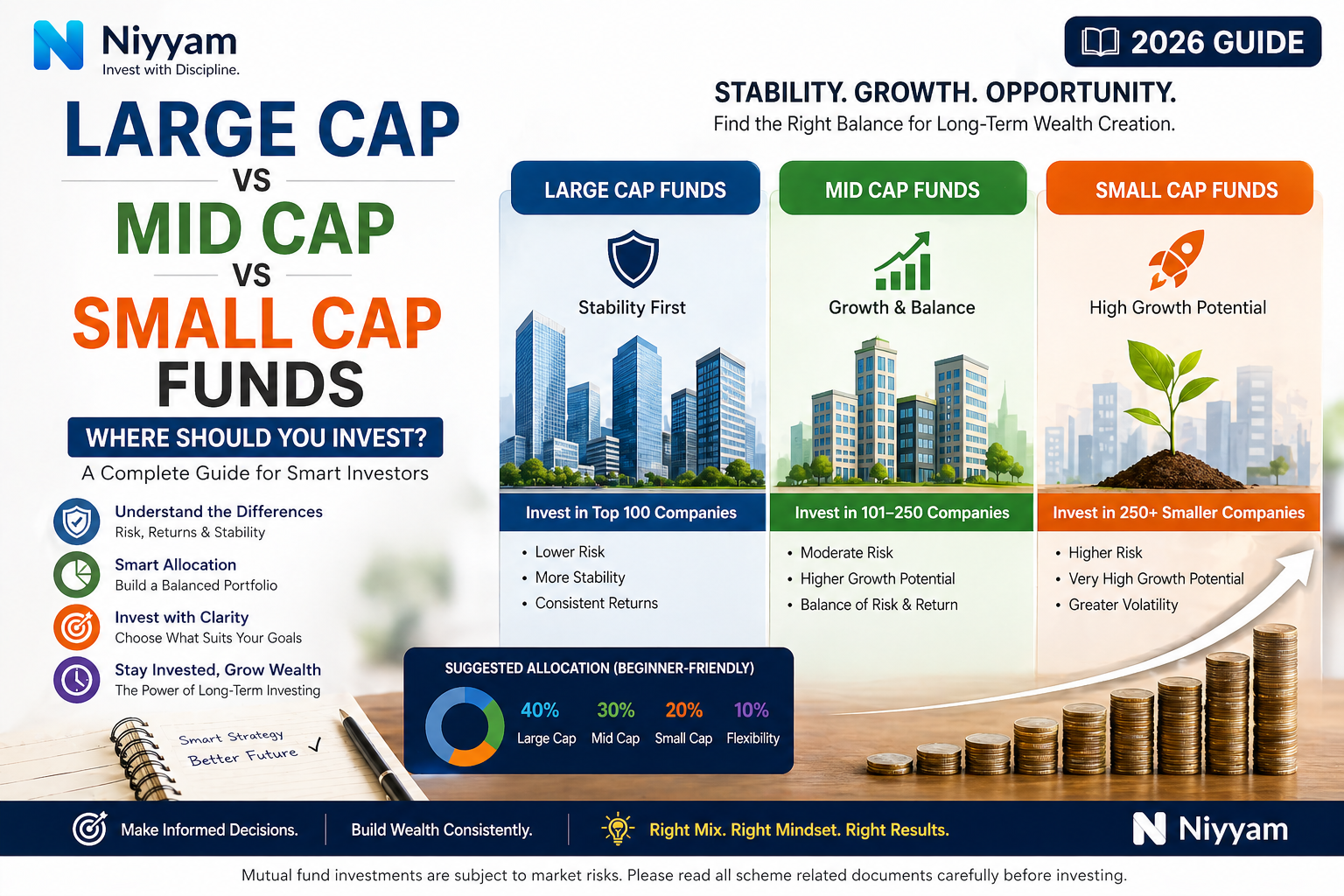
- Large Cap Funds → Stability and consistency
- Mid Cap Funds → Growth with moderate risk
- Small Cap Funds → High growth with high volatility
A balanced allocation like 40% large cap, 30% mid cap, 20% small cap is ideal for long-term wealth creation.
What Are Large Cap, Mid Cap, and Small Cap Funds?
Mutual funds are categorized based on the size of companies they invest in.
Large Cap Funds
These invest in the top 100 companies in India.
Examples include companies like:
- Reliance Industries
- TCS
- HDFC Bank
Characteristics
- Strong and established businesses
- Lower volatility
- Stable returns
Mid Cap Funds
These invest in companies ranked 101–250.
Characteristics
- Growing businesses
- Higher return potential
- Moderate volatility
Small Cap Funds
These invest in companies ranked beyond 250.
Characteristics
- Emerging businesses
- Very high growth potential
- High volatility
Key Difference (Simple Comparison)
| Category | Risk Level | Return Potential | Stability |
|---|---|---|---|
| Large Cap | Low | Moderate | High |
| Mid Cap | Medium | High | Moderate |
| Small Cap | High | Very High | Low |
Simple Way to Remember
- Large Cap = Stability
- Mid Cap = Growth
- Small Cap = Aggressive Growth
Large Cap Funds: Stability First
Large-cap funds focus on well-established companies.
Why Investors Choose Large Cap
- Lower volatility
- Consistent returns
- Strong business fundamentals
Example Scenario
During a market crash:
- Large-cap funds fall less
- Recover faster
Best For
- Beginners
- Conservative investors
- Long-term stable growth
Key Insight
Large-cap funds form the foundation of a strong portfolio.
Mid Cap Funds: Balance of Growth and Risk
Mid-cap funds invest in companies that are expanding rapidly.
Why Investors Choose Mid Cap
- Higher return potential than large caps
- Opportunity to capture growth early
Example
A mid-cap company today can become a large-cap leader tomorrow.
Best For
- 5–10 year investment horizon
- Moderate risk tolerance
Key Insight
Mid caps offer the best balance between growth and risk.
Small Cap Funds: High Risk, High Reward
Small-cap funds invest in emerging businesses.
Why Investors Choose Small Cap
- Very high return potential
- Early-stage growth opportunities
But There’s a Catch
- Highly volatile
- Can fall 30–40% during market downturns
Best For
- Experienced investors
- Long-term horizon (7–10+ years)
Key Insight
Small caps create wealth — but only for patient investors.
Real-Life Scenario (Important)
Let’s compare three investors:
Investor A (Large Cap Only)
- SIP: ₹10,000
- Returns: ~10–12%
- Experience: Stable, low stress
Investor B (Small Cap Only)
- SIP: ₹10,000
- Returns: 12–18% (volatile)
- Experience: High stress
Investor C (Balanced Portfolio)
- Mix of all three
Outcome
- Better stability
- Good growth
- Lower emotional stress
Key Insight
Balance leads to better long-term results.
Where Should YOU Invest?
Instead of choosing one category, build a balanced portfolio.
Suggested Allocation (Beginner-Friendly)
- 40% → Large Cap
- 30% → Mid Cap
- 20% → Small Cap
- 10% → Flexibility
Why This Works
- Stability from large caps
- Growth from mid caps
- Upside from small caps
Key Insight
Allocation matters more than fund selection.
How This Fits Into SIP Investing
When investing via SIP:
- Timing matters less
- Allocation matters more
If you’re exploring SIP strategy:
Best Mutual Funds for SIP in India (2026 Guide for Beginners)
How to Choose the Right Category for You
Ask yourself:
- Can I handle volatility?
- What is my investment horizon?
- Do I want stability or aggressive growth?
If unsure:
How to Choose the Right Mutual Fund in India (A Beginner’s Practical Guide)
How Market Cycles Affect These Funds
During Bull Markets
- Small caps perform best
- Mid caps perform strongly
- Large caps are steady
During Bear Markets
- Large caps fall less
- Mid and small caps fall more
Key Insight
Diversification protects you across cycles.
Practical Strategy (What You Should Do Now)
Step 1: Start Simple
- Large Cap Fund
- Flexi Cap Fund
Step 2: Add Growth
- Add Mid Cap Fund
Step 3: Add Small Cap Carefully
Only if:
- You understand risk
- You have long-term horizon
Step 4: Stay Invested
Minimum: 5 years
Ideal: 10+ years
To understand compounding:
How SIP Builds Wealth Through Compounding (With Simple Examples)
Key Insight
Wealth is created by time, not timing.
Common Mistakes to Avoid
- Investing only in small caps
- Ignoring mid caps
- No diversification
- Panic during crashes
Key Insight
Emotional decisions destroy returns.
Advanced Insight: Rebalancing Strategy
Over time, your allocation changes.
Example
- Small caps grow faster → portfolio becomes risky
What You Should Do
- Rebalance every 1–2 years
- Maintain target allocation
Key Insight
Rebalancing protects your gains.
Psychology of Investors
Beginner Mistake
- Chase returns
- Panic during fall
Smart Investor
- Stays disciplined
- Follows allocation
Truth
Behavior matters more than category selection.
Frequently Asked Questions (FAQs)
1. Which is better: large cap, mid cap, or small cap?
All three are important. A balanced allocation works best.
2. Can I invest only in small-cap funds?
Not recommended. Risk is too high.
3. Is large cap safe?
Relatively safer, but still market-linked.
4. How much should I allocate to small caps?
Typically 10–20% depending on risk tolerance.
5. Should beginners invest in mid caps?
Yes, but in a limited proportion.
Final Thoughts
Large cap, mid cap, and small cap funds are not competitors.
They each play a specific role:
- Large Cap → Stability
- Mid Cap → Growth
- Small Cap → High return potential
Final Insight
Wealth is created by balance, discipline, and long-term investing.
Soft CTA
If you want to invest with clarity and build a balanced mutual fund portfolio, structure matters.
Niyyam helps you simplify investing and stay consistent with your financial goals.
Start your investment journey with confidence.
Disclaimer
This content is for educational purposes only and does not constitute investment advice.
Mutual fund investments are subject to market risks. Investors should read all scheme-related documents carefully before investing and consider their financial goals, risk tolerance, and investment horizon.
Share this guide with your friends, family, and colleagues to help them make better financial decisions.
If this article helped you, share it with at least one person who needs this guidance.
Leave a Reply