
By Ashok Prasad, Founder, Niyyam
Published: March 2026
Introduction
One of the most misunderstood concepts in mutual fund investing is NAV (Net Asset Value).
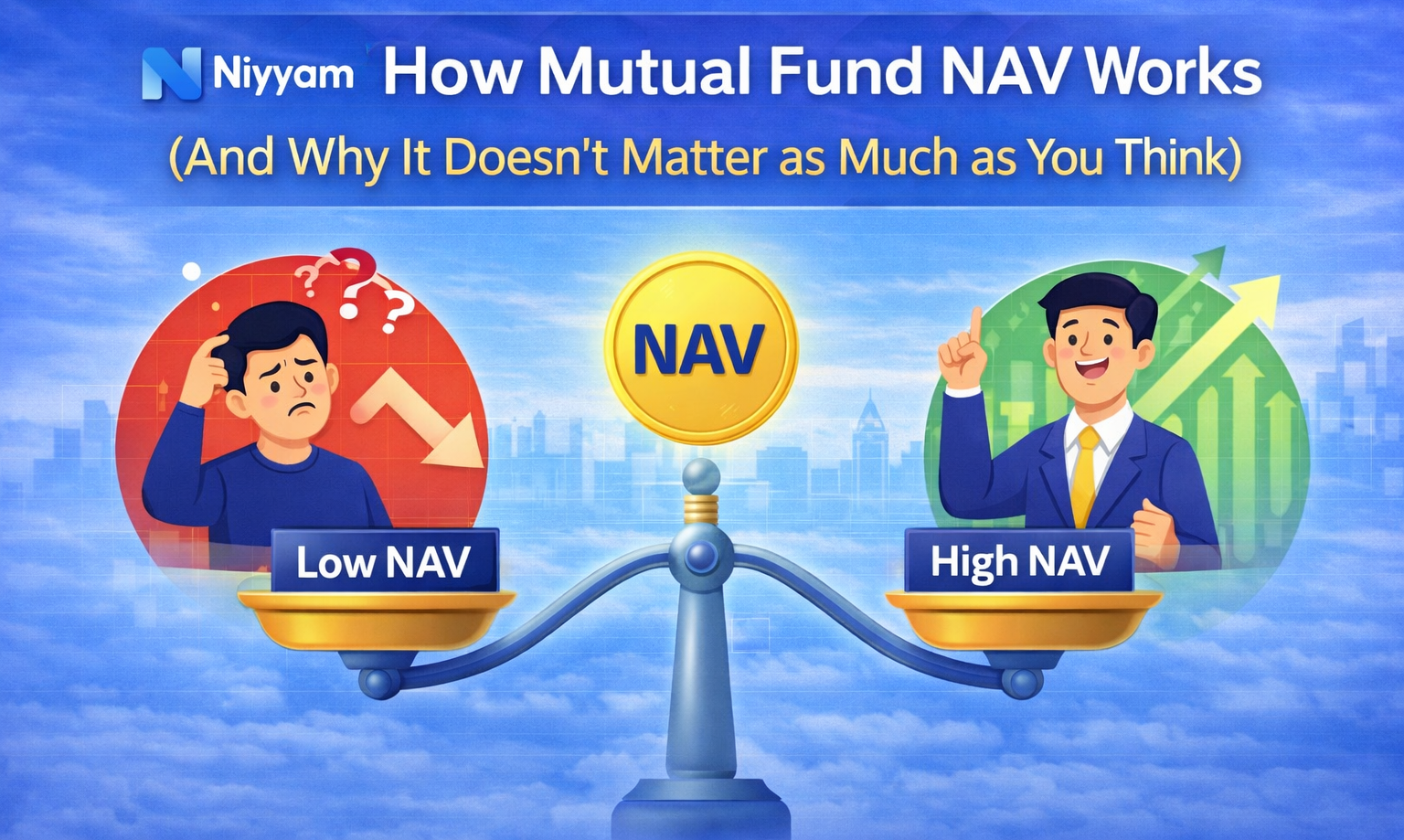
Many investors believe that a fund with a lower NAV is cheaper and therefore a better investment. Others assume that a high NAV means the fund is already “expensive” and may not grow much further.
Both assumptions are incorrect.
In reality, NAV has very little impact on your long-term returns, yet it continues to influence investor decisions in a major way.
Understanding how NAV works — and more importantly, what actually matters instead — can significantly improve the quality of your investment decisions.
If you are serious about building long-term wealth through mutual funds, this is one concept you must understand clearly.
💡 Key Takeaways
- NAV is simply the price per unit of a mutual fund
- It does not determine returns
- Lower NAV does not mean cheaper or better
- Higher NAV does not limit growth potential
- Focus should always be on performance, consistency, and cost
Direct Answer
NAV (Net Asset Value) in mutual funds is the per-unit price of a fund, calculated as total assets minus liabilities divided by total units. It does not indicate whether a fund is good or bad and does not affect long-term returns.
What is NAV in Mutual Funds?
NAV stands for Net Asset Value.
It represents the per-unit price of a mutual fund.
Whenever you invest in a mutual fund, you are buying units, and NAV is the price at which those units are bought or sold.
If a fund has an NAV of ₹50, it simply means one unit costs ₹50.
At a basic level, NAV helps you understand how many units you will receive when you invest a certain amount.
How is NAV Calculated?
NAV is calculated using the formula:
NAV = (Total Value of Assets – Liabilities) ÷ Total Number of Units
Breakdown:
- Assets include stocks, bonds, and other securities held by the fund
- Liabilities include management fees, expenses, and other obligations
- Units represent total investor holdings
NAV is updated at the end of every trading day based on the current market value of the fund’s portfolio.
This means the NAV keeps changing daily depending on market movements.
Quick Reality Check About NAV
Before going deeper, it is important to understand a few key truths:
- NAV is just a price, not a measure of performance
- A lower NAV does not mean a fund is better
- A higher NAV does not mean limited growth
- Returns depend on percentage growth, not NAV level
If you understand this clearly, you avoid one of the most common beginner mistakes in mutual fund investing.
The Biggest Myth: “Lower NAV Means Better Investment”
This is where most investors go wrong.
They compare:
- Fund A → NAV ₹20
- Fund B → NAV ₹200
And assume Fund A has more growth potential.
This assumption comes from stock market thinking, where price sometimes reflects valuation.
But mutual funds work differently.
To understand how returns are actually generated, you should read
How Mutual Funds Generate Returns for Investors (With Simple Examples)
Why NAV is Not Like Share Price
In stock investing:
- A lower price may indicate undervaluation
- Higher price may indicate overvaluation
But in mutual funds:
- NAV reflects the value of underlying assets
- It does not indicate whether the fund is cheap or expensive
For example:
- ₹20 becomes ₹22 (10% return)
- ₹200 becomes ₹220 (10% return)
In both cases, returns are identical.
This is why comparing NAV across funds is meaningless.
Simple Example to Understand NAV Clearly
Let’s compare two investors:
Investor A
Invests ₹10,000 in a fund with NAV ₹10
Units received = 1,000 units
Investor B
Invests ₹10,000 in a fund with NAV ₹100
Units received = 100 units
Now assume both funds grow by 20%.
- Investor A → ₹12,000
- Investor B → ₹12,000
Despite different NAVs, both investors earn the same return.
This clearly shows that NAV has no impact on wealth creation.
What Actually Determines Your Returns
Instead of NAV, your returns depend on:
- Performance of underlying assets
- Fund manager’s decisions
- Market conditions
- Expense ratio and costs
Many investors ignore the impact of costs, but even small differences can significantly affect long-term returns.
To understand this in detail, read
What is Expense Ratio in Mutual Funds? How It Affects Your Returns (2026 Guide)
Understanding NAV in SIP Investing
NAV becomes even less relevant when you invest through SIP (Systematic Investment Plan).
This is because SIP works on rupee cost averaging.
- When NAV is low → you buy more units
- When NAV is high → you buy fewer units
Over time, this averages out your cost.
This reduces the importance of entry price and helps manage market volatility.
To understand this better, refer to
How SIP Builds Wealth Through Compounding (With Simple Examples)
NAV vs Fund Quality
A common misconception is linking NAV with fund quality.
Let’s compare:
- Fund A → NAV ₹150, consistent performance
- Fund B → NAV ₹12, inconsistent performance
Clearly, Fund A is the better choice.
This proves that NAV does not reflect the quality of a mutual fund.
Instead, consistency and portfolio strength matter more.
Why High NAV Funds Are Not “Expensive”
Many investors avoid high NAV funds thinking that they have already grown too much.
This is incorrect.
Future growth depends on:
- Market opportunities
- Portfolio composition
- Fund manager strategy
Not on the current NAV.
Avoiding high NAV funds can lead to missed opportunities in well-performing funds.
Why New Funds (Low NAV) Can Be Risky
New funds usually start with an NAV of ₹10.
This creates a psychological illusion that they are cheap.
However:
- They have no performance history
- Strategy is untested
- Risk is higher
Instead of focusing on NAV, investors should understand different fund categories and their suitability.
Types of Mutual Funds in India
Where NAV Actually Matters
NAV does have some limited importance:
- It determines your buying and selling price
- It helps track your investment value
- It reflects daily portfolio movement
Beyond this, NAV should not influence your investment decisions.
Common Mistakes Investors Make with NAV
Investors often:
- Choose funds based on the lowest NAV
- Avoid funds with high NAV
- Compare NAV across different categories
- Assume NAV indicates growth potential
These mistakes can reduce long-term returns and lead to poor investment choices.
A Better Way to Evaluate Mutual Funds
Instead of focusing on NAV, ask:
- Is the fund consistent over time?
- Does it align with my financial goals?
- Is the risk level appropriate?
- Are costs reasonable?
This approach helps you make smarter investment decisions.
Advanced Insight: The Psychology Behind NAV Bias
Many investors are influenced by something called unit bias.
They feel that getting more units means getting a better deal.
For example:
- 1,000 units feels better than 100 units
But in reality:
- Units do not matter
- Total investment value matters
This psychological bias leads investors to choose low NAV funds, even when they are not suitable.
Understanding this behavior is important for long-term success.
Quick Decision Rule for Investors
Whenever you see NAV, remember:
- NAV tells you the price, not the value
- Returns depend on percentage growth
- Focus on quality, not cost per unit
Real-World Insight
Consider two investors:
- Investor A chooses funds based on low NAV
- Investor B chooses funds based on performance and consistency
Over time:
- Investor A struggles with inconsistent returns
- Investor B builds stable and meaningful wealth
The difference lies in understanding what truly matters.
Conclusion
NAV is one of the most misunderstood concepts in mutual fund investing.
It is simply a pricing mechanism and does not determine returns.
Focusing on NAV can distract you from the factors that truly matter — performance, consistency, and cost.
Final Thought
The moment you stop chasing low NAV and start focusing on quality, your investment journey becomes clearer, more disciplined, and more effective.
Frequently Asked Questions (FAQs)
1. Is a low NAV better for investment?
No. NAV does not indicate whether a fund is good or bad.
2. Should I avoid high NAV funds?
No. High NAV funds can still deliver strong returns.
3. Does NAV affect SIP returns?
No. SIP works on cost averaging, making NAV less relevant.
4. What should I check instead of NAV?
Focus on performance, consistency, expense ratio, and risk profile.
Disclaimer
This content is for educational purposes only and does not constitute investment advice.
Mutual fund investments are subject to market risks. Investors should read all scheme-related documents carefully before investing and consider their financial goals, risk tolerance, and investment horizon.
Share this guide with your friends, family, and colleagues to help them make better financial decisions.
If this article helped you, share it with at least one person who needs this guidance.
Leave a Reply