
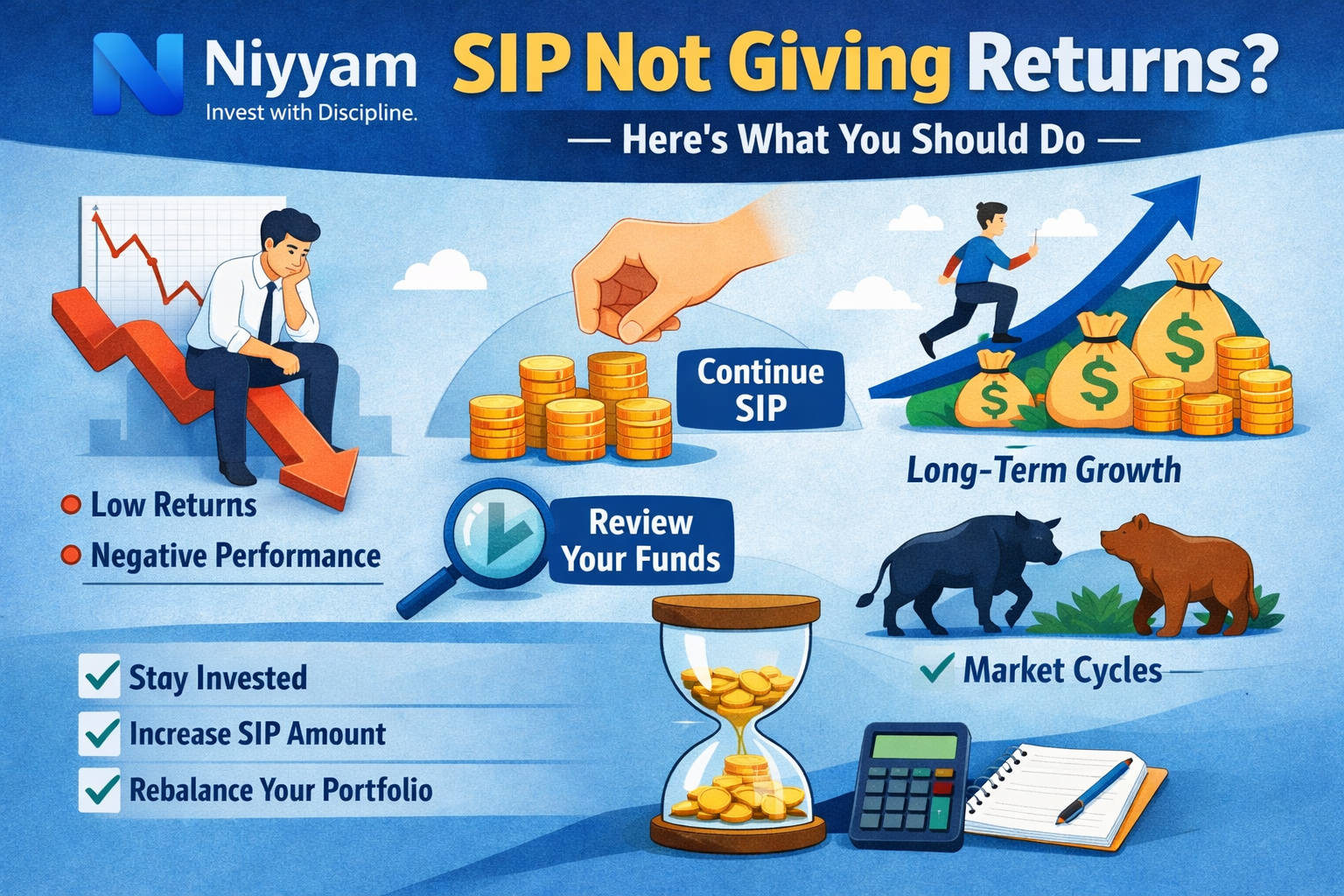
By Ashok Prasad, Founder, Niyyam
Published: March 2026
Introduction
One of the most common concerns among investors is:
“My SIP is not giving returns. What should I do?”
You start a SIP expecting steady growth. But after months—or sometimes even a few years—you check your portfolio and see:
- Low returns
- Flat performance
- Or even negative returns
This creates confusion and frustration.
Many investors then:
- Stop their SIP
- Withdraw their investments
- Shift to low-risk options prematurely
But here’s the reality:
In most cases, the problem is not your SIP—it is your expectations, time horizon, or strategy.
💡 Key Takeaways
- SIP returns depend on time, market cycles, and fund quality
- Short-term underperformance is normal in equity investing
- Stopping SIP during low-return phases is often a mistake
- Market corrections benefit long-term SIP investors
- Reviewing strategy is better than reacting emotionally
- Consistency is the most important factor in SIP success
Before taking any action, it is important to understand:
- Why SIP returns appear low
- What is actually happening in your portfolio
- What you should do next
If you are new to mutual funds, it may help to first understand what is a mutual fund and how it works, as this builds the foundation for everything else.
Why Your SIP May Not Be Giving Returns
Investment Duration Is Too Short
SIPs need time to show results.
- 0–3 years: highly volatile
- 3–5 years: stabilizing phase
- 7–10 years: strong compounding
If your SIP is recent, low returns are normal.
To understand how long-term investing works, you can explore how SIP builds wealth through compounding, which explains why patience is critical.
Market Cycle Impact
Markets move in cycles:
- Bull phase
- Bear phase
- Sideways phase
If your SIP started during a peak:
- Initial returns may appear low
This is part of normal market behavior.
Wrong Fund Selection
Sometimes the issue is not the SIP, but the fund.
Common issues include:
- Poor performance consistency
- Wrong category selection
- Misalignment with your goals
To avoid this, you should learn how to choose the right mutual fund in India, especially as a beginner.
Unrealistic Expectations
Many investors expect:
- Fixed returns
- High returns every year
But equity investing does not work like that.
If you want realistic clarity, you should read mutual fund returns in India: कितना return मिलता है, which explains what you can actually expect.
Poor Asset Allocation
If your portfolio is not balanced:
- Too much equity → volatility
- Too little equity → low growth
A structured approach is necessary.
You can understand this better through how to build a mutual fund portfolio for long-term wealth creation.
The Biggest Mistake: Stopping SIP
When returns are low, investors often:
- Stop SIP
- Exit investments
- Lose confidence
This is usually the wrong move.
Because:
Low-return phases are the most powerful phase for SIP investing.
What Is Actually Happening During Low Returns
During market corrections:
- Prices fall
- Your SIP buys more units
- Your average cost reduces
This is called rupee cost averaging.
To understand this clearly, you should explore what is rupee cost averaging in SIP and how it works with real examples.
Action Framework: What You Should Do Now
Step 1: Do Not Panic
- Avoid emotional reactions
- Do not stop SIP immediately
Step 2: Check Your Investment Horizon
Ask:
- Have I invested for at least 5 years?
If not:
- Continue your SIP
Step 3: Evaluate Fund Performance
Check:
- 3–5 year consistency
- Performance vs peers
- Fund strategy
Step 4: Continue SIP
- Stay consistent
- Maintain discipline
Step 5: Increase SIP During Market Corrections
If possible:
- Increase your investment
This helps:
- Accumulate more units
- Improve long-term returns
Step 6: Rebalance Your Portfolio
Over time, your allocation may change.
You should review and adjust periodically.
For practical guidance, you can refer to how to rebalance your mutual fund portfolio.
Practical Case Study 1
Scenario
- SIP: ₹10,000/month
- Duration: 2 years
- Market: volatile
Outcome
- Returns appear low
Reality
- More units accumulated
- Future returns have the potential to improve
Practical Case Study 2
Scenario
- SIP: ₹15,000/month
- Duration: 6 years
Outcome
- Stable returns
- Strong compounding
Lesson
Time in the market matters more than timing the market.
When Should You Take Action?
You should review your SIP if:
- Fund underperforms for 3+ years
- Strategy changes significantly
- Your financial goals change
When Should You NOT Take Action?
Do not react if:
- The market is temporarily down
- Returns are low in the short term
- Your SIP duration is less than 3–5 years
Common Mistakes to Avoid
Expecting Quick Returns
SIPs are long-term tools.
Checking Portfolio Too Frequently
Leads to:
- Anxiety
- Poor decisions
Stopping SIP During Market Fall
This breaks compounding.
Chasing Past Performance
Past winners may not remain winners.
Ignoring Market Opportunities
Market corrections are opportunities.
To build confidence, you should understand how to invest during market crashes in mutual funds.
How Long Should You Continue SIP?
- Minimum: 5 years
- Ideal: 10–15 years
Long-term investing:
- Reduces risk
- Improves returns
Advanced Insight: Why SIP Works Even When Returns Look Low
Even during low-return phases:
- You accumulate more units
- Your average cost reduces
- Your long-term gains improve
This is why disciplined investors succeed.
Frequently Asked Questions (FAQs)
Why is my SIP showing negative returns?
Due to short-term market volatility.
Should I stop SIP if returns are low?
No. Continuing SIP is usually the better approach.
When should I review my SIP?
Every 6 to 12 months.
Can SIP guarantee returns?
No. Returns depend on market performance.
Should I switch funds?
Only if performance is consistently poor.
How long should I stay invested?
At least 5 years, preferably longer.
Final Thought
If your SIP is not giving returns, the answer is not panic—it is patience.
SIP is a discipline, not a shortcut.
Low-return phases are not failures.
They are part of the process.
If you stay consistent:
Your long-term wealth will follow.
Disclaimer
This content is for educational purposes only and does not constitute investment advice.
Mutual fund investments are subject to market risks. Investors should read all scheme-related documents carefully before investing and consider their financial goals, risk tolerance, and investment horizon.
Share this guide with your friends, family, and colleagues to help them make better financial decisions.
If this article helped you, share it with at least one person who needs this guidance.
Leave a Reply