
By Ashok Prasad, Founder, Niyyam
Published: March 2026
Introduction
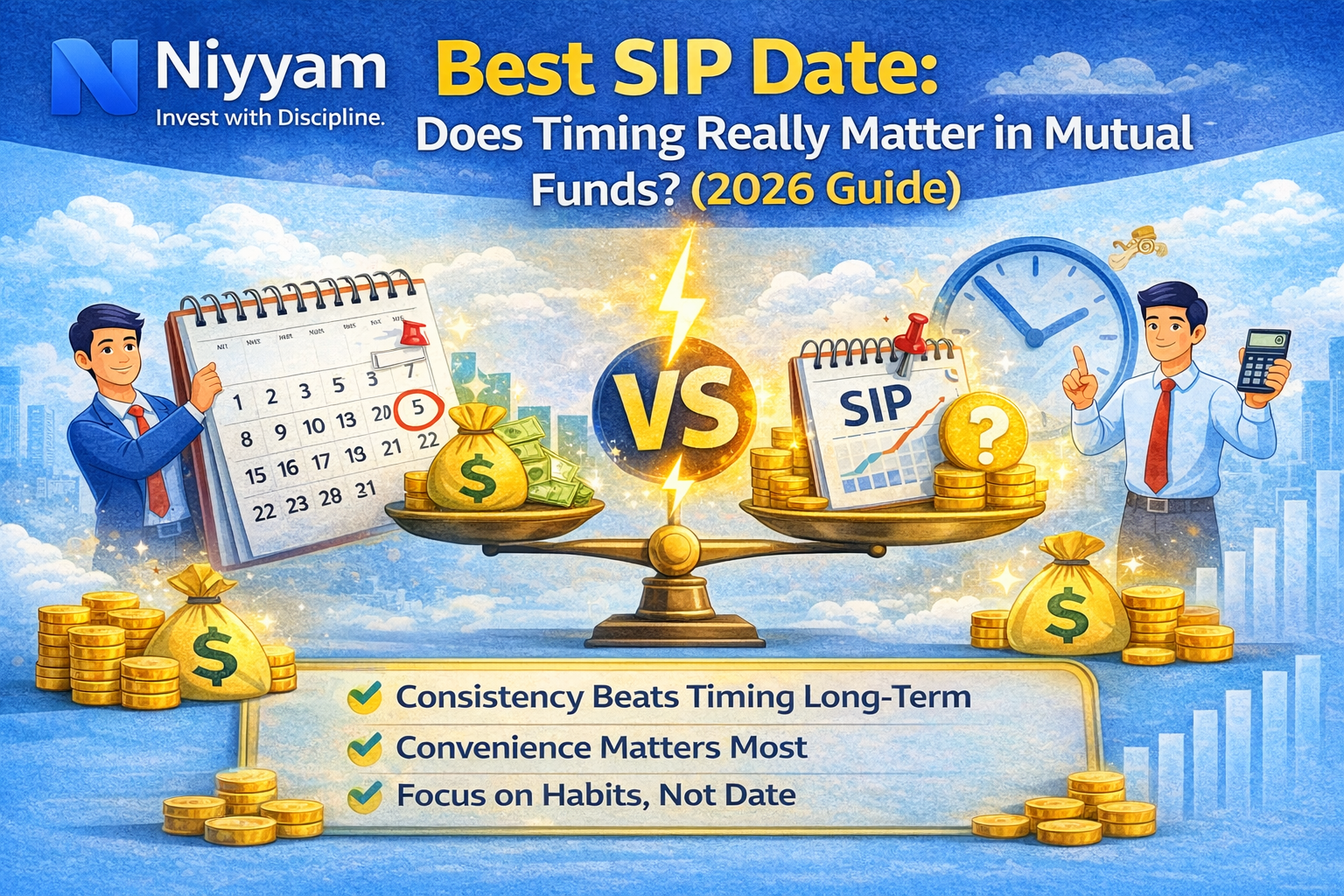
Best SIP date in mutual funds is a common concern among investors, but in reality, SIP timing has very little impact on long-term returns compared to consistency and investment duration.
One of the most frequently asked questions by SIP investors is:
Which is the best date to invest in SIP?
Many investors believe:
- Investing on a specific date can give better returns
- Some dates are strategically better than others
- Market timing can improve SIP performance
But is this actually true?
The reality is simple:
There is no single best SIP date.
What matters far more is:
- Staying consistent
- Investing for the long term
- Increasing your SIP regularly
If you are new to investing, it is important to first understand What is SIP in Mutual Funds? A Complete Beginner’s Guide (2026), because SIP works differently from lump sum investing.
💡 Key Takeaways
- There is no single best SIP date
- Timing has minimal impact on long-term returns
- Consistency matters more than timing
- SIP works through cost averaging
- Choosing a convenient date is the best strategy
Direct Answer
What is the best SIP date in mutual funds?
There is no best SIP date. Investors should choose a convenient date based on their cash flow, as SIP returns are driven by long-term consistency rather than timing.
Does SIP Date Really Matter?
Let us answer this clearly:
SIP date does not matter significantly in the long term.
SIP is designed to:
- Invest regularly
- Capture market ups and downs
- Average the purchase cost
This means that the exact day you invest has very limited influence over time.
Why People Think SIP Date Matters
Many investors assume SIP timing matters because:
- Markets fluctuate daily
- NAV changes every day
- Some days may have lower prices
This creates the illusion that choosing the “right date” can improve returns.
Reality Check
| Belief | Reality |
|---|---|
| Choosing the right date increases returns | Impact is negligible |
| Early-month SIP is better | No consistent evidence |
| Late-month SIP is better | No proven advantage |
| Timing matters in SIP | Consistency matters more |
Real Example: SIP Date Comparison
Let us compare different SIP dates.
Assumptions:
- SIP amount: ₹10,000
- Duration: 10 years
- Return: 12%
Results:
| SIP Date | Approx Value | Difference |
|---|---|---|
| 1st | ₹23–24 lakh | Minimal |
| 10th | ₹23–24 lakh | Negligible |
| 20th | ₹23–24 lakh | Negligible |
Key Insight:
The difference between SIP dates is typically less than 1–2%.
Why SIP Date Has Little Impact
1. Market is Unpredictable
No one can predict daily movements.
Short-term price changes are random.
2. SIP Uses Cost Averaging
SIP invests at different price levels:
- When markets fall → more units
- When markets rise → fewer units
Over time, this balances out.
To understand this better, refer to How SIP Builds Wealth Through Compounding (With Simple Examples).
3. Long-Term Investing Cancels Timing
If you invest for:
- 10 years
- 15 years
- 20 years
Small timing differences become irrelevant.
What Matters More Than SIP Date
Instead of focusing on the date, focus on these:
1. Investment Duration
| Duration | Impact |
|---|---|
| 5 years | Limited growth |
| 10 years | Moderate growth |
| 20+ years | Wealth creation |
To understand this, refer to SIP for 5 Years vs 10 Years vs 20 Years: How Time Impacts Wealth.
2. SIP Amount
Higher investment leads to higher wealth.
3. Consistency
- Regular investing
- No interruptions
Missing SIPs has a much bigger negative impact than choosing the wrong date.
4. Step-Up Strategy
Increasing SIP every year significantly improves compounding.
When SIP Date Might Slightly Matter
In most cases, the SIP date does not matter.
However, in certain scenarios:
| Scenario | Impact |
|---|---|
| Highly volatile markets | Slight variation |
| Short-term investing | Minor difference |
| Lump sum comparison | Timing matters more |
Insight:
SIP date matters only in the short term, not in long-term investing.
Best Strategy for Choosing SIP Date
Instead of overthinking:
Choose a convenient date.
Ideal Approach
- Choose a date close to salary credit
- Ensure sufficient bank balance
- Avoid missed SIP
Example
| Salary Date | Ideal SIP Date |
|---|---|
| 1st | 3rd–5th |
| 5th | 7th–10th |
| 10th | 12th–15th |
Common Mistakes Investors Make
1. Over-Optimizing SIP Date
Trying to find the perfect date has no real benefit.
2. Delaying Investment
Waiting for a better date results in lost time.
3. Changing SIP Dates Frequently
This creates unnecessary complexity.
4. Missing SIP Due to Poor Planning
This has a bigger negative impact than timing.
To understand broader mistakes, refer to 7 SIP Mistakes to Avoid (A Complete Beginner’s Guide for Mutual Fund Investors).
SIP vs Lump Sum: Where Timing Matters
Timing is more important in lump-sum investing.
| Factor | SIP | Lump Sum |
|---|---|---|
| Timing importance | Low | High |
| Risk | Lower | Higher |
| Cost averaging | Yes | No |
| Best for | Regular investors | Experienced investors |
To understand this better, refer to SIP vs Lumpsum Investing in India: Which Strategy Builds More Wealth in 2026?.
Role of Market Cycles
Markets go through:
- Bull phase
- Bear phase
- Sideways phase
Impact on SIP
| Market Phase | SIP Benefit |
|---|---|
| Bull | Portfolio grows |
| Bear | More units accumulated |
| Sideways | Cost averaging works |
To understand this better, refer to SIP in Bear Market vs Bull Market: Where Do You Benefit More?.
Long-Term Impact vs Short-Term Noise
Many investors focus on small details like the SIP date because they see daily market movements.
Short-Term (1–2 years)
- Market fluctuations matter
- SIP dates may show small variations
Long-Term (10–20 years)
- Compounding dominates
- Timing differences disappear
Example:
- 1-year SIP → noticeable variation
- 20-year SIP → almost identical results
Key Insight:
Short-term noise creates confusion.
Long-term consistency creates wealth.
Practical Example
Two investors:
| Investor | SIP Date | Duration | Outcome |
|---|---|---|---|
| A | 1st | 20 years | ₹1 crore |
| B | 20th | 20 years | ₹98–99 lakh |
Insight:
The difference is negligible compared to the total wealth created.
Advanced Insight: Investor Psychology
Many investors:
- Overthink timing
- Focus on small details
- Ignore big factors
Successful investors:
- Focus on consistency
- Stay invested
- Ignore short-term noise
What Should You Focus On Instead?
Priority list:
- Start early
- Stay consistent
- Increase SIP regularly
- Stay invested long term
Conclusion
The best SIP date is not about timing.
It is about discipline.
If you focus on:
- The right date → you delay investing
- The right habit → you build wealth
The truth is simple:
Consistency beats timing in SIP investing.
Frequently Asked Questions (FAQs)
1. What is the best SIP date?
There is no best date. Choose a convenient one.
2. Does SIP date affect returns?
Only marginally in the short term, not in the long term.
3. Should I change my SIP date?
Not necessary unless needed for convenience.
4. Is early-month SIP better?
No proven advantage.
5. Can timing improve SIP returns?
Not significantly.
Disclaimer
This content is for educational purposes only and does not constitute investment advice.
Mutual fund investments are subject to market risks. Investors should read all scheme-related documents carefully before investing and consider their financial goals, risk tolerance, and investment horizon.
Share this guide with your friends, family, and colleagues to help them make better financial decisions.
If this article helped you, share it with at least one person who needs this guidance.
Leave a Reply