
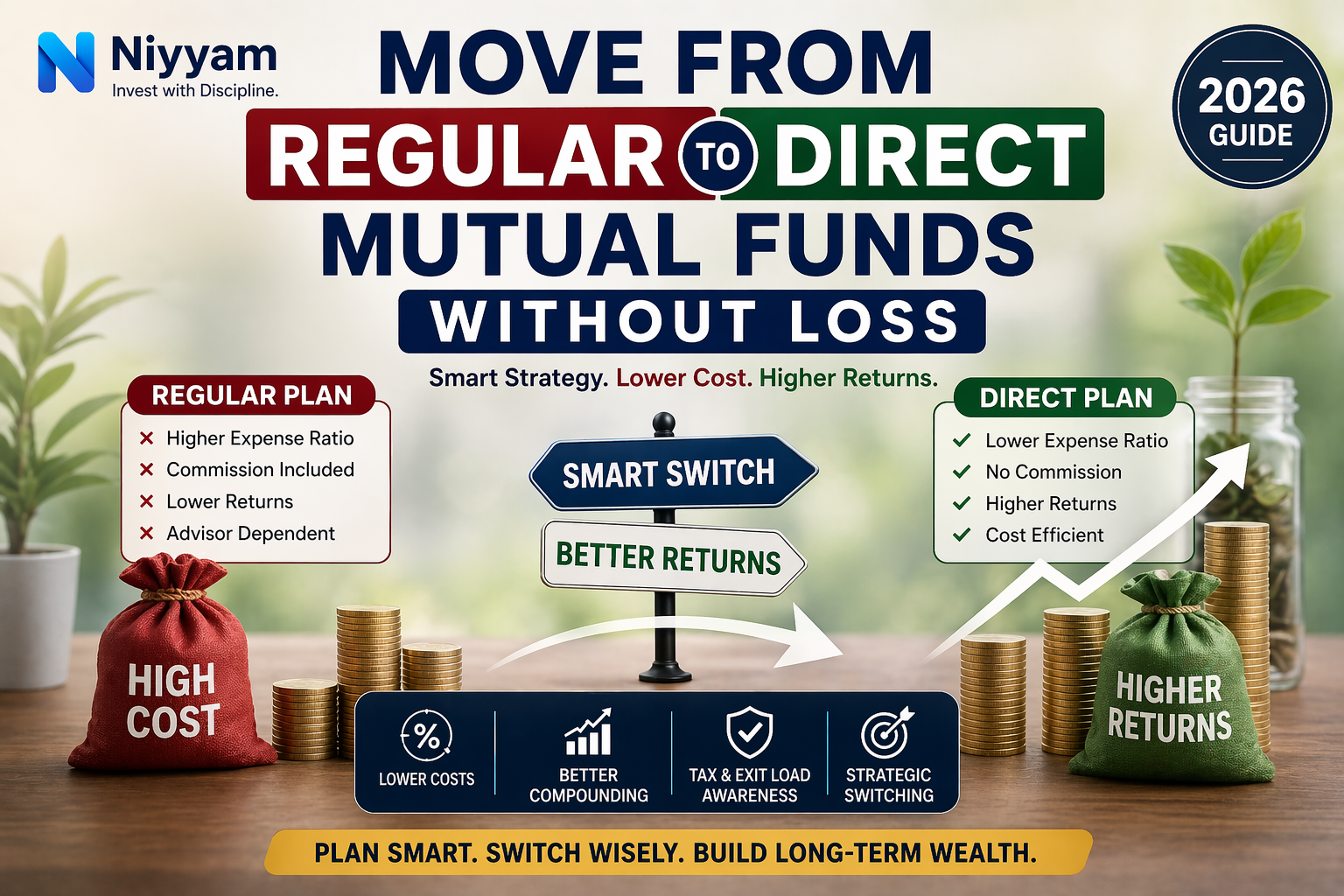
By Ashok Prasad, Founder, Niyyam
Published: March 2026
Introduction: The Hidden Cost Most Investors Realize Late
Most Indian investors begin their mutual fund journey through:
- Banks
- Agents
- Brokers
These are known as regular mutual funds.
At the beginning, everything seems fine. Investments are running, SIPs are active, and the portfolio looks stable.
But over time, investors start noticing:
- Returns are slightly lower than expected
- Expense ratios are higher
- A portion of the returns is being deducted as commission
This is when many investors discover direct mutual funds.
Direct plans offer:
- Lower costs
- Higher long-term returns
- Better compounding
This leads to an important question:
How to move from regular to direct mutual funds without loss?
Before making any decision, it is equally important to understand
how to choose the right mutual fund in India, because switching alone does not guarantee better outcomes.
Direct Answer
You can move from regular to direct mutual funds by redeeming your regular plan and reinvesting in the direct plan of the same fund, while carefully managing tax, exit load, and timing.
Key points:
- Switching is treated as redemption + fresh investment
- Tax and exit load may apply
- Direct plans improve long-term compounding
💡 Key Takeaways
- Direct plans have lower expense ratios
- Switching involves redemption and reinvestment
- Tax and exit load must be considered
- Gradual switching reduces risk
- Long-term investors benefit the most
- Cost savings significantly improve compounding
- Avoid switching blindly without a strategy
Regular vs Direct Mutual Funds: Core Difference
| Feature | Regular Plan | Direct Plan |
|---|---|---|
| Expense Ratio | Higher | Lower |
| Commission | Included | Not included |
| Returns | Lower | Higher |
| Advisor Support | Yes | No |
The difference looks small, but over time it becomes significant.
How Much Difference Does It Make?
Long-Term Cost Impact
| Investment Period | Regular Plan | Direct Plan |
|---|---|---|
| ₹10 lakh (10 years) | ₹20 lakh | ₹22–23 lakh |
| ₹10 lakh (15 years) | ₹35 lakh | ₹40+ lakh |
Even a 1% cost difference creates a major impact over time.
Why Direct Plans Perform Better
- Lower expense ratio → Higher net returns
- No commission → More money stays invested
- Better compounding → Stronger long-term wealth
To understand this deeper, you can explore
How SIP Builds Wealth Through Compounding (With Simple Examples)
What Happens When You Switch?
Switching is not a simple conversion.
| Action | Reality |
|---|---|
| Switch | Redemption + Reinvestment |
| Tax | Applicable |
| Exit Load | May apply |
This is why planning is critical.
Step-by-Step: How to Move to Direct Funds
Step 1: Identify Regular Funds
Check:
- Plan type → Regular
- Expense ratio → Higher
- Distributor → Present
Step 2: Check Exit Load
| Holding Period | Exit Load |
|---|---|
| Less than 1 year | Applicable |
| More than 1 year | Usually zero |
Avoid switching during the exit load period.
Step 3: Check Tax Impact
| Holding Period | Tax |
|---|---|
| Less than 1 year | 20% STCG |
| More than 1 year | 12.5% LTCG above ₹1.25 lakh |
Tax planning is essential before switching.
Step 4: Redeem Regular Plan
- Sell units of the regular plan
- Amount gets credited to your bank
Step 5: Reinvest in the Direct Plan
- Choose the direct version of the same fund
- Invest a lump sum or stagger
SIP vs Lump Sum Switching Strategy
| Investment Type | Strategy |
|---|---|
| SIP | Stop old SIP and start direct SIP |
| Lump Sum | Redeem gradually and reinvest |
SIP investors should avoid exiting fully at once.
Smart Strategies to Switch Without Loss
Strategy 1: Gradual Switching
- Partial redemption
- Lower tax burden
- Reduced market timing risk
Strategy 2: Use STP (Systematic Transfer Plan)
- Gradual transfer
- Smooth transition
- Market averaging benefit
Strategy 3: Wait for Tax Efficiency
- Hold for more than 1 year
- Reduce short-term tax impact
Hidden Cost of Staying in Regular Plans
Many investors underestimate the long-term impact of expense ratios.
Even a 0.5%–1% higher cost may seem small initially, but over 10–15 years, it can reduce your final corpus significantly.
This happens because:
- Costs are deducted every year
- Compounding works on reduced returns
- Wealth erosion becomes visible only in the long term
Direct plans eliminate this leakage and allow your investments to grow more efficiently.
Switch vs Stay Decision Framework
| Scenario | Action |
|---|---|
| Long-term investor | Switch |
| Short-term holding | Wait |
| High exit load | Delay |
| High expense ratio | Switch gradually |
Real-Life Example
Wrong Approach
- Immediate full switch
- Ignored exit load
- Paid unnecessary tax
Result: Loss of capital
Smart Approach
- Waited for 1 year
- Reduced tax impact
- Switched gradually
Result: Better returns and smoother transition
Before vs After Switching
| Scenario | Outcome |
|---|---|
| Regular plan only | Lower returns |
| Direct plan switch | Higher returns |
When You Should Switch
- Long-term investment horizon
- High expense ratio
- No meaningful advisory support
When NOT to Switch Immediately
Avoid switching if:
- Exit load is still applicable
- Short-term capital gains tax is high
- Market conditions are volatile
- You recently made a lump sum investment
In such cases, waiting can significantly reduce unnecessary losses.
Why Simplicity Wins in Investing
Many investors complicate switching decisions.
But a simple approach works best:
- Clear strategy
- Gradual execution
- Long-term focus
This reduces mistakes and improves outcomes.
Common Mistakes Investors Make
- Switching without tax planning
- Ignoring exit load
- Switching all funds at once
- Not comparing expense ratios properly
- Expecting immediate results
These behavioral mistakes are similar to those explained in
Why Most SIP Investors Fail to Build Wealth (And How to Avoid It in 2026)
Decision Framework (Most Important)
| Scenario | Action |
|---|---|
| Long-term holding | Switch |
| Short-term holding | Wait |
| Exit load active | Delay |
| High expense ratio | Switch gradually |
Impact on Long-Term Wealth
| Strategy | Outcome |
|---|---|
| Stay in regular plan | Lower compounding |
| Move to direct plan | Higher wealth creation |
Even small cost savings lead to significant long-term gains.
Frequently Asked Questions (FAQs)
Is switching to direct mutual funds beneficial?
Yes, it improves long-term returns.
Will I lose money while switching?
Not if done with proper tax and exit load planning.
Is switching taxable?
Yes, it is treated as redemption.
Can I switch partially?
Yes, gradual switching is recommended.
Is direct plan always better?
Yes, for long-term cost-conscious investors.
Conclusion: Strategy Matters More Than Speed
Switching from regular to direct mutual funds is a smart decision.
But it should not be rushed.
The right approach is:
- Understand tax implications
- Plan exit load timing
- Switch gradually
Final Verdict
- Reduces cost
- Improves returns
- Enhances compounding
A well-planned switch creates a meaningful long-term advantage.
Final Thought
Wealth creation is about optimization.
Even saving 1% in cost can generate significant additional returns over time.
Make the switch strategically and let compounding work in your favor.
Disclaimer
This content is for educational purposes only and does not constitute investment advice.
Mutual fund investments are subject to market risks. Investors should read all scheme-related documents carefully before investing and consider their financial goals, risk tolerance, and investment horizon.
Share this guide with your friends, family, and colleagues to help them make better financial decisions.
If this article helped you, share it with at least one person who needs this guidance.
Leave a Reply