
By Ashok Prasad, Founder, Niyyam
Published: March 2026
Introduction
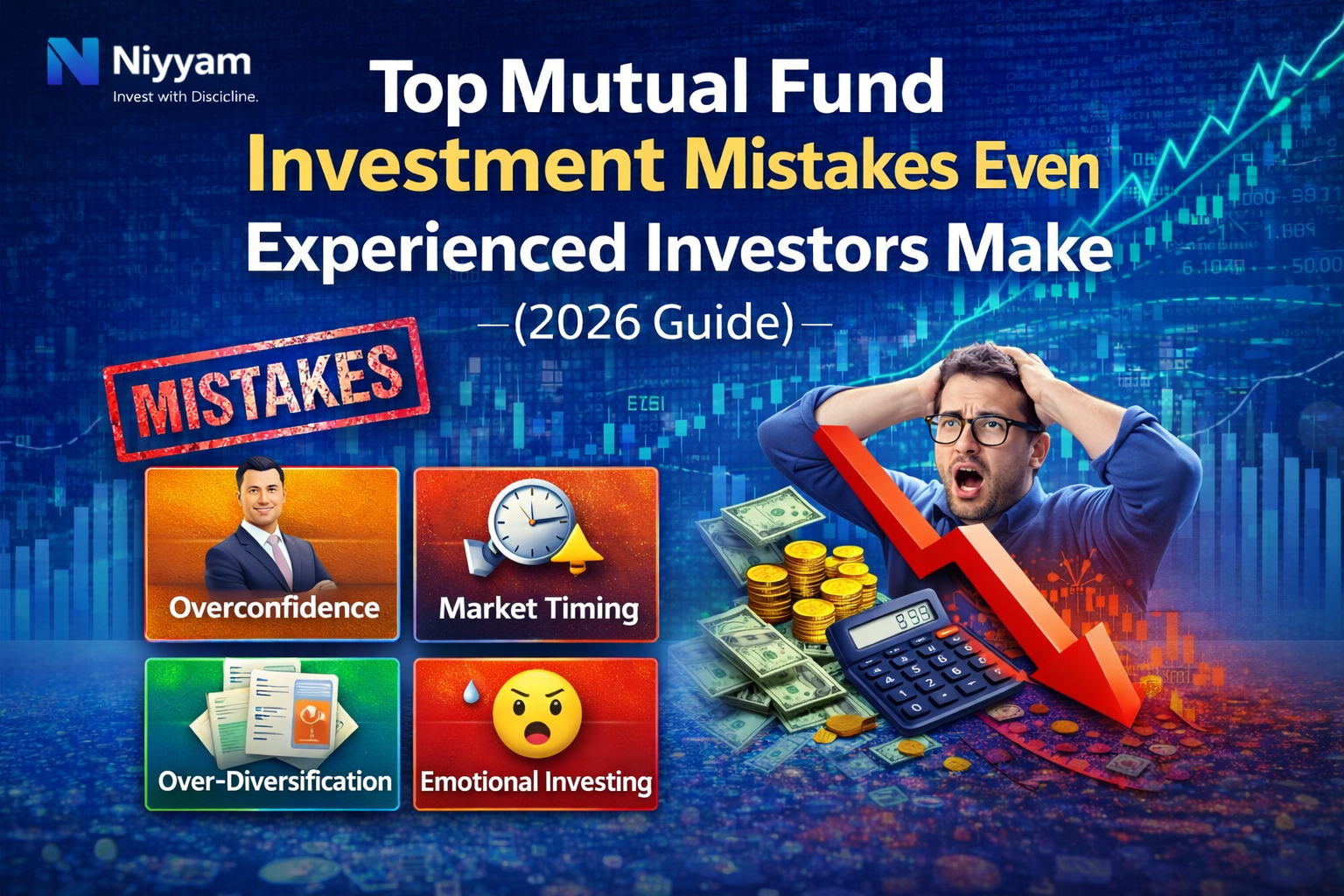
Mutual fund investment mistakes are not limited to beginners. Even experienced investors make critical errors that reduce long-term returns and increase risk.
Most people assume that experience automatically leads to better investing decisions.
But the reality is very different.
Experienced investors often make more dangerous mistakes because:
- They become overconfident
- They try to predict market movements
- They overcomplicate their strategy
These mistakes are not due to a lack of knowledge.
They happen because of:
- Behavioral biases
- Emotional decisions
- Over-analysis
- Lack of discipline
The biggest issue is that these mistakes are subtle. They do not immediately show their impact, but over time, they significantly reduce wealth creation potential.
If you want to succeed in mutual fund investing, avoiding these advanced-level mistakes is far more important than finding the “best” fund.
💡 Key Takeaways
- Even experienced investors make behavioral mistakes
- Overconfidence leads to poor mutual fund decisions
- Market timing rarely works consistently
- Over-diversification reduces returns
- Asset allocation is more important than fund selection
- Frequent portfolio changes harm long-term performance
- Emotional investing is the biggest risk
- Simplicity outperforms complexity in the long run
Direct Answer
Experienced mutual fund investors often make mistakes such as overconfidence, excessive diversification, frequent portfolio changes, and attempting to time the market. These mistakes are primarily behavioral rather than technical. Avoiding them and maintaining a disciplined, long-term strategy is essential for consistent returns.
Why Experienced Mutual Fund Investors Make Mistakes
Experience does not eliminate mistakes. It introduces a new type of risk — behavioral risk.
Beginner vs Experienced Investors
| Investor Type | Common Mistake |
|---|---|
| Beginner | Lack of knowledge |
| Experienced | Overconfidence |
As investors gain experience:
- Knowledge increases
- Confidence increases
- But discipline often decreases
This creates a dangerous gap.
Key Insight:
Experience without discipline leads to poor outcomes.
Mistake 1: Overconfidence in Mutual Fund Selection
After a few successful investments, investors believe they can consistently pick winning funds.
What Happens
| Behavior | Result |
|---|---|
| Ignoring research | Poor decisions |
| Concentrated bets | High risk |
| Sector bias | Volatility |
Example
- Heavy allocation to small-cap funds after strong returns
- Ignoring portfolio balance
This is often linked to a misunderstanding risk metrics. If you want to evaluate funds more scientifically, refer to What is Alpha and Beta in Mutual Funds? How to Actually Use Them (2026 Practical Guide).
Key Insight:
Confidence helps, but overconfidence destroys discipline.
Mistake 2: Trying to Time the Market
Many experienced investors believe they can enter and exit at the perfect time.
Reality
| Strategy | Outcome |
|---|---|
| Market timing | Rarely successful |
| Systematic investing | Consistent |
What Happens
- Missing market recovery
- Entering at peak levels
- Exiting during corrections
A better approach is understanding long-term strategies like SIP vs Lump Sum: Which Investment Strategy Is Better for Beginners?.
Key Insight:
Time in the market beats timing the market.
Mistake 3: Over-Diversification of Mutual Funds
Diversification is essential, but excessive diversification reduces returns.
Portfolio Structure
| Number of Funds | Impact |
|---|---|
| 3–5 funds | Optimal |
| 8+ funds | Over-diversified |
Problems
- Duplicate holdings
- Lower returns
- Difficult tracking
Many investors don’t even realize their portfolios overlap significantly. This is explained clearly in What is Portfolio Overlap in Mutual Funds & Why It Can Reduce Your Returns (2026 Guide).
Key Insight:
More funds do not mean better diversification.
Mistake 4: Frequent Buying and Selling
Experienced investors often over-manage their portfolios.
Impact
| Action | Result |
|---|---|
| Frequent switching | Lower returns |
| Emotional reactions | Losses |
| Over-monitoring | Stress |
Why It Happens
- Market news
- Short-term volatility
- Over-analysis
Frequent changes reduce compounding benefits. Instead, periodic structured reviews like Mutual Fund Portfolio Review Checklist (Monthly, Quarterly, Yearly Strategy 2026) can help maintain discipline.
Key Insight:
Activity is not equal to performance.
Mistake 5: Ignoring Asset Allocation
Many investors focus only on fund selection and ignore allocation.
Importance
| Factor | Impact |
|---|---|
| Asset allocation | High |
| Fund selection | Medium |
Example
| Allocation | Result |
|---|---|
| 90% equity | High risk |
| Balanced portfolio | Stability |
To understand how to structure allocation properly, refer to How to Build a Mutual Fund Portfolio for Long-Term Wealth Creation (2026 Guide).
Key Insight:
Allocation drives long-term returns more than fund choice.
Mistake 6: Chasing Past Performance
Selecting funds based on recent returns is a common trap.
Reality
| Criteria | Truth |
|---|---|
| Top performer today | May underperform tomorrow |
What Happens
- Buying at peak valuations
- Selling during underperformance
Key Insight:
Past performance is not a reliable predictor of future returns.
Mistake 7: Ignoring Expense Ratio
Costs significantly impact long-term returns.
Impact
| Expense Ratio | Effect |
|---|---|
| Low | Better long-term wealth |
| High | Reduced returns |
Even a small difference compounds over time.
Key Insight:
Costs silently reduce your wealth.
Mistake 8: Not Reviewing Portfolio Properly
Experienced investors often become complacent.
What Happens
- Holding poor-performing funds
- Ignoring allocation imbalance
- Missing correction opportunities
Solution
- Monthly tracking
- Quarterly review
- Annual rebalancing
Key Insight:
Regular review prevents long-term damage.
Mistake 9: Emotional Decision Making
Even experienced investors are influenced by emotions.
Emotional Triggers
| Emotion | Impact |
|---|---|
| Fear | Selling at loss |
| Greed | Over-investing |
Market volatility is normal, but emotional reactions amplify losses.
Key Insight:
Emotions are the biggest enemy of investors.
Mistake 10: Overcomplicating the Strategy
Many investors believe complexity leads to better returns.
Complex vs Simple
| Strategy | Result |
|---|---|
| Complex | Confusion |
| Simple | Consistency |
Examples
- Too many funds
- Too many strategies
- Frequent changes
Key Insight:
Simple strategies are easier to follow and more effective.
Quick Rule of Thumb
- Avoid overconfidence
- Do not try to time the market
- Keep your mutual fund portfolio simple
- Review regularly
- Stay disciplined
Common Patterns of Failure
- Over-trading
- Chasing returns
- Ignoring allocation
- Emotional investing
- Lack of discipline
Failure Impact Table
| Pattern | Result |
|---|---|
| Overconfidence | Losses |
| No review | Poor performance |
| Emotional decisions | Instability |
Advanced Insight
The biggest difference between successful and unsuccessful investors is not knowledge.
It is behavior.
Reality Check
| Factor | Importance |
|---|---|
| Knowledge | Medium |
| Discipline | High |
| Behavior | Maximum |
Wealth Creation Truth
| Investor Type | Outcome |
|---|---|
| Smart but emotional | Losses |
| Average but disciplined | Wealth creation |
Key Insight:
Behavior matters more than intelligence.
Conclusion
Even experienced mutual fund investors make mistakes.
But awareness creates a powerful advantage.
If you:
- Stay disciplined
- Avoid behavioral mistakes
- Focus on long-term investing
- Keep your strategy simple
You can significantly improve your returns.
Final Verdict
- Avoid behavioral mistakes
- Focus on long-term mutual fund investing
- Maintain discipline
- Keep your portfolio simple
Consistency always beats intelligence.
Final Thought
The biggest risk in mutual fund investing is not the market.
It is your own behavior.
Frequently Asked Questions (FAQs)
Do experienced investors make mistakes?
Yes, mainly due to overconfidence and emotional decisions.
Is diversification always good?
Yes, but over-diversification reduces returns.
Should I frequently change funds?
No, it harms long-term performance.
Is market timing possible?
Not consistently.
What is the biggest mistake?
Emotional investing.
Disclaimer
This content is for educational purposes only and does not constitute investment advice.
Mutual fund investments are subject to market risks. Investors should read all scheme-related documents carefully before investing and consider their financial goals, risk tolerance, and investment horizon.
Share this guide with your friends, family, and colleagues to help them make better financial decisions.
If this article helped you, share it with at least one person who needs this guidance.
Leave a Reply