
By Ashok Prasad, Founder, Niyyam
Published: March 2026
Introduction
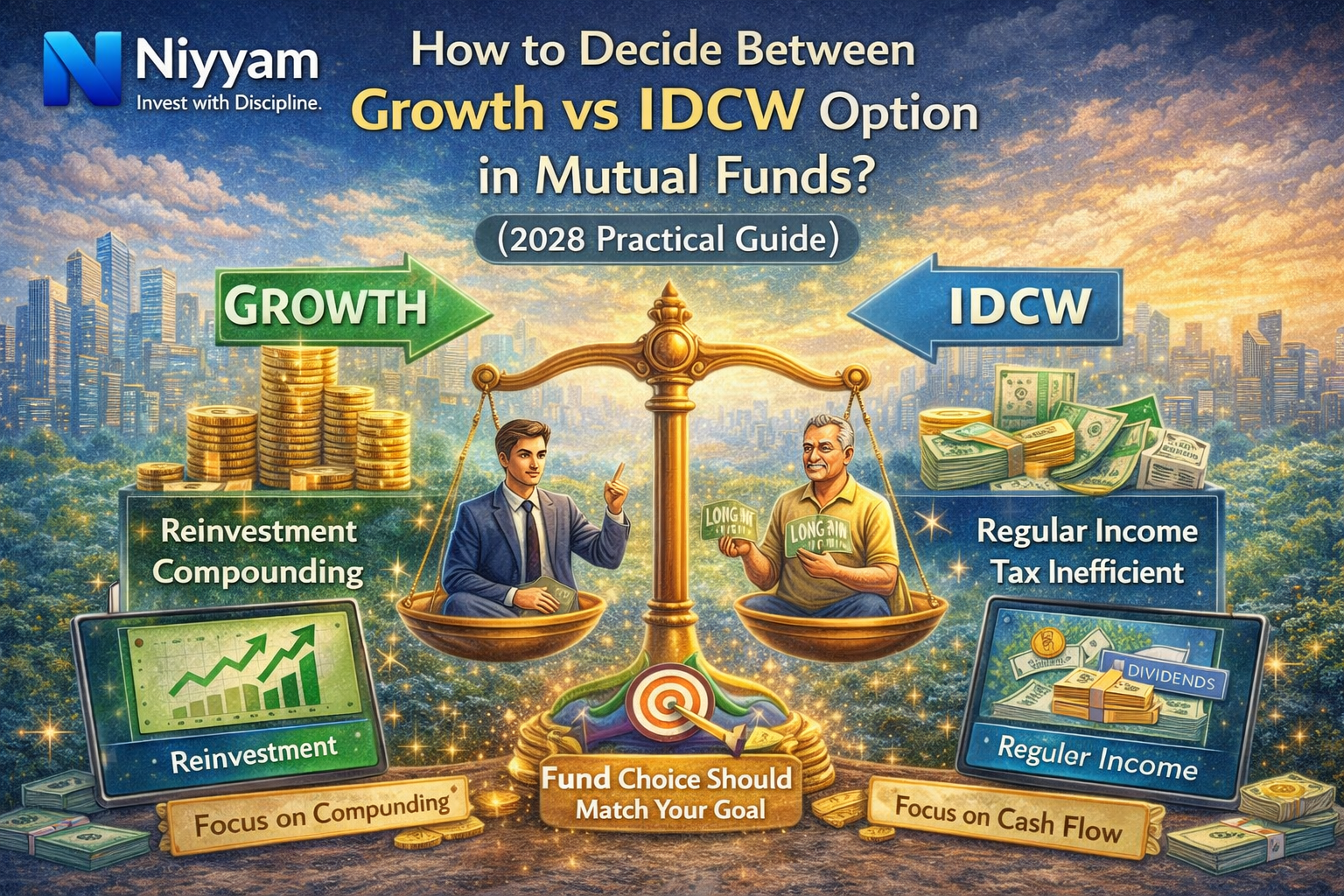
Growth vs IDCW mutual funds — which one actually gives you more money in the long run?
Growth vs IDCW mutual funds is one of the most important decisions that directly impacts your long-term returns and tax efficiency.
Many investors assume IDCW gives “extra income” or “bonus returns,” while others blindly choose Growth without understanding when IDCW might actually be useful.
This confusion often leads to:
- Lower long-term returns
- Poor tax efficiency
- Misaligned financial planning
The reality is simple but powerful:
Growth vs IDCW is not a preference decision — it is a strategy decision.
It depends on:
- Your financial goal
- Your cash flow needs
- Your investment horizon
- Your tax situation
💡 Key Takeaways
- Growth option maximizes compounding and long-term wealth
- IDCW provides cash flow but reduces total returns
- Growth is more tax-efficient than IDCW
- IDCW is suitable only for income-focused investors
- Most investors should prefer Growth during the accumulation phase
- Wrong selection can reduce wealth by 20–30% over time
In this guide, you will clearly understand when to choose each option and how to avoid costly mistakes.
Direct Answer
Growth option is better for long-term wealth creation as it reinvests profits and allows compounding, while IDCW is suitable only if you need regular income but is less tax-efficient and reduces overall returns.
What is Growth Option in Mutual Funds?
In the Growth option, all profits generated by the fund are reinvested automatically.
Key Features
| Feature | Explanation |
|---|---|
| Profit handling | Reinvested |
| NAV movement | Increases steadily |
| Taxation | Only on redemption |
| Compounding | Strong |
Example of Growth
| Year | Investment Value |
|---|---|
| Year 1 | ₹1,10,000 |
| Year 5 | ₹1,60,000 |
| Year 10 | ₹3,00,000+ |
This growth happens because profits remain invested.
To understand compounding deeply, you can revisit “How SIP Builds Wealth Through Compounding (With Simple Examples)”.
What is the IDCW Option?
IDCW means profits are distributed to investors periodically.
Key Features
| Feature | Explanation |
|---|---|
| Profit handling | Paid out |
| NAV movement | Drops after payout |
| Taxation | Taxed each time |
| Compounding | Reduced |
Example of IDCW
| Year | Dividend Paid | Portfolio Value |
|---|---|---|
| Year 1 | ₹5,000 | ₹95,000 |
| Year 5 | ₹25,000 total | Lower than growth |
This reduces compounding.
Growth vs IDCW: Complete Comparison
| Factor | Growth | IDCW |
|---|---|---|
| Wealth creation | High | Low |
| Tax efficiency | High | Low |
| Cash flow | No | Yes |
| Compounding | Strong | Weak |
| Ideal for | Long-term investors | Income seekers |
Taxation Difference (Critical Section)
Taxation plays a major role in decision-making.
However, most investors only have a basic understanding of taxation and often underestimate its real impact on long-term wealth creation.
Mutual fund taxation is not just about rates — it involves understanding holding periods, capital gains, and how different fund categories are taxed. A deeper understanding can significantly improve your post-tax returns.
To get a complete clarity on this, read Mutual Fund Taxation in India (Complete 2026 Guide).
| Aspect | Growth | IDCW |
|---|---|---|
| Tax trigger | On redemption | On payout |
| Frequency | Low | High |
| Efficiency | Better | Poor |
For a deeper understanding of tax optimization, read “How to Reduce Taxes on Mutual Fund Gains Legally (Advanced Strategies for 2026)”.
Real Wealth Impact (10-Year Comparison)
Scenario: ₹1 Lakh Investment
| Option | Final Value |
|---|---|
| Growth | ₹3,00,000+ |
| IDCW | ₹2,00,000–₹2,30,000 |
Why This Happens
Another key reason behind this difference is taxation efficiency.
Frequent payouts in IDCW trigger taxation regularly, while the growth option defers taxation until redemption, allowing more money to stay invested and compound over time.
To understand how taxation directly impacts your returns, refer to Mutual Fund Taxation in India (Complete 2026 Guide).
| Reason | Impact |
|---|---|
| Money stays invested | Higher compounding |
| No frequent tax | Better returns |
| No withdrawal | Faster growth |
Growth vs IDCW vs SWP (Very Important)
Many investors confuse IDCW with income strategies.
Comparison
| Feature | Growth | IDCW | SWP |
|---|---|---|---|
| Income | No | Yes | Yes |
| Control | High | Low | High |
| Tax efficiency | High | Low | Better |
| Flexibility | High | Low | High |
SWP is often a better alternative than IDCW.
To understand withdrawal strategies, refer to “SWP in Mutual Funds Explained: How to Create Monthly Income (2026 Guide)”.
When Should You Choose Growth?
Growth is ideal in most cases.
Suitable For
| Investor Type | Reason |
|---|---|
| Salaried individuals | No income need |
| Young investors | Long horizon |
| Wealth creators | Compounding benefit |
Practical Insight
If your goal is:
- Retirement
- Financial freedom
- Long-term wealth
Then Growth is the correct choice.
When Should You Choose IDCW?
IDCW is useful in limited situations.
Suitable For
| Investor Type | Reason |
|---|---|
| Retired individuals | Need income |
| Passive income seekers | Cash flow |
| No reinvestment plan | Simplicity |
Important Reality
IDCW does not create income —
It distributes your own money.
What Most Investors Get Wrong
Common Misconceptions
| It is a payout of capital | Reality |
|---|---|
| IDCW gives extra returns | It reduces NAV |
| Dividend is profit | It is payout of capital |
| IDCW is safer | No impact on risk |
Real-Life Investor Case Studies
Case 1: Young Investor (Age 28)
| Choice | Outcome |
|---|---|
| Growth | Maximum wealth |
| IDCW | Lower returns |
Case 2: Retired Investor (Age 65)
| Choice | Outcome |
|---|---|
| Growth + SWP | Better control |
| IDCW | Fixed payouts |
Case 3: Middle-Aged Investor (Age 45)
| Choice | Outcome |
|---|---|
| Growth | Better long-term planning |
| IDCW | Inefficient |
Decision Framework (Very Important)
Use this simple framework:
Step-by-Step
| Question | If Yes | If No |
|---|---|---|
| Do you need income? | IDCW | Growth |
| Long-term goal? | Growth | IDCW |
| Want tax efficiency? | Growth | IDCW |
| Need control? | Growth | IDCW |
Role of Market Conditions
| Market Type | Growth | IDCW |
|---|---|---|
| Bull market | Strong returns | Limited |
| Bear market | Recovers better | Weak |
| Sideways | Moderate | Stable |
Switching Between Growth and IDCW
Switching is allowed but taxable.
Key Points
| Factor | Impact |
|---|---|
| Switching | Taxable event |
| Timing | Critical |
| Planning | Required |
For better clarity, read “Switch vs Redeem in Mutual Funds: Tax Impact & Strategy (2026 Guide)”.
Advanced Strategy (Smart Investors Use This)
Most experienced investors follow:
| Phase | Strategy |
|---|---|
| Accumulation | Growth |
| Retirement | SWP (not IDCW) |
Quick Rule of Thumb
- If you do not need income → choose Growth
- If you need a regular income → consider IDCW or SWP
- For long-term wealth, → Growth is best
- Avoid IDCW for compounding goals
Common Mistakes Investors Make
| Mistake | Impact |
|---|---|
| Choosing IDCW blindly | Lower wealth |
| Ignoring tax impact | Reduced returns |
| Confusing dividend with profit | Wrong decision |
| Switching frequently | Higher tax |
To avoid mistakes, also read “How Not to Choose a Mutual Fund: 7 Critical Mistakes Investors Must Avoid (2026 Guide)”.
Advanced Insight
Wealth Impact Over Time
| Scenario | Return | After 10 Years |
|---|---|---|
| Growth | 12% | ₹3 lakh+ |
| IDCW | 12% (with payout) | ₹2.2 lakh approx |
Growth vs IDCW: Long-Term Wealth Impact (15-Year Example)
Let’s understand the real difference using a long-term scenario.
| Investment | Monthly SIP | Duration | Final Value (Growth) | Final Value (IDCW) |
|---|---|---|---|---|
| Scenario | ₹10,000 | 15 years | ₹50–55 lakh | ₹35–40 lakh |
The difference happens because:
- Growth reinvests profits
- IDCW pays out profits
- Compounding gets reduced in IDCW
Over long periods, even small differences become very large.
Growth vs IDCW: Investor Psychology
Many investors prefer IDCW because:
- They feel they are earning income
- They like regular cash flow
- They misunderstand dividends
However, experienced investors focus on:
- Long-term compounding
- Tax efficiency
- Total wealth creation
This mindset difference is what separates average investors from successful ones.
A major part of this difference also comes from how investors manage taxation.
Successful investors focus not just on returns, but on post-tax returns. They structure their investments in a way that minimizes unnecessary tax outflows and maximizes compounding.
To learn how to build tax-efficient investment strategies, read Mutual Fund Taxation in India (Complete 2026 Guide).
Conclusion
The decision between Growth and IDCW is straightforward once you understand the purpose.
Growth focuses on building wealth through compounding, while IDCW focuses on providing cash flow at the cost of returns.
For most investors, especially those in their earning years, Growth is the better option.
Final Verdict
The growth option should be your default choice unless you specifically need income.
Final Thought
Wealth is not created by withdrawing money.
It is created by letting money stay invested and compound over time.
Frequently Asked Questions (FAQs)
1. Which is better: Growth or IDCW?
Growth is better for long-term wealth creation.
2. Is IDCW tax-free?
No, IDCW payouts are taxable.
3. Can I switch between them?
Yes, but it is treated as a taxable event.
4. Does IDCW reduce NAV?
Yes, NAV falls after payout.
5. Should beginners choose Growth?
Yes, Growth is generally better for beginners.
Disclaimer
This content is for educational purposes only and does not constitute investment advice.
Mutual fund investments are subject to market risks. Investors should read all scheme-related documents carefully before investing and consider their financial goals, risk tolerance, and investment horizon.
Share this guide with your friends, family, and colleagues to help them make better financial decisions.
If this article helped you, share it with at least one person who needs this guidance.
Leave a Reply