
By Ashok Prasad, Founder, Niyyam
Published: March 2026
When it comes to saving tax in India, most investors look for simple and familiar options.
They often choose:
- Fixed deposits (tax-saving FD)
- Public Provident Fund (PPF)
- Insurance-linked products
However, there is one option that combines tax savings with long-term wealth creation:
ELSS Mutual Funds (Equity Linked Savings Scheme)
But in 2026, there is an important update every investor must understand:
ELSS tax benefits depend on the tax regime you choose.
In this guide, you will learn:
- What ELSS mutual funds are
- How tax benefits work under the old vs new tax regime
- Why is ELSS still relevant even without the tax benefit
- How to use ELSS for long-term wealth creation
💡 Key Takeaways
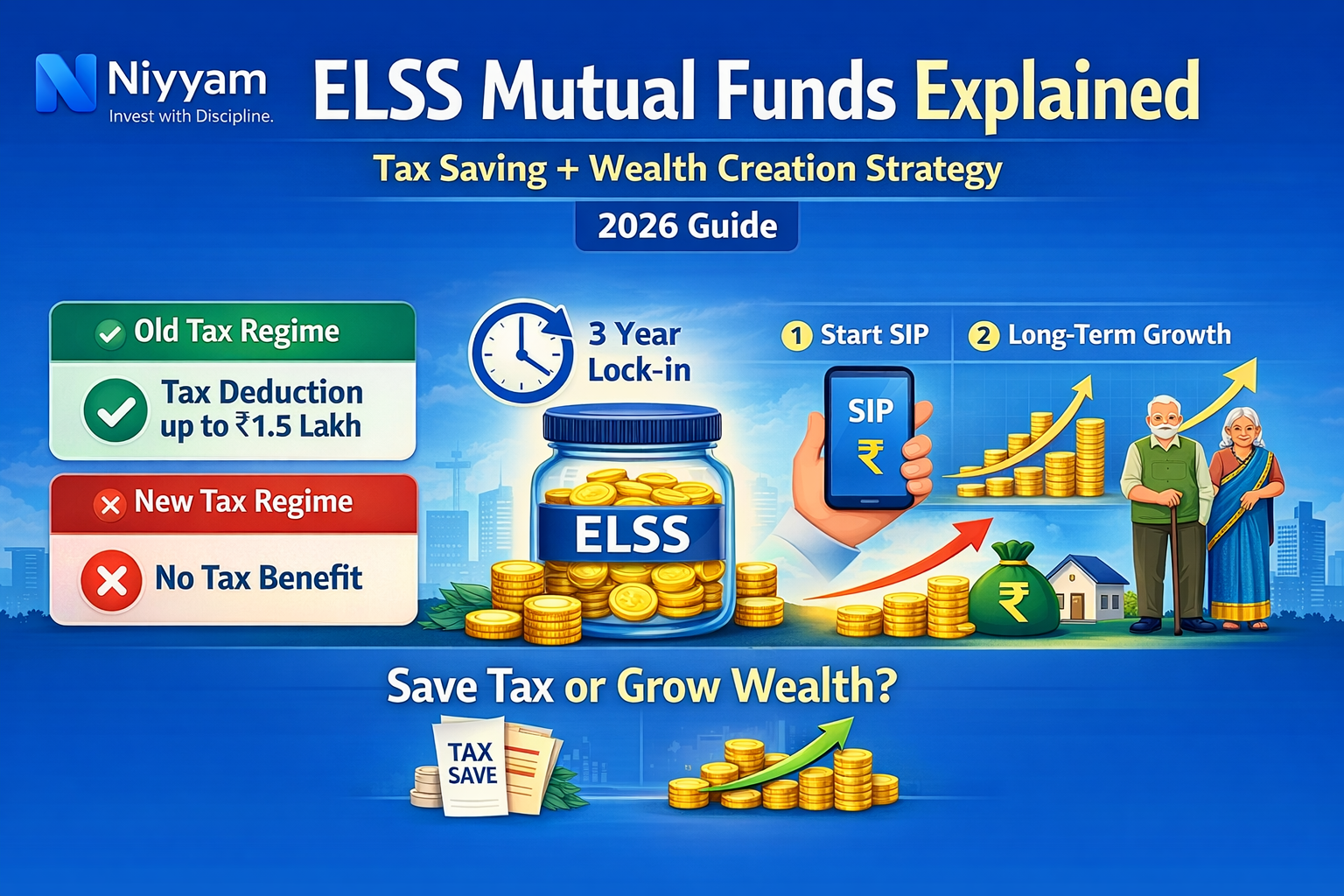
- Section 80C Benefit: ELSS is the only mutual fund that offers a tax deduction of up to ₹1.5 Lakh under the Old Tax Regime.
- Shortest Lock-in: Compared to PPF (15 years) or Tax-Saving FDs (5 years), ELSS has the shortest lock-in period of only 3 years.
- Equity Advantage: Since ELSS is equity-linked, it has the potential to provide much higher returns than traditional tax-saving instruments.
- SIP in ELSS: Don’t wait until March; start an ELSS SIP in April to spread your tax-saving burden throughout the financial year.
What is an ELSS Mutual Fund?
ELSS (Equity Linked Savings Scheme) is a type of equity mutual fund that invests primarily in the stock market.
Key Features:
- Invests mainly in equities (stocks)
- Has a mandatory lock-in period of 3 years
- Historically offers higher return potential than traditional tax-saving options
Simple Understanding:
- ELSS is a mutual fund that can help you grow your money and (in some cases) save tax
Tax Benefit of ELSS (Updated for 2026)
This is the most important section you must understand.
Under the Old Tax Regime:
- ELSS qualifies under Section 80C
- You can claim a deduction up to ₹1.5 lakh per year
- This reduces your taxable income
Example:
- Income: ₹8 lakh
- ELSS investment: ₹1.5 lakh
Taxable income becomes:
- ₹6.5 lakh
Under New Tax Regime:
- No Section 80C deductions are allowed
- ELSS does not provide any tax benefit
What This Means:
- If you opt for the old tax regime, ELSS helps in tax savings
- If you opt for the new tax regime, ELSS becomes a pure investment tool
Important Insight:
- Always evaluate your tax regime before investing in ELSS for tax savings
- Do not invest in ELSS assuming the tax benefit applies automatically
Lock-in Period (Important Feature)
ELSS comes with a 3-year lock-in period.
What This Means:
- You cannot withdraw your investment for 3 years
- Each SIP installment has a separate lock-in
Why This is Beneficial:
- Encourages long-term investing
- Prevents emotional selling
- Supports compounding
Important Point:
- ELSS has the shortest lock-in among all 80C options
ELSS vs Other Tax Saving Options
ELSS vs PPF
- ELSS: Market-linked, higher growth potential
- PPF: Fixed return, low risk
ELSS vs Tax-Saving FD
- ELSS: Potential to beat inflation
- FD: Fixed returns, often low after tax
ELSS vs Insurance Plans
- ELSS: Transparent, flexible, market-linked
- Insurance: Often complex with lower returns
Key Insight:
- ELSS offers growth potential that traditional options may not provide
Returns in ELSS Mutual Funds
ELSS funds invest in equities.
Expected Returns:
- Long-term average: 10% – 14% (market dependent)
Important Understanding:
- Returns are not guaranteed
- Short-term volatility is normal
- Long-term returns can outperform inflation
Refer:
How Mutual Funds Generate Returns for Investors (With Simple Examples)
ELSS as a Wealth Creation Tool
Even without a tax benefit, ELSS remains powerful.
Why?
- Equity exposure
- Long-term compounding
- Disciplined investing due to lock-in
Example:
- ₹1.5 lakh invested annually
- 12% return
- 15 years
Result:
- Investment: ₹22.5 lakh
- Value: ₹50+ lakh
Key Insight:
- ELSS should not be used only for tax savings
- It should be used for long-term wealth creation
How to Invest in ELSS
Lump Sum
- Invest the entire amount at once
- Suitable during market corrections
SIP (Recommended)
- Invest monthly
- Reduces timing risk
- Builds discipline
Best Approach:
- Use SIP instead of a last-minute lump sum
Refer:
What is SIP in Mutual Funds? A Complete Beginner’s Guide (2026)
How to Choose the Right ELSS Fund
1. Long-Term Performance
- Check 5–10 year returns
2. Consistency
- Avoid funds with unstable performance
3. Expense Ratio
- Lower cost improves net returns
4. Fund Strategy
- Prefer funds with a clear investment approach
Refer:
How to Compare Mutual Funds in India (5 Key Metrics Every Investor Must Check)
Where ELSS Fits in Your Portfolio
ELSS should be part of your broader allocation.
Suggested Allocation:
- 50%–70% Equity funds
- 10%–20% ELSS
- Remaining in debt funds
Important Insight:
- Do not over-allocate to ELSS
- Treat it as part of equity allocation
Refer:
Mutual Fund Portfolio Allocation Strategy (Equity vs Debt vs Hybrid – 2026 Guide)
Common Mistakes to Avoid
Investing Only for Tax Saving
- Ignoring long-term potential
Investing in March Rush
- Leads to poor decisions
Exiting After Lock-in Ends
- Misses compounding benefits
Choosing Too Many ELSS Funds
- Creates unnecessary complexity
Important Insight:
- ELSS is not a short-term product
ELSS Strategy for 2026 Investors
Step-by-Step Plan:
- Decide your tax regime first
- Start SIP early in the financial year
- Invest consistently instead of last-minute
- Hold investments beyond 3 years
- Combine ELSS with other funds
- Review performance periodically
ELSS vs Regular Equity Funds
ELSS
- Tax benefit (only in the old regime)
- 3-year lock-in
- Encourages discipline
Equity Funds
- No lock-in
- More flexibility
Key Insight:
- Both have a role in your portfolio
Who Should Invest in ELSS?
ELSS is suitable for:
- Investors under the old tax regime
- Long-term equity investors
- Beginners looking for disciplined investing
- Investors aiming for both tax savings and growth
Key Takeaways
- ELSS offers tax savings only under the old tax regime
- No tax benefit under the new tax regime
- Equity exposure provides long-term growth potential
- 3-year lock-in supports disciplined investing
- ELSS should be used for wealth creation, not just tax saving
Final Thought
ELSS is often misunderstood as just a tax-saving tool.
But in reality:
It is a long-term equity investment with an added tax benefit (in the old regime).
If used correctly:
- It can reduce your tax burden
- It can build significant wealth over time
Smart investors do not just save tax.
They use tax-saving tools to grow wealth.
Frequently Asked Questions (FAQs)
1. Does ELSS still provide a tax benefit in 2026?
Only under the old tax regime.
2. Is ELSS useful in the new tax regime?
Yes, but only as a wealth creation tool.
3. What is the lock-in period?
3 years.
4. Is ELSS risky?
It carries market risk but offers long-term growth potential.
Disclaimer
This content is for educational purposes only and does not constitute investment advice.
Mutual fund investments are subject to market risks. Investors should read all scheme-related documents carefully before investing and consider their financial goals, risk tolerance, and investment horizon.
Share this guide with your friends, family, and colleagues to help them make better financial decisions.
If this article helped you, share it with at least one person who needs this guidance.
Leave a Reply