
By Ashok Prasad, Founder, Niyyam
Published: March 2026
Most investors spend time searching for the “best mutual fund.”
But very few take the time to understand how not to choose one.
In reality, wealth is rarely destroyed because of bad products. It is destroyed because of poor decisions, emotional reactions, and a lack of a structured approach.
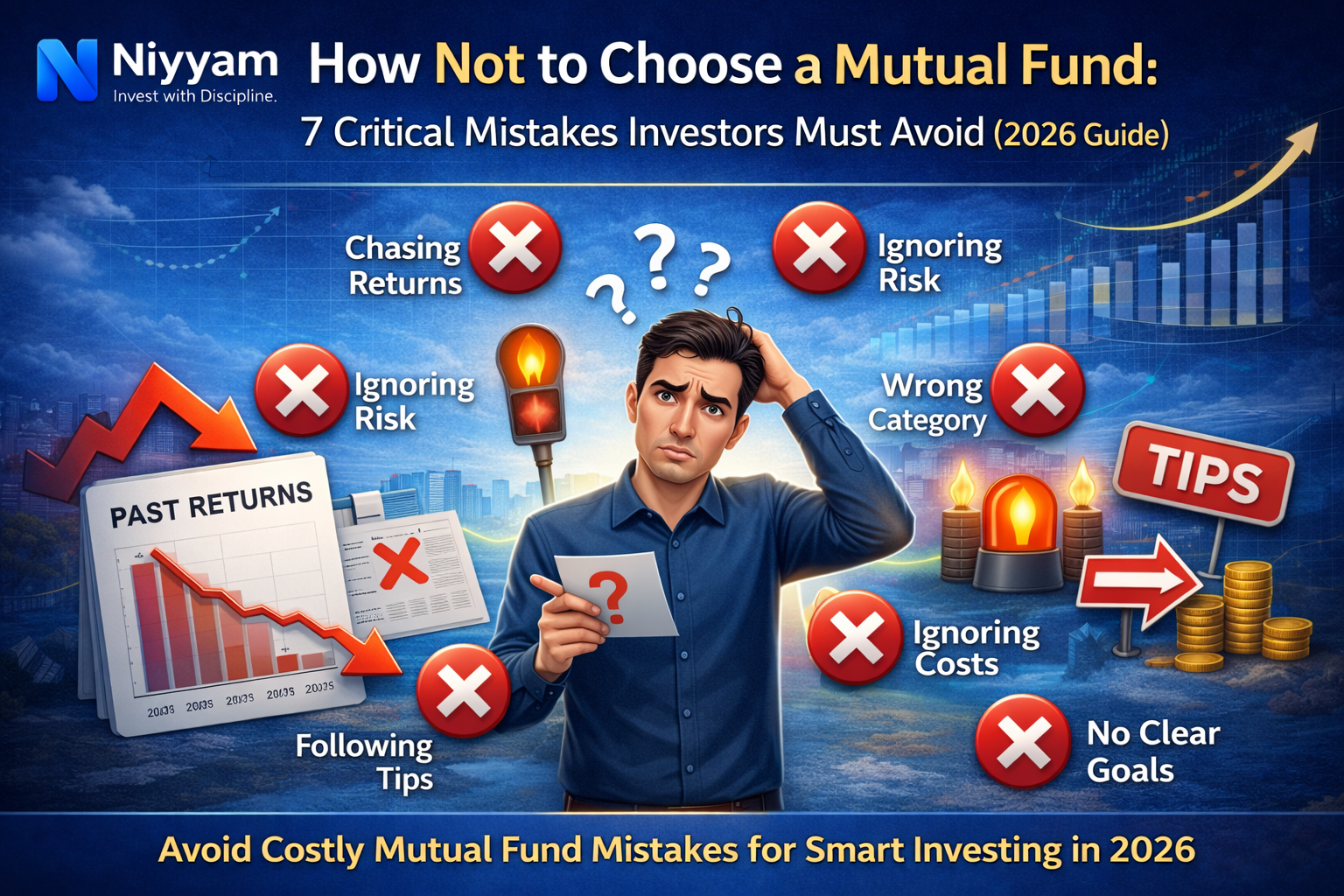
Many investors unknowingly repeat the same mistakes:
- Chasing returns
- Ignoring risk
- Following the tips blindly
These mistakes may seem small at first, but over time they lead to inconsistent performance, loss of confidence, and missed opportunities to create wealth.
Understanding these mistakes is the first step toward becoming a disciplined and successful investor.
💡 Key Takeaways
- Return Chasing is the Biggest Trap: Past performance does not guarantee future returns.
- Risk Alignment is Critical: A fund must match your financial goals and risk tolerance.
- Category Selection Matters Most: Choosing the wrong category leads to poor outcomes regardless of fund quality.
- Avoid Noise and Tips: Investment decisions should be data-driven, not influenced by opinions.
- Process Over Emotion: Long-term success comes from discipline, not prediction.
Why Understanding Mistakes is Important
Most investors assume:
“If I select the right fund, everything else will work.”
However, even a good fund can deliver poor results if selected incorrectly or used incorrectly.
Important Insight:
- Investment success depends more on behavior than product selection
Refer:
How to Choose the Right Mutual Funds for a Lump Sum Investment in India (2026 Framework)
Mistake 1: Chasing Past Returns
This is the most common and dangerous mistake.
Investors tend to select funds based on:
- Top-performing lists
- Recent 1-year returns
- Trending funds
Why This Fails:
Markets move in cycles. A fund that performed well recently may not perform well in the future.
Real Impact:
- Buying at peak
- Entering late
- Experiencing correction
Key Insight:
- High past returns often indicate higher risk, not future opportunity
Refer:
How to Compare Mutual Funds in India (5 Key Metrics Every Investor Must Check)
Mistake 2: Ignoring Risk Profile
Many investors focus only on returns and ignore risk.
Example:
A conservative investor chooses a small-cap fund because it shows high returns.
When markets fall, the fund drops sharply, leading to panic selling.
Result:
- Emotional stress
- Early exit
- Losses
Important Insight:
- The best fund is not the one with the highest returns, but the one you can stay invested in
Mistake 3: Choosing the Wrong Fund Category
This is a structural mistake.
Example:
- Investing in equity funds for short-term goals
- Using aggressive funds for low-risk needs
Consequences:
- Volatility
- Mismatch with expectations
- Forced withdrawals
Key Insight:
- Wrong category selection cannot be corrected by choosing a good fund within that category
Refer:
Types of Mutual Funds in India: Equity, Debt, and Hybrid Explained
Mistake 4: Following Tips Blindly
Many investors rely on:
- Friends
- Social media
- Market “experts”
Problem:
- Advice is generic
- Does not consider your financial situation
- No accountability
Real Risk:
- Entering the wrong funds
- Exiting at the wrong time
Important Insight:
- What works for others may not work for you
Mistake 5: Ignoring Expense Ratio
Expense ratio may seem small, but its impact is large.
Example:
A difference of 1% annually can significantly reduce your final corpus over 10–15 years.
Why Investors Ignore It:
- Focus on returns
- Lack of awareness
Key Insight:
- Cost is one of the few factors you can control — use it wisely
Refer:
What is Expense Ratio in Mutual Funds? How It Affects Your Returns (2026 Guide)
Mistake 6: Over-Diversification
Investors often believe that more funds mean more safety.
Reality:
- Too many funds create overlap
- Portfolio becomes difficult to manage
- Returns get diluted
Ideal Strategy:
- Maintain a focused portfolio
- Avoid unnecessary duplication
Important Insight:
- Diversification protects, but over-diversification weakens performance
Mistake 7: Investing Without Clear Goals
Many investors start investing without defining a purpose.
Consequences:
- Random decisions
- Lack of discipline
- Frequent withdrawals
Example:
Investor invests without a goal → market falls → withdraws → misses recovery
Key Insight:
- Clarity of goal creates clarity of action
Refer:
Goal-Based Investing in Mutual Funds: How to Plan SIPs for Financial Goals (2026 Guide)

How to Avoid These Mistakes (Practical Framework)
To invest effectively, follow a structured approach:
Step 1: Define Your Goal
Step 2: Choose an Appropriate Category
Step 3: Evaluate Risk and Cost
Step 4: Stay Disciplined
Important Insight:
- A simple process followed consistently beats complex strategies
Refer:
How to Read a Mutual Fund Factsheet (Step-by-Step Guide for Smart Investors 2026)
Quick Rule of Thumb
Before investing, ask:
- Why am I investing?
- What is my time horizon?
- Can I handle this risk?
Golden Rule:
- If you don’t understand the investment, don’t invest in it
Mini Case Study
Investor A
- Selects the top-performing fund
- Ignores risk and category
- Exits during market fall
Investor B
- Understands fundamentals
- Chooses suitable category
- Stays invested long-term
Outcome:
Investor B builds stable wealth, while Investor A struggles with inconsistent returns.
Key Insight:
- Discipline and process outperform short-term decisions
Frequently Asked Questions (FAQs)
1. What is the biggest mistake investors make?
Chasing past returns without understanding risk.
2. How many mutual funds should I invest in?
Ideally, 2–4 funds are sufficient.
3. Should I follow expert recommendations?
You can consider them, but always validate based on your goals.
4. Is risk more important than return?
Yes, because risk determines whether you stay invested.
5. Can beginners avoid these mistakes?
Yes, by following a structured and disciplined approach.
6. How do I know if I selected the wrong fund?
If it does not match your goal, risk profile, or time horizon.
Final Thought
Mutual fund investing is not about finding the perfect fund.
It is about avoiding predictable mistakes.
Success in investing does not come from doing extraordinary things.
It comes from consistently avoiding ordinary mistakes.
Disclaimer
This content is for educational purposes only and does not constitute investment advice.
Mutual fund investments are subject to market risks. Investors should read all scheme-related documents carefully before investing and consider their financial goals, risk tolerance, and investment horizon.
Share this guide with your friends, family, and colleagues to help them make better financial decisions.
If this article helped you, share it with at least one person who needs this guidance.
Leave a Reply