
By Ashok Prasad, Founder, Niyyam
Published: March 2026
Introduction
Most mutual fund advice focuses on long-term investing.
But what if your goal is just 1 to 3 years away?
For example:
- Buying a car
- Planning a vacation
- Paying a down payment
- Building an emergency buffer
The challenge is:
How do you invest in mutual funds for short-term goals without taking unnecessary risk?
Because in the short term:
- Markets are unpredictable
- Equity can be volatile
- Wrong choices can lead to losses
Many investors make the mistake of chasing returns instead of protecting capital.
The truth is:
Short-term investing is not about maximizing returns. It is about minimizing risk while achieving your goal.
💡 Key Takeaways
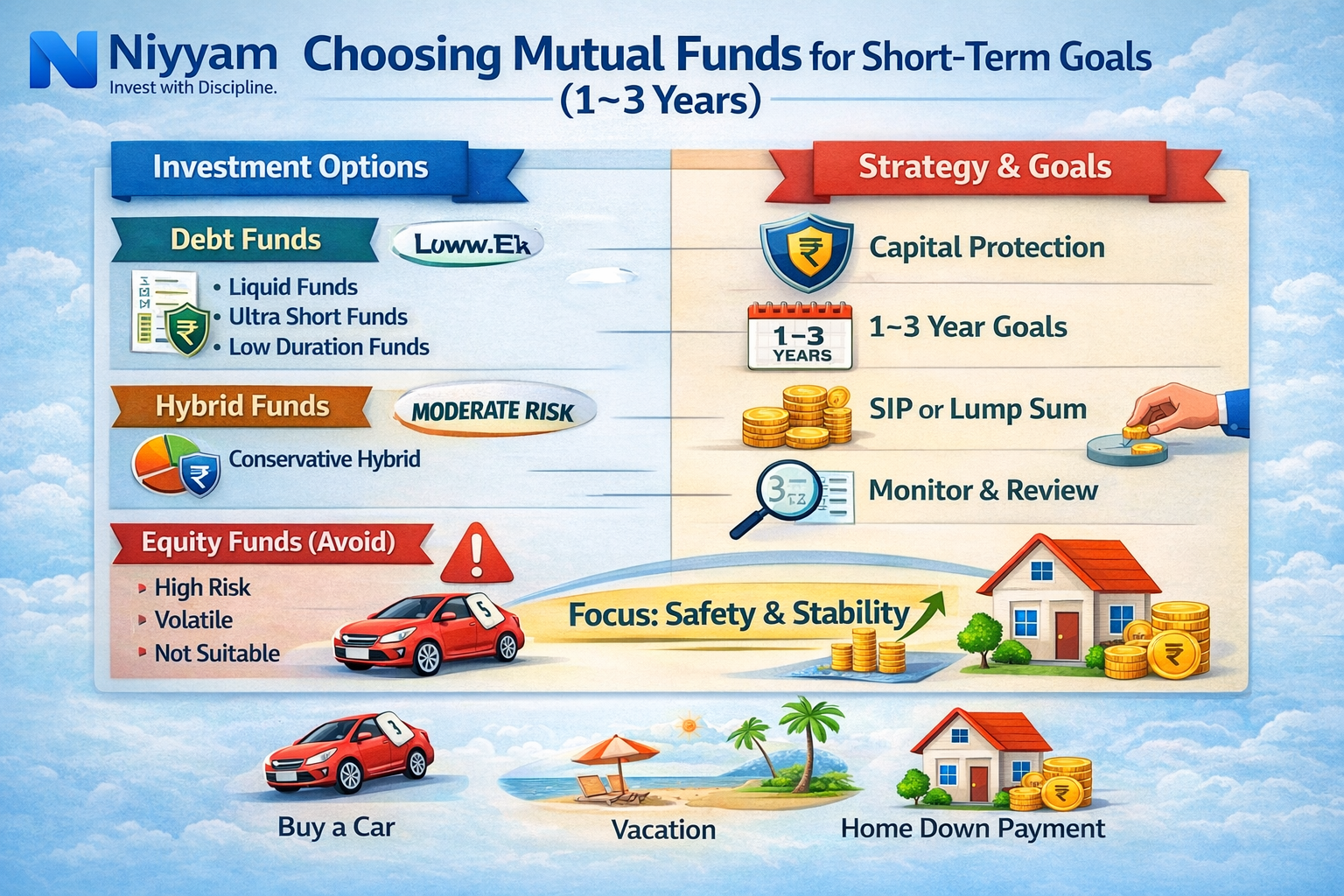
- Capital protection should be the primary focus for 1–3 year goals
- Debt funds are generally the most suitable option
- Limited hybrid exposure can be used cautiously
- Equity funds are not ideal for short-term goals
- Liquidity and stability are more important than returns
- Proper fund selection reduces risk significantly
If you are new, it is important to understand what is a mutual fund and how it works, because that forms the base of your decision-making.
Why Short-Term Investing Is Different
Short-term investing behaves very differently from long-term investing.
Key Differences
- Less time to recover from losses
- Higher sensitivity to volatility
- Lower margin for error
In long-term investing:
- Time reduces risk
In short-term investing:
- Wrong decisions increase risk significantly
Expected Returns for 1–3 Years (Reality Check)
Before selecting funds, you must set realistic expectations.
Typical Return Range
- Liquid funds: 4% to 6%
- Ultra short duration funds: 5% to 6.5%
- Low duration funds: 6% to 7%
- Conservative hybrid funds: 6% to 8%
Important Insight
- Returns are lower because risk is controlled
- Trying to increase returns increases risk
If you want to understand broader expectations, refer to how much return can you expect from mutual funds in India.
Biggest Mistake Investors Make
Many investors:
- Invest in equity funds for short-term goals
- Expect quick, high returns
This is risky because:
- Markets can fall anytime
- Recovery may take years
Ideal Mutual Fund Types for Short-Term Goals
Debt Funds (Primary Choice)
Debt funds are the safest mutual fund category for short-term investing.
Advantages
- Lower volatility
- Predictable returns
- Better capital protection
Types of Debt Funds to Consider
- Liquid funds
- Ultra-short duration funds
- Low-duration funds
These are designed for:
- Short-term horizons
- Stability
Conservative Hybrid Funds (Limited Use)
- Small equity exposure
- Slightly higher returns than pure debt
- Moderate risk
Funds to Avoid
Avoid:
- Mid-cap funds
- Small-cap funds
- Sectoral funds
These carry high volatility and are not suitable.
Fund Selection Checklist (Very Important)
Before choosing any fund, check:
- Low volatility history
- Consistent performance
- Short portfolio duration
- High liquidity
- Low expense ratio
To understand cost impact, read what is expense ratio in mutual funds and how it affects your returns.
Step-by-Step Investment Strategy
Step 1: Define Your Goal
- Exact amount required
- Clear timeline
Step 2: Choose Asset Allocation
- 80%–100% in debt funds
- 0%–20% in conservative hybrid
Step 3: Decide Investment Mode
- Lump sum for immediate deployment
- SIP if investing gradually
To understand better, refer to SIP vs lump sum which is better for beginners.
Step 4: Monitor Periodically
- Review every 3–6 months
- Avoid frequent changes
Real-Life Scenario 1 (1-Year Goal)
Profile
- Goal: ₹3 lakh in 1 year
Strategy
- 100% liquid funds
Outcome
- Stable returns
- Minimal risk
Real-Life Scenario 2 (2-Year Goal)
Profile
- Goal: ₹5 lakh
Strategy
- Liquid + ultra-short duration funds
Outcome
- Better returns than a savings account
- Low volatility
Real-Life Scenario 3 (3-Year Goal)
Profile
- Goal: ₹10 lakh
Strategy
- 80% debt funds
- 20% conservative hybrid
Outcome
- Balanced return and stability
Risk Management Strategy
Avoid Equity Exposure
- Equity increases volatility
- Not suitable for short-term
Diversify Across Funds
- Use 2–3 funds
- Avoid concentration risk
Keep Emergency Fund Separate
- Do not mix goals
Stay Disciplined
- Avoid unnecessary changes
Taxation in Short-Term Investing
Debt Funds
- Gains are taxed as per the income slab
Hybrid Funds
- Tax depends on equity exposure
To understand clearly, refer to the mutual fund taxation in India explained.
Decision Framework (Quick Guide)
If your goal is:
- Less than 1 year → Avoid mutual funds
- 1–2 years → Liquid / ultra short funds
- 2–3 years → Low duration + hybrid mix
If your risk tolerance is:
- Low → 100% debt
- Moderate → Small hybrid allocation
If you need:
- Stability → Debt funds
- Slight growth → Hybrid funds
Common Mistakes to Avoid
Chasing High Returns
High return = high risk.
Ignoring Risk
Short-term investing is risk-sensitive.
Over-diversification
Too many funds reduce clarity.
Frequent Switching
Destroys stability.
No Clear Goal
Leads to poor decisions.
When Should You Avoid Mutual Funds?
Avoid mutual funds if:
- Your investment horizon is less than 1 year
- You need guaranteed returns
- You cannot tolerate any fluctuation
In such cases, you can consider fixed deposits.
You can compare options through mutual funds vs fixed deposits where should you invest in India.

Advanced Insight: Balance Between Safety and Returns
Short-term investing is about balance:
- Too safe → low returns
- Too aggressive → risk of loss
The ideal approach is:
Controlled risk with reasonable return expectations
Frequently Asked Questions (FAQs)
Can I invest in equity funds for short-term goals?
Not recommended due to volatility.
Which mutual fund is safest?
Liquid and ultra short duration funds.
Can I use SIP?
Yes, but lump sum may also be effective.
Are returns guaranteed?
No, but risk is lower in debt funds.
How often should I review?
Every 3 to 6 months.
What if the market falls?
Debt funds are less affected than equity funds.
Final Thought
Short-term investing is not about chasing returns.
It is about:
- Protecting your capital
- Achieving your goal
- Avoiding unnecessary risk
If you stay disciplined and follow the right strategy:
You can achieve your short-term goals with confidence and stability.
Disclaimer
This content is for educational purposes only and does not constitute investment advice.
Mutual fund investments are subject to market risks. Investors should read all scheme-related documents carefully before investing and consider their financial goals, risk tolerance, and investment horizon.
Share this guide with your friends, family, and colleagues to help them make better financial decisions.
If this article helped you, share it with at least one person who needs this guidance.
Leave a Reply