
By Ashok Prasad, Founder, Niyyam
Published: March 2026
Introduction
Most investors spend a lot of time trying to find the best mutual funds.
But very few ask a more important question:
“How do I identify a bad mutual fund?”
This is critical because:
- A bad fund can destroy long-term returns
- It can increase the risk unnecessarily
- It can delay your financial goals
In reality, successful investing is not just about picking winners — it is about avoiding losers consistently.
If you are still building your foundation, it is useful to revisit how mutual funds work in India (complete beginner guide) to understand how funds operate before evaluating them.
How to Identify a Bad Mutual Fund
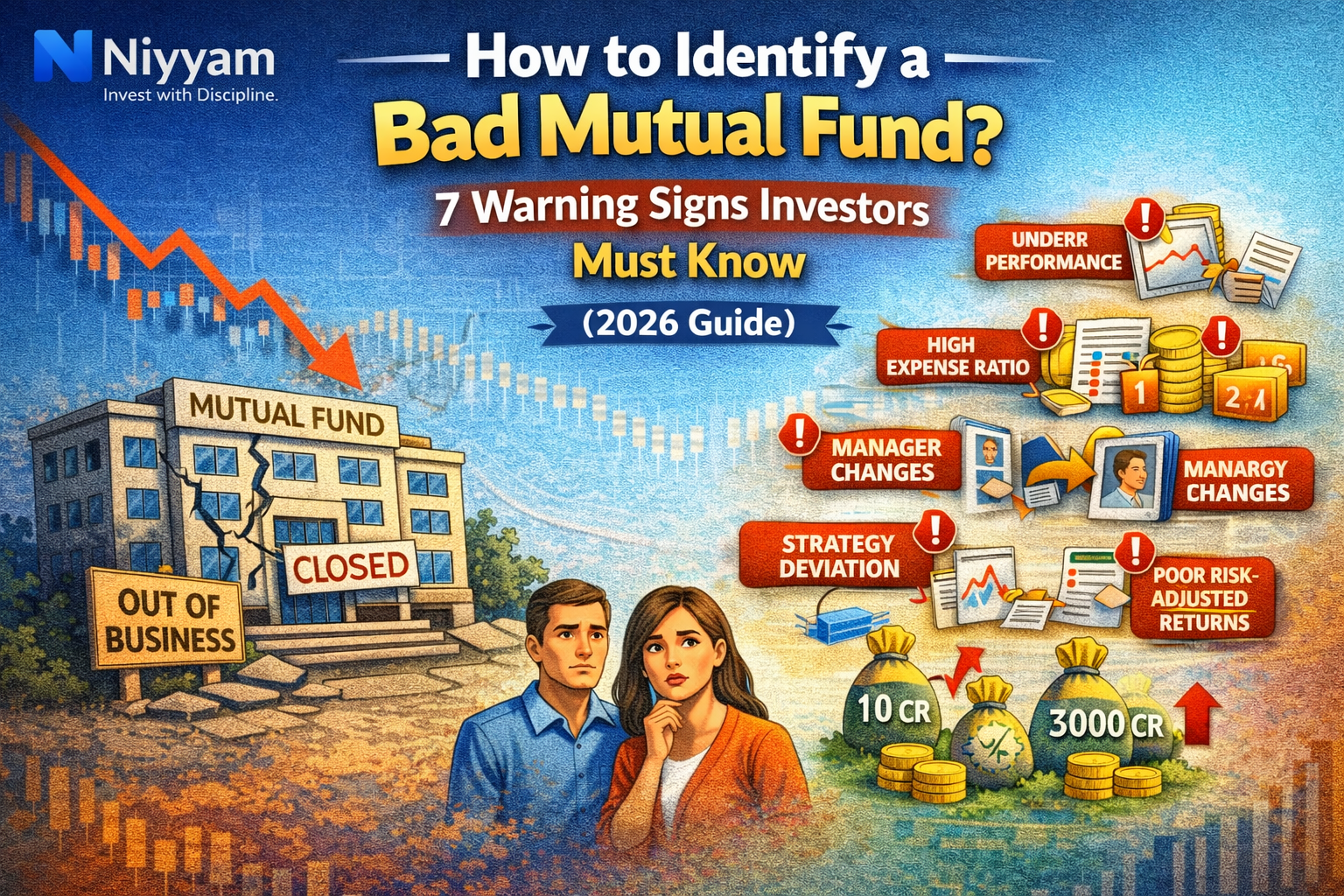
A bad mutual fund is one that consistently underperforms, has high costs, shows unstable management, deviates from its strategy, and delivers poor risk-adjusted returns.
💡 Key Takeaways
- Consistent underperformance is the biggest red flag
- High expense ratio reduces long-term returns
- Frequent fund manager changes indicate instability
- Strategy deviation makes the fund unpredictable
- Risk-adjusted returns matter more than absolute returns
- Regular review is essential to avoid holding bad funds
Why Identifying Bad Funds is Important
Impact of a Bad Mutual Fund
| Factor | Impact |
|---|---|
| Returns | Lower than benchmark |
| Risk | Higher than necessary |
| Wealth creation | Slower |
| Opportunity cost | Very high |
Insight
A bad mutual fund doesn’t just reduce returns — it wastes valuable time.
7 Warning Signs of a Bad Mutual Fund
1. Consistent Underperformance
This is the most critical indicator.
What to Check
| Metric | Red Flag |
|---|---|
| 3-year returns | Below category average |
| 5-year returns | Below benchmark |
| Rolling returns | Inconsistent |
Insight
One bad year is normal — consistent underperformance is not.
2. High Expense Ratio
Costs silently reduce your wealth.
Expense Impact
| Expense Ratio | Interpretation |
|---|---|
| 0.5%–1% | Good |
| 1%–2% | Acceptable |
| Above 2% | Red flag |
Insight
Higher expenses reduce compounding over time.
To understand cost differences, refer to direct vs regular mutual funds, which is better for investors.

3. Frequent Fund Manager Changes
Fund managers play a crucial role.
What to Watch
| Factor | Concern |
|---|---|
| Frequent changes | Lack of stability |
| Short tenure | No proven track record |
Insight
Stable fund management often leads to consistent performance.
4. Deviation from Investment Strategy
Every fund has a defined objective.
Red Flags
| Situation | Problem |
|---|---|
| Large-cap fund investing in small caps | Increased risk |
| Debt fund taking equity-like exposure | Misalignment |
Insight
If a fund does not follow its mandate, it becomes unpredictable.
5. Poor Risk-Adjusted Returns
Returns alone are not enough.
What to Check
| Metric | Meaning |
|---|---|
| Sharpe Ratio | Return vs risk |
| Standard Deviation | Volatility |
| Downside Risk | Loss potential |
Insight
A good fund balances risk and return effectively.
6. Very Small or Very Large AUM
Fund size impacts performance.
AUM Analysis
| AUM Size | Concern |
|---|---|
| Too small | Liquidity issues |
| Too large | Difficult to manage |
Insight
Moderate AUM funds often perform better.
7. Poor Downside Protection
Market corrections are inevitable.
What to Check
| Scenario | Ideal Behavior |
|---|---|
| Market fall | Lower fall than benchmark |
| Recovery | Faster bounce back |
Insight
Good funds protect better during downturns.
To understand market behavior, refer to best SIP date does timing really matter in mutual funds.
Real-Life Comparison
Good Fund vs Bad Fund
| Factor | Good Fund | Bad Fund |
|---|---|---|
| Performance | Consistent | Unstable |
| Risk | Controlled | High |
| Strategy | Clear | Unclear |
| Costs | Reasonable | High |
How Often Should You Review Your Mutual Funds?
Investing and forgetting completely is a mistake.
Ideal Review Frequency
| Investor Type | Frequency |
|---|---|
| Beginner | Every 6 months |
| Experienced | Every 6–12 months |
| Active investor | Quarterly |
What to Check
- Performance vs category
- Expense ratio
- Fund manager stability
- Risk metrics
Insight
Regular review helps you identify bad funds early.
Can a Good Fund Become a Bad Fund?
Yes, and this is very important.
Reasons
| Reason | Impact |
|---|---|
| Fund manager change | Strategy shift |
| Increase in AUM | Reduced flexibility |
| Market cycle change | Performance drop |
| Style drift | Risk mismatch |
Insight
Past performance does not guarantee future performance.
Common Mistakes Investors Make
Mistakes
- Chasing recent top performers
- Ignoring expense ratio
- Not reviewing investments
- Holding underperforming funds too long
To avoid portfolio mistakes, refer to how many mutual funds should you have in your portfolio (2026 guide).
When Should You Exit a Bad Mutual Fund?
Exit Signals
| Situation | Action |
|---|---|
| Consistent underperformance | Exit |
| Strategy deviation | Exit |
| High cost vs peers | Switch |
Should You Switch Immediately?
Decision Guide
| Scenario | Action |
|---|---|
| Temporary underperformance | Wait |
| Structural issues | Exit |
| Market downturn | Continue SIP |
SIP Investors: What Should You Do?
SIP Strategy
| Situation | Action |
|---|---|
| Fund underperforming | Stop SIP |
| Better alternative available | Switch |
| Market fall | Continue SIP |
To understand long-term discipline, refer to can SIP make you crorepati real numbers time and strategy.

Simple 3-Step Rule to Identify a Bad Fund
Quick Filter
- Is it underperforming for 3+ years?
- Is the expense ratio higher than peers?
- Is the strategy inconsistent?
Insight
If the answer is Yes to 2 or more, consider exiting.
Decision Snapshot
Quick Checklist
| Question | Yes/No |
|---|---|
| Underperforming consistently? | |
| High expense ratio? | |
| Strategy unclear? |
Frequently Asked Questions (FAQs)
How do I identify a bad mutual fund?
Check for consistent underperformance, high costs, unstable management, and poor risk-adjusted returns.
Should I exit immediately?
Only if underperformance is consistent and structural issues exist.
Can a bad fund recover?
Sometimes, but relying on recovery without analysis is risky.
How often should I review funds?
Every 6–12 months is ideal.
Final Verdict
A good mutual fund helps you build wealth.
A bad mutual fund:
- Reduces your returns
- Increases your risk
- Delays your goals
Final Thought
Successful investing is not about finding the perfect fund.
It is about:
Avoiding bad funds consistently and staying disciplined.
If you master this:
Your long-term returns will improve significantly.
Disclaimer
This content is for educational purposes only and does not constitute investment advice.
Mutual fund investments are subject to market risks. Investors should read all scheme-related documents carefully before investing and consider their financial goals, risk tolerance, and investment horizon.
Share this guide with your friends, family, and colleagues to help them make better financial decisions.
If this article helped you, share it with at least one person who needs this guidance.
Leave a Reply