
By Ashok Prasad, Founder, Niyyam
Published: March 2026
Introduction
Most investors start their journey with a fixed SIP amount.
For example:
- ₹5,000 per month
- ₹10,000 per month
But here is the problem:
If your SIP remains constant, your wealth growth becomes limited.
Your income increases over time through:
- Salary hikes
- Bonuses
- Business growth
So your investments should also increase.
This is where the Step-Up SIP strategy comes in.
Step-Up SIP Strategy: What It Is and Why It Matters?
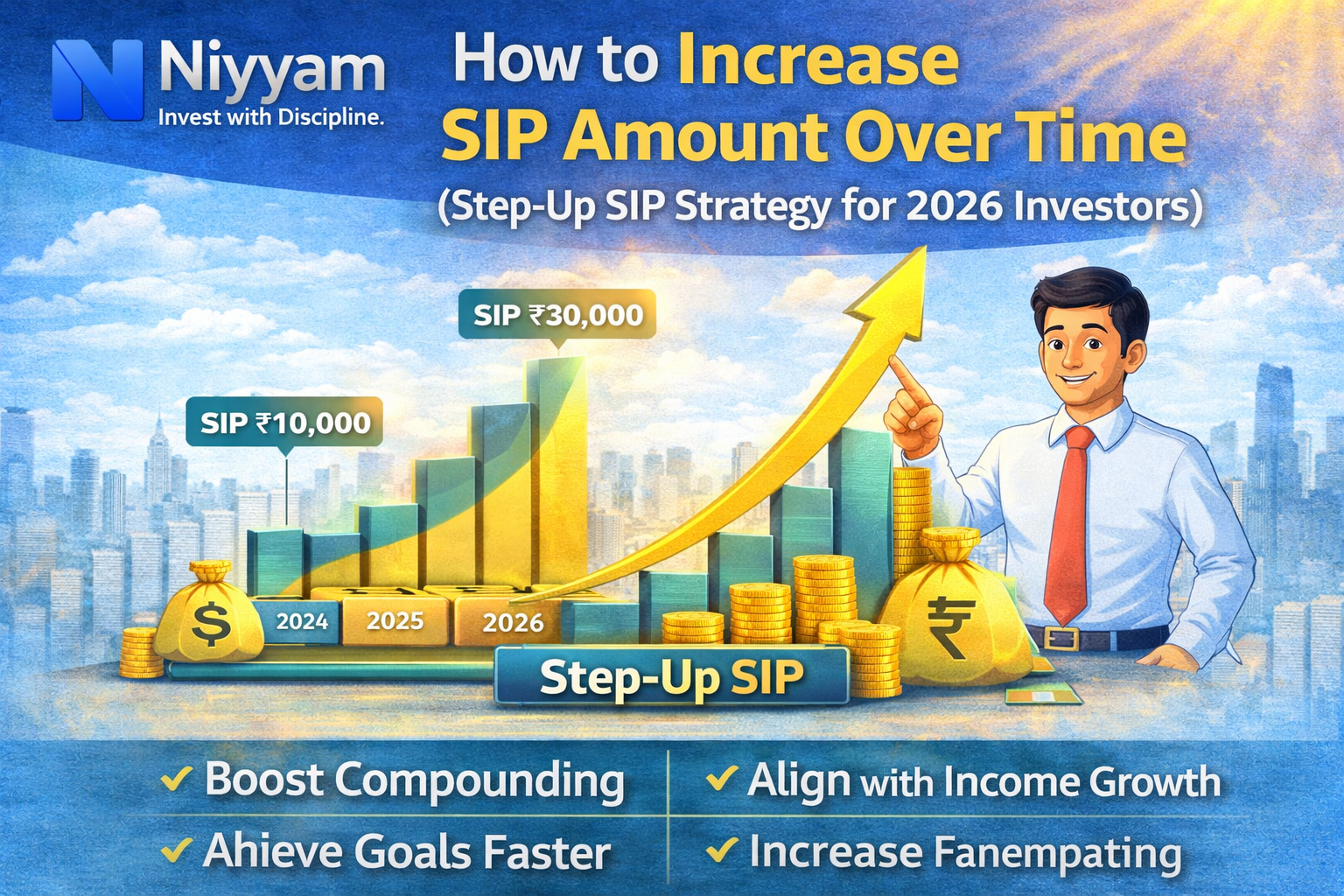
Step-Up SIP is a strategy where you increase your SIP amount every year to match your income growth and significantly boost long-term wealth creation.
- It helps you invest more as your salary increases
- It improves compounding impact
- It can generate 2–3x higher returns than a fixed SIP
What is Step-Up SIP?
A Step-Up SIP means:
Increasing your SIP amount periodically (usually every year) instead of keeping it constant.
Step-Up SIP: Simple Definition
Step-Up SIP is a strategy where you increase your SIP amount annually to match your growing income and boost long-term wealth creation.
💡 Key Takeaways
- Step-Up SIP helps you increase investments gradually without burden
- Even a 10% yearly increase can double your final corpus
- It aligns your investments with your income growth
- It significantly boosts long-term wealth through compounding
- It is one of the most powerful yet underused strategies in India
Why You Should Increase SIP Over Time
Problem with Fixed SIP
| Factor | Fixed SIP |
|---|---|
| Investment growth | Constant |
| Wealth potential | Limited |
| Inflation impact | High |
| Income alignment | Poor |
Advantage of Step-Up SIP
| Factor | Step-Up SIP |
|---|---|
| Investment growth | Increasing |
| Wealth potential | High |
| Inflation protection | Better |
| Income alignment | Strong |
Insight
Your income grows every year — your SIP should too.
Step-Up SIP vs Regular SIP (Real Comparison)
Example Scenario
- Starting SIP: ₹10,000/month
- Duration: 20 years
- Returns: 12%
Comparison Table
| Strategy | Total Investment | Final Value |
|---|---|---|
| Regular SIP | ₹24 lakh | ~₹99 lakh |
| Step-Up SIP (10% yearly) | ~₹76 lakh | ~₹2.5–3 crore |
Insight
Step-Up SIP can generate 2–3 times more wealth than a regular SIP.
How Step-Up SIP Works
Example Breakdown
| Year | Monthly SIP | Annual Investment |
|---|---|---|
| Year 1 | ₹10,000 | ₹1,20,000 |
| Year 2 | ₹11,000 | ₹1,32,000 |
| Year 3 | ₹12,100 | ₹1,45,200 |
| Year 5 | ₹14,641 | ₹1,75,692 |
| Year 10 | ₹23,579 | ₹2,82,948 |
Insight
Your investment grows without feeling like a burden.
Ideal Step-Up Percentage
Recommended Step-Up Rates
| Income Growth | Suggested SIP Increase |
|---|---|
| 5% hike | 5–7% step-up |
| 10% hike | 10–12% step-up |
| 15% hike | 12–15% step-up |
Insight
A 10% annual increase is a simple and powerful rule.
When Should You Increase SIP?
Ideal Timing
| Event | Action |
|---|---|
| Salary hike | Increase SIP |
| Bonus received | Increase SIP or invest lump sum |
| New income source | Add new SIP |
| Reduced expenses | Increase SIP |
Who Should Use Step-Up SIP?
Suitable For
- Salaried employees
- Young investors
- Long-term investors
- Investors aiming for financial independence
Step-Up SIP for Different Goals
Goal-Based Strategy
| Goal | Strategy |
|---|---|
| Retirement | High step-up (10–15%) |
| Child education | Moderate step-up |
| Wealth creation | Aggressive step-up |
| Short-term goals | Not required |
Common Mistakes to Avoid
Mistakes
- Increasing SIP too aggressively
- Ignoring the emergency fund
- Stopping SIP during market fall
- Not reviewing annually
To understand behavioral mistakes, refer to why most SIP investors fail to build wealth.
Step-Up SIP vs Lump Sum Investment
Comparison Table
| Factor | Step-Up SIP | Lump Sum |
|---|---|---|
| Risk | Lower | Higher |
| Timing dependency | Low | High |
| Discipline | High | Low |
| Flexibility | High | Low |
Step-Up SIP in Different Market Conditions
Market Impact
| Market Phase | Strategy |
|---|---|
| Bull market | Continue SIP |
| Bear market | Increase SIP |
| Sideways market | Stay consistent |
Insight
Market downturns are the best time to increase SIP.
Psychological Advantage
Behavioral Benefits
| Factor | Benefit |
|---|---|
| Discipline | Builds habit |
| Confidence | Increases over time |
| Wealth mindset | Strengthens |
How to Start Step-Up SIP
Step-by-Step Process
- Start with a comfortable SIP amount
- Decide the annual increase percentage (5–10%)
- Set a reminder for the yearly increase
- Review investments annually
- Stay consistent
Advanced Strategy: Bonus Step-Up
Smart Approach
- Use annual bonus to:
- Increase SIP permanently
- Add a lump sum investment
Decision Snapshot
Should You Use Step-Up SIP?
| If You Want | Action |
|---|---|
| Faster wealth creation | Use Step-Up SIP |
| Stable investment | Regular SIP |
| Maximum compounding | Step-Up SIP |
| Low effort strategy | Regular SIP |
Frequently Asked Questions (FAQs)
What is Step-Up SIP?
Step-Up SIP is a strategy where you increase your SIP amount every year to boost long-term returns.
Is Step-Up SIP better than regular SIP?
Yes, Step-Up SIP generates higher returns due to increasing investment and compounding.
How much should I increase SIP every year?
A 5–10% annual increase is ideal for most investors.
Can Step-Up SIP make you crorepati?
Yes, Step-Up SIP significantly increases your chances of reaching a ₹1 crore portfolio.
Final Verdict
A fixed SIP is good.
But a Step-Up SIP is powerful.
- Regular SIP → Wealth creation
- Step-Up SIP → Accelerated wealth creation
Final Thought
If you want to build serious wealth:
Do not just invest — increase your investment every year.
That small yearly increase can:
- Multiply your returns
- Fast-track your financial goals
Disclaimer
This content is for educational purposes only and does not constitute investment advice.
Mutual fund investments are subject to market risks. Investors should read all scheme-related documents carefully before investing and consider their financial goals, risk tolerance, and investment horizon.
Share this guide with your friends, family, and colleagues to help them make better financial decisions.
If this article helped you, share it with at least one person who needs this guidance.
Leave a Reply