
By Ashok Prasad, Founder, Niyyam
Published: March 2026
Market crashes are the most feared phase for investors.
Portfolio values fall, news turns negative, and uncertainty spreads rapidly. Many investors start questioning their decisions:
- “Should I stop my SIP?”
- “Is this the right time to exit?”
- “What if markets fall further?”
This is exactly where most investors go wrong.
They react emotionally instead of acting strategically.
The truth is:
Market crashes are not the time to panic — they are the time to invest wisely.
In fact, some of the best long-term investment opportunities are created during market downturns.
In this guide, you will learn how to invest during a market crash and how to turn volatility into long-term wealth creation.
💡 Key Takeaways
- Market Crashes Create Opportunities: Lower prices allow you to accumulate more units.
- Continue SIP Without Fail: SIP works best during falling markets.
- Avoid Emotional Decisions: Panic actions destroy long-term returns.
- Invest Lump Sum Gradually: Use phased investing to reduce risk.
- Stay Focused on Long-Term Goals: Market cycles are temporary.
What is a Market Crash?
A market crash is a sharp and sudden fall in stock market prices, often triggered by:
- Economic slowdown
- Global uncertainty
- Investor panic
- Market correction
Example:
A decline of 20–30% within a short period is considered a crash.
Important Insight:
- Market crashes are a normal part of investing
Why Market Crashes Are Actually Beneficial
Although they feel uncomfortable, market crashes offer strong advantages.
1. Lower Investment Prices
You can buy more units at a lower NAV.
2. Higher Future Returns
Investments made during downturns often generate better returns.
3. Rupee Cost Averaging Advantage
SIP buys more units when markets fall.
Key Insight:
- Wealth is created when you invest during fear, not comfort
Refer:
What is Rupee Cost Averaging in SIP? How It Works with Real Examples (2026 Guide)
Common Mistakes Investors Make During a Market Crash
1. Panic Selling
Locks in losses permanently.
2. Stopping SIP
Reduces long-term returns.
3. Waiting for Perfect Timing
Leads to missed opportunities.
4. Following Market Noise
Leads to emotional decisions.
Important Insight:
- Investor behavior causes losses, not market decline
Refer:
How to Recover from Mutual Fund Losses (Step-by-Step Strategy for 2026 Investors)
Smart Strategies to Invest During a Market Crash
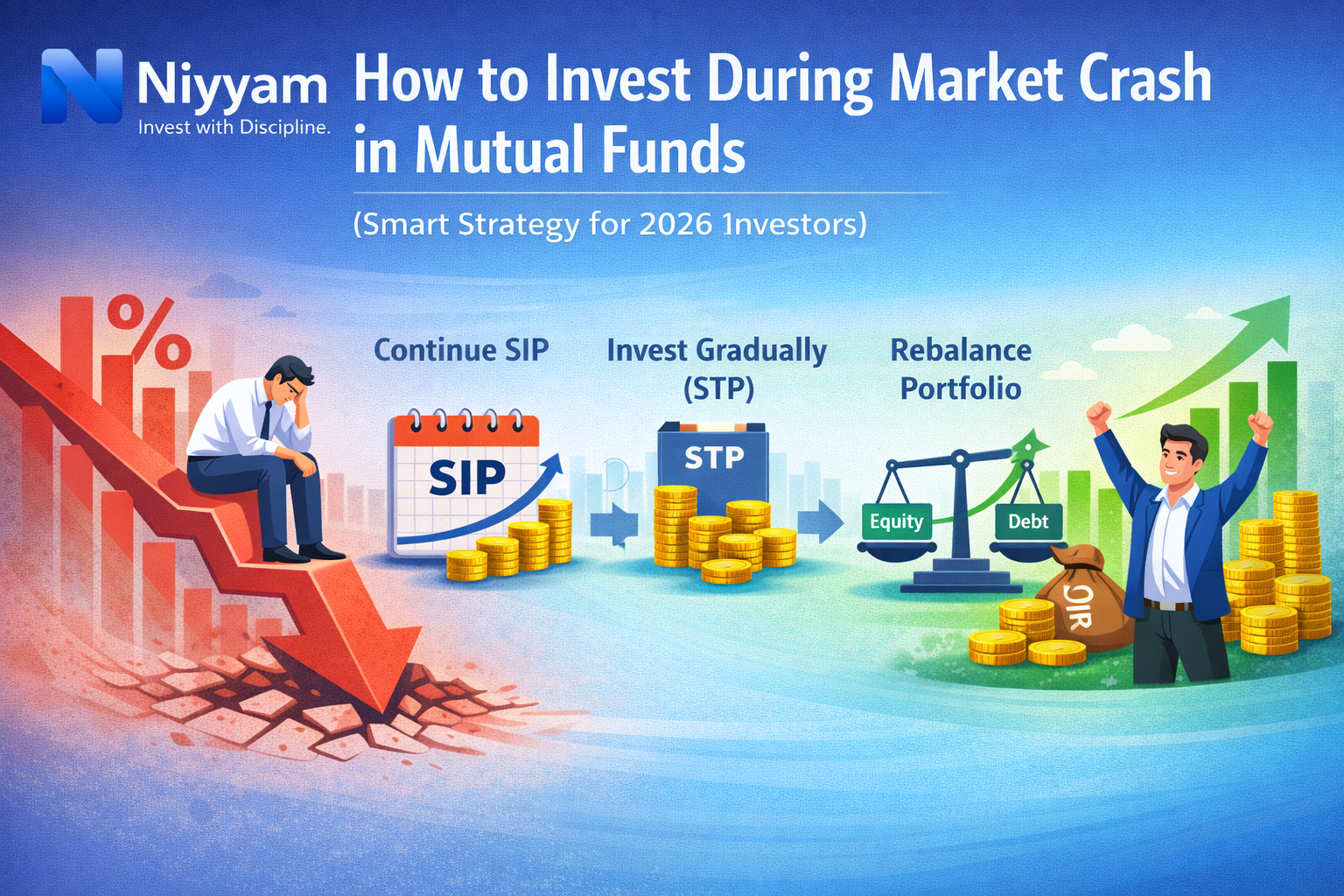
1. Continue Your SIP (Golden Rule)
SIP is your biggest advantage during a crash.
Why?
- More units at lower prices
- Lower average cost
- Better long-term returns
Key Insight:
- Stopping SIP during a crash is the biggest mistake
Refer:
How SIP Builds Wealth Through Compounding (With Simple Examples)
2. Invest Lump Sum Gradually (STP Strategy)
If you have surplus funds, avoid investing everything at once.
Smart Approach:
- Invest in phases over 3–6 months
- Use STP
Benefit:
- Reduces timing risk
- Utilizes volatility
Important Insight:
- Phased investing is better than market timing
Refer:
SIP vs SWP vs STP: What is the Difference and When Should You Use Each? (2026 Complete Guide)

3. Rebalance Your Portfolio
Market crashes disrupt asset allocation.
Example:
- Equity allocation reduces after a fall
Action:
- Gradually restore target allocation
Key Insight:
- Rebalancing improves long-term performance
4. Increase SIP During Market Fall
If financially possible, increase your SIP.
Why?
- More units at lower cost
- Faster wealth creation
Important Insight:
- Market downturns are the best time to invest more
5. Avoid Frequent Portfolio Checking
Checking daily increases anxiety and leads to poor decisions.
Key Insight:
- Ignore short-term volatility
Practical Investment Strategy During Market Crash
Step 1: Continue SIP
Never stop your existing investments
Step 2: Deploy Extra Cash Gradually
Invest 20–30% now and spread the rest
Step 3: Rebalance Portfolio
Maintain your asset allocation
Step 4: Avoid Emotional Decisions
Ignore noise and headlines
Step 5: Stay Focused on Goals
Keep long-term objectives in mind
Important Insight:
- A structured plan removes emotional mistakes
How Different Investors Should Act During a Market Crash
Not every investor should follow the same approach.
Beginner Investors
- Continue SIP
- Avoid frequent tracking
- Focus on discipline
Intermediate Investors
- Continue SIP
- Increase investments gradually
- Rebalance portfolio
Advanced Investors
- Invest a lump sum in phases
- Use STP strategically
- Take advantage of volatility
Key Insight:
- Your strategy should depend on your experience and financial situation
Real-Life Example
Investor A
- Stops SIP during a crash
- Waits for recovery
Result:
- Misses opportunity
- Lower returns
Investor B
- Continues SIP
- Invests more during a downturn
Result:
- Higher returns
- Faster recovery
Key Insight:
- Discipline always beats timing
What Should Beginners Do?
Simple Approach:
- Continue SIP
- Stay invested
- Avoid panic
Important Insight:
- Doing nothing is often the best decision
When Should You Be Careful?
Situations:
- Short-term goals
- Low risk tolerance
- High equity exposure
Action:
- Adjust allocation
Key Insight:
- Investment decisions should align with your goals
Common Myths About Market Crash
Myth 1: Wait for recovery before investing
Reality: You miss the best opportunities
Myth 2: SIP doesn’t work in falling markets
Reality: SIP works best in falling markets
Myth 3: Sell now and invest later
Reality: Most investors fail to re-enter
Important Insight:
- Market timing is extremely difficult
Long-Term Perspective
Reality:
- Every crash is temporary
- Markets recover and grow
Pattern:
- Crash → Recovery → Growth
Key Insight:
- Time in the market matters more than timing the market
Frequently Asked Questions (FAQs)
1. Should I stop SIP during a market crash?
No, continue SIP.
2. Is a market crash a good time to invest?
Yes, for long-term investors.
3. Should I invest a lump sum during a crash?
Yes, but gradually.
4. How long do crashes last?
They vary, but markets recover over time.
5. What is the biggest mistake?
Panic selling.
6. Can beginners invest during a crash?
Yes, with discipline.
Final Thought
Market crashes are not the end of your investment journey.
They are the most important phase of wealth creation.
Most investors lose money not because markets fall,
but because they react emotionally.
If you stay disciplined and consistent,
market crashes can become your biggest opportunity.
Disclaimer
This content is for educational purposes only and does not constitute investment advice.
Mutual fund investments are subject to market risks. Investors should read all scheme-related documents carefully before investing and consider their financial goals, risk tolerance, and investment horizon.
Share this guide with your friends, family, and colleagues to help them make better financial decisions.
If this article helped you, share it with at least one person who needs this guidance.
Leave a Reply