
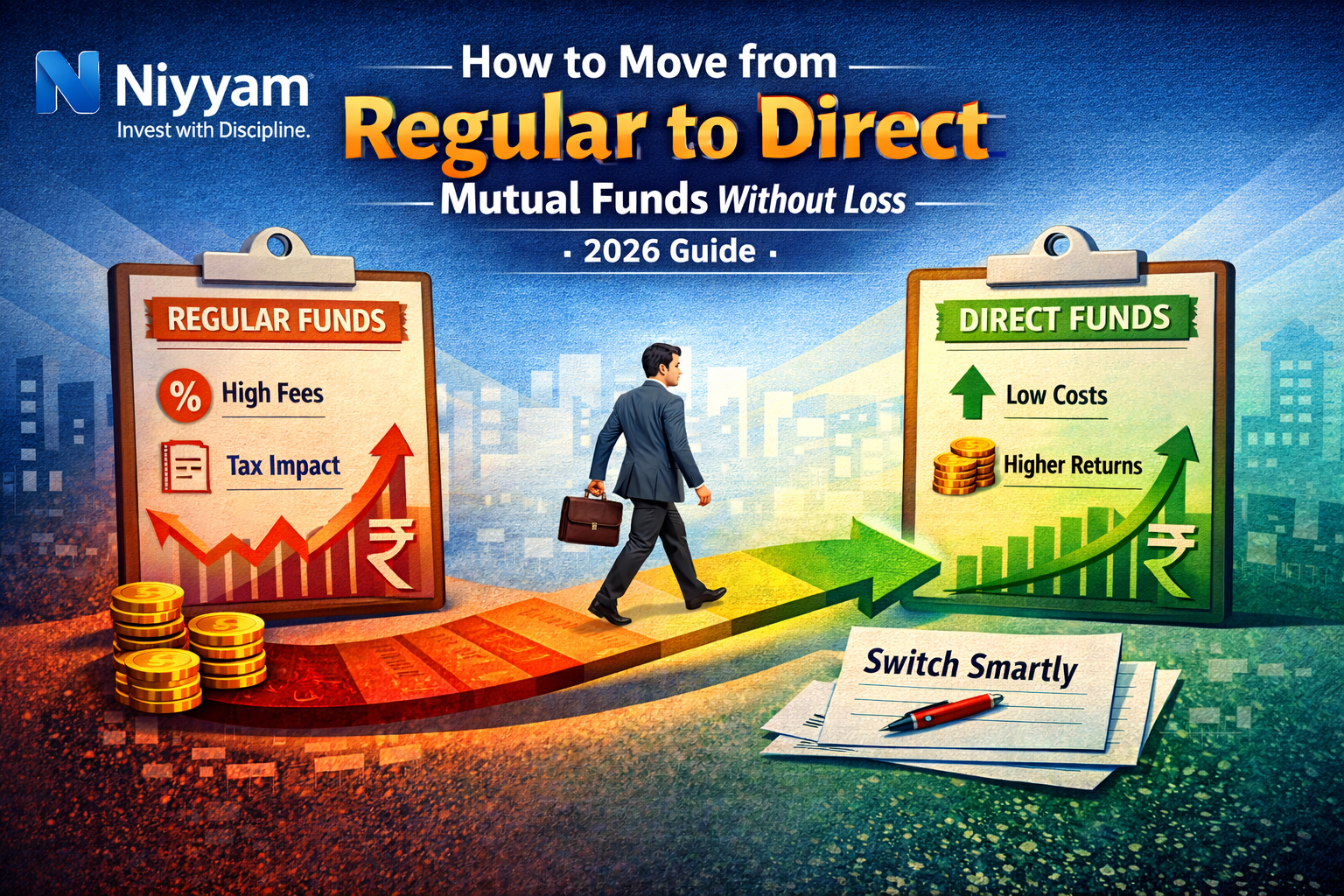
By Ashok Prasad, Founder, Niyyam
Published: March 2026
Introduction
Most Indian investors begin their mutual fund journey through:
- Banks
- Agents
- Brokers
These are called regular mutual funds.
At first, everything looks fine. But over time, you start noticing:
- Returns are slightly lower than expected
- Expense ratios are higher
- Hidden commissions are eating into your gains
Then you discover direct mutual funds.
They offer:
- Lower costs
- Better long-term returns
Now the confusion begins:
- Should I switch from regular to direct?
- Will I lose money if I switch?
- Is there a tax or exit load involved?
This confusion stops many investors from taking action.
So the real question is:
How can you move from regular to direct mutual funds without loss?
Direct Answer
You can move from regular to direct mutual funds by redeeming your regular plan and reinvesting in the direct plan of the same fund, while minimizing losses by managing tax, exit load, and timing carefully.
- Switch is treated as redemption + fresh investment
- Plan timing to reduce tax and exit load impact
- Direct plans improve long-term compounding
💡 Key Takeaways
- Direct plans have lower expense ratios
- Switching involves redemption and reinvestment
- Tax and exit load must be considered
- Gradual switching reduces risk and cost impact
- Long-term investors benefit the most
- Switching improves compounding over time
- Avoid switching blindly without a strategy
Regular vs Direct Mutual Funds (Core Difference)
| Feature | Regular Plan | Direct Plan |
|---|---|---|
| Expense Ratio | Higher | Lower |
| Commission | Included | Not included |
| Returns | Lower | Higher |
| Advisor Support | Yes | No |
- Direct plans eliminate distributor commissions
- This directly improves investor returns
How Much Difference Does It Make?
Long-Term Cost Impact
| Investment | Regular Plan | Direct Plan |
|---|---|---|
| ₹10 lakh (10 years) | ₹20 lakh | ₹22–23 lakh |
| ₹10 lakh (15 years) | ₹35 lakh | ₹40+ lakh |
- Even a 1% cost difference creates a massive long-term impact
Why Direct Plans Perform Better
| Factor | Impact |
|---|---|
| Lower expense ratio | Higher net returns |
| No commission | Better compounding |
| Long-term holding | Wealth creation improves |
What Happens When You Switch?
Switching is not a simple conversion.
| Action | Reality |
|---|---|
| Switch | Redemption + Reinvestment |
| Tax | Applicable |
| Exit Load | May apply |
- This is why planning is critical
Step-by-Step: How to Move to Direct Funds
Step 1: Identify Regular Funds
| Check | What to Look For |
|---|---|
| Plan Type | Regular |
| Expense Ratio | Higher |
| Distributor | Present |
Step 2: Check Exit Load
| Holding Period | Exit Load |
|---|---|
| < 1 year | Applicable |
| > 1 year | Usually zero |
- Avoid switching during the exit load period
Step 3: Check Tax Impact
| Holding Period | Tax |
|---|---|
| < 1 year | 20% STCG |
| > 1 year | 12.5% LTCG above ₹1.25 lakh |
- Tax planning is essential before switching
Step 4: Redeem Regular Plan
- Sell units of the regular plan
- The amount gets credited to your bank account
Step 5: Reinvest in the Direct Plan
| Step | Action |
|---|---|
| Choose fund | Direct version |
| Invest | Same or staggered |
SIP vs Lump Sum Switching Strategy
| Investment Type | Strategy |
|---|---|
| SIP | Stop old SIP and start direct SIP |
| Lump Sum | Redeem gradually and reinvest |
- SIP investors should not exit fully at once
Smart Strategies to Switch Without Loss
Strategy 1: Gradual Switching
| Approach | Benefit |
|---|---|
| Partial redemption | Lower tax burden |
| Staggered reinvestment | Reduced market risk |
Strategy 2: Use STP (Systematic Transfer Plan)
| Feature | Benefit |
|---|---|
| Gradual transfer | Smooth transition |
| Market averaging | Reduced timing risk |
Strategy 3: Wait for Tax Efficiency
- Hold for more than 1 year before switching
- Reduce short-term tax impact
Switch vs Stay Decision Table
| Scenario | Action |
|---|---|
| Long-term investor | Switch |
| Short-term holding | Wait |
| High exit load | Delay |
| High expense ratio | Switch gradually |
Real-Life Example
Wrong Approach
| Action | Result |
|---|---|
| Immediate full switch | High tax |
| Ignored exit load | Loss |
Smart Approach
| Action | Result |
|---|---|
| Waited 1 year | Tax saved |
| Switched gradually | Smooth transition |
| Reinvested strategically | Better returns |
Before vs After Switching
| Scenario | Outcome |
|---|---|
| Regular plan only | Lower returns |
| Direct plan switch | Higher returns |
When You Should Switch
| Situation | Action |
|---|---|
| Long-term goal | Switch |
| High expense ratio | Switch |
| No advisor value | Switch |
When You Should NOT Switch Immediately
| Situation | Reason |
|---|---|
| Exit load active | Wait |
| High short-term gains | Tax impact |
| Market volatility | Avoid timing risk |
Link with Portfolio Optimization
Switching to direct plans works best when combined with portfolio cleanup.
Refer to:
- How to Consolidate Multiple Mutual Funds into a Clean Portfolio (2026 Guide)
- Which Mutual Funds Should You Sell First? (Smart Exit Strategy for 2026 Investors)
- How to Identify Over-Diversification in Mutual Funds (And Fix It in 2026)
- What is Portfolio Overlap in Mutual Funds & Why It Can Reduce Your Returns (2026 Guide)
- How to Review Your Mutual Fund Portfolio (When to Hold, Switch or Exit)
Common Mistakes Investors Make
- Switching without tax planning
- Ignoring exit load
- Switching all funds at once
- Not comparing expense ratios properly
- Expecting instant results
Decision Framework (MOST IMPORTANT)
| Scenario | Action |
|---|---|
| Long-term holding | Switch |
| Short-term holding | Wait |
| Exit load active | Delay |
| High expense ratio | Switch gradually |
Impact on Long-Term Wealth
| Strategy | Outcome |
|---|---|
| Stay in regular plan | Lower compounding |
| Move to direct plan | Higher wealth creation |
- Even small cost savings lead to large long-term gains
Frequently Asked Questions (FAQs)
Is switching to direct mutual funds beneficial?
Yes, it improves long-term returns.
Will I lose money while switching?
Not if done with proper tax and exit load planning.
Is switching taxable?
Yes, it is treated as redemption.
Can I switch partially?
Yes, gradual switching is recommended.
Is a direct plan always better?
Yes, for long-term cost-conscious investors.
Final Verdict
Switching from regular to direct mutual funds is a smart move.
- It reduces costs
- It improves returns
- It enhances long-term compounding
But it must be done strategically to avoid unnecessary losses.
Final Thought
Wealth creation is about optimization.
- Even saving 1% in costs can create lakhs of extra returns
Make the switch wisely, and let compounding work in your favor.
Disclaimer
This content is for educational purposes only and does not constitute investment advice.
Mutual fund investments are subject to market risks. Investors should read all scheme-related documents carefully before investing and consider their financial goals, risk tolerance, and investment horizon.
Share this guide with your friends, family, and colleagues to help them make better financial decisions.
If this article helped you, share it with at least one person who needs this guidance.
Leave a Reply