
By Ashok Prasad, Founder, Niyyam
Published: March 20026
Mutual funds are one of the most accessible ways to participate in financial markets. However, for many investors, one concern continues to dominate their decision-making — risk.
It is important to understand that risk in mutual fund investing cannot be eliminated. However, it can be controlled, managed, and significantly reduced with the right approach.
Successful investing is not about avoiding risk entirely. It is about understanding risk and managing it intelligently over time.
In this guide, you will learn:
- What does risk mean in mutual fund investing
- Types of risks investors face
- Practical strategies to reduce risk
- Common mistakes to avoid
- How to build a stable long-term investment approach
What Does Risk Mean in Mutual Funds?
Risk in mutual funds refers to the possibility that the value of your investment may fluctuate or decline due to market conditions.
Important points to understand:
- Risk is a natural part of investing
- Higher return potential usually comes with higher risk
- Short-term volatility does not always indicate long-term loss
If you are new to investing, you may first want to understand the basics in
What is a Mutual Fund? A Simple Explanation for Beginners.
Types of Risks in Mutual Fund Investing
Understanding different types of risks is the first step in managing them.
1. Market Risk
- Caused by overall market movements
- Impacts equity mutual funds significantly
2. Interest Rate Risk
- Affects debt mutual funds
- Rising rates can reduce bond prices
3. Credit Risk
- Risk of default by issuers
- Relevant in certain debt funds
4. Liquidity Risk
- Difficulty in selling investments quickly
- More visible during stressed markets
5. Behavioral Risk
- Driven by investor emotions
- Includes panic selling and chasing returns
Behavioral risk is often the most underestimated risk.
Why Managing Risk is More Important Than Maximizing Returns
Many investors focus only on returns.
However:
- High returns with high volatility may not be sustainable
- Consistent returns with controlled risk are more reliable
Long-term wealth creation depends more on risk management discipline than short-term gains.
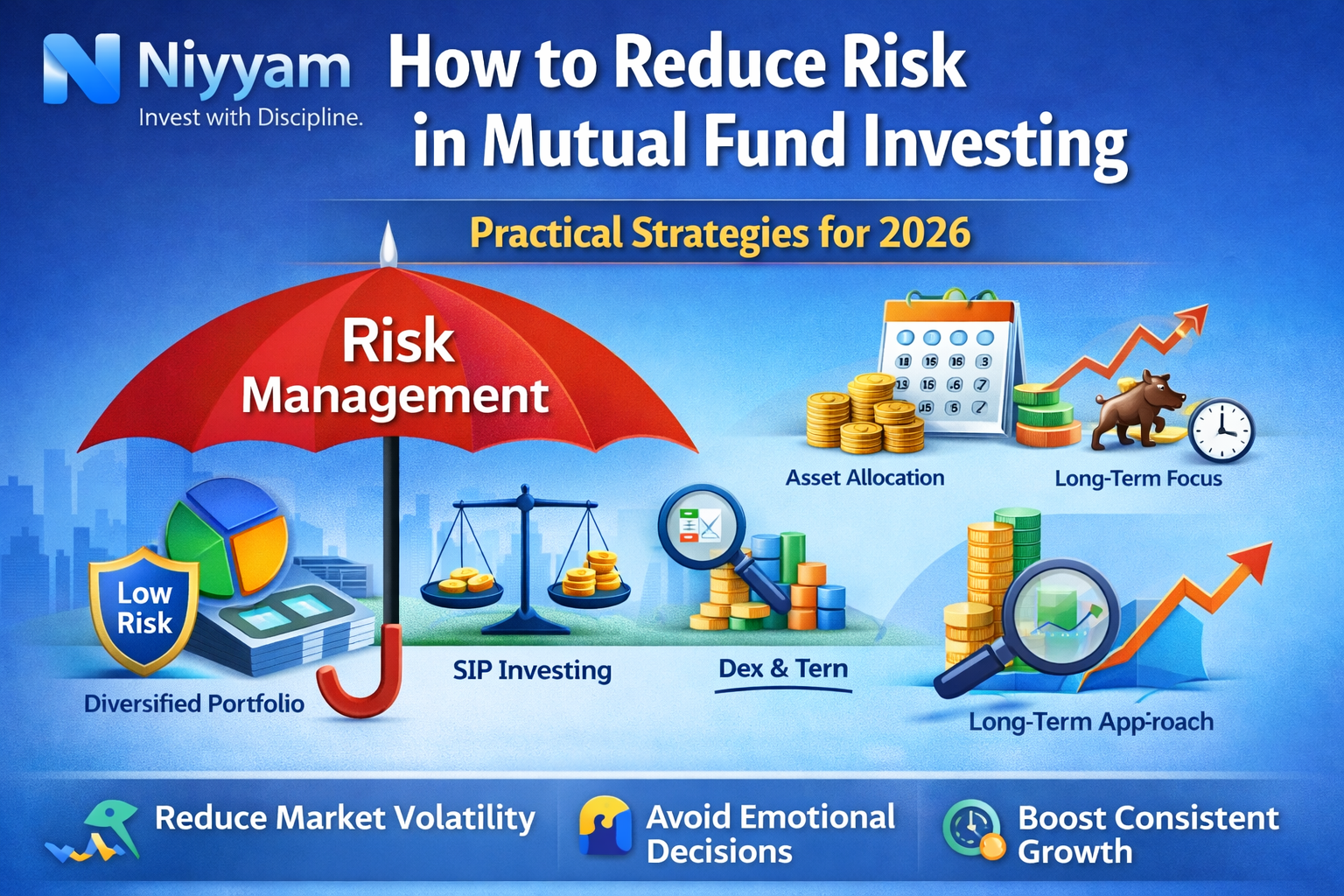
Practical Strategies to Reduce Risk in Mutual Fund Investing
1. Diversify Your Portfolio
Avoid concentrating your investments in one category.
Instead:
- Spread across equity, debt, and hybrid funds
- Avoid overexposure to one sector or theme
Diversification reduces the impact of poor performance in any single segment.
To understand portfolio structure, refer to
How to Build a Mutual Fund Portfolio for Long-Term Wealth Creation (2026 Guide).
2. Align Investments with Your Risk Profile
Your investment decisions should reflect your:
- Age
- Income stability
- Financial goals
- Investment horizon
Choosing funds without considering risk profile can lead to discomfort during volatility.
You can learn more in
How to Select Mutual Funds Based on Risk Profile in India (Beginner to Advanced Guide 2026).
3. Invest Through SIP Instead of a Lump Sum
Systematic Investment Plans (SIPs) help reduce risk by:
- Spreading investments over time
- Reducing timing risk
- Smoothing market volatility
This reduces the impact of investing at unfavorable market levels.
To understand this better, refer to
SIP vs Lump Sum: Which Investment Strategy Is Better for Beginners?
4. Maintain Proper Asset Allocation
Asset allocation is one of the strongest tools for risk control.
For example:
- Aggressive investors may hold higher equity
- Conservative investors may prefer more debt
Balanced allocation reduces overall volatility.
5. Rebalance Your Portfolio Regularly
Market movements can distort your allocation.
Rebalancing helps:
- Maintain target allocation
- Control risk exposure
- Protect gains
To understand this in detail, read
How to Rebalance Your Mutual Fund Portfolio (When, Why & How – 2026 Guide).
6. Avoid Chasing Past Performance
Investing based on recent high returns often leads to:
- Entering at peak valuations
- Increased downside risk
Past performance is not a reliable predictor of future results.
7. Focus on Long-Term Investing
Short-term volatility is unavoidable.
However:
- Markets tend to reward long-term investors
- Time in the market reduces risk impact
8. Understand Fund Categories Before Investing
Different categories carry different risk levels:
- Equity funds: Higher risk, higher potential return
- Debt funds: Lower risk, relatively stable
- Hybrid funds: Balanced approach
Understanding categories improves decision-making.
9. Monitor Your Investments Periodically
Review your portfolio periodically:
- Identify underperformance
- Ensure alignment with goals
Avoid excessive tracking of daily movements.
10. Avoid Emotional Decisions
Emotional reactions increase the risk significantly.
Common mistakes include:
- Selling during market corrections
- Investing during market hype
A disciplined approach is essential.
11. Use Proper Evaluation Metrics
Instead of relying only on returns:
- Use rolling returns to assess consistency
- Use XIRR to evaluate actual returns
You can learn more in
What are Rolling Returns in Mutual Funds? Why It Matters More Than CAGR (2026 Guide)
and
What is XIRR in Mutual Funds? How to Calculate and Use It (Beginner to Advanced Guide).
12. Invest Based on Financial Goals
Goal-based investing provides:
- Clear direction
- Better asset allocation
- Reduced emotional decisions
Refer to
Goal-Based Investing in Mutual Funds: How to Plan SIPs for Financial Goals (2026 Guide).

Risk vs Strategy (Quick Reference Table)
| Type of Risk | Practical Strategy to Reduce It |
|---|---|
| Market Risk | Diversification + Long-term investing |
| Interest Rate Risk | Invest across duration in debt funds |
| Credit Risk | Prefer high-quality instruments |
| Liquidity Risk | Avoid overexposure to illiquid segments |
| Behavioral Risk | Follow disciplined SIP strategy |
This table provides a quick reference for investors to align risks with solutions.
Real-World Scenario: How Risk Reduction Works
Consider two investors:
Investor A
- Invests a lump sum during a market peak
- Concentrates only in equity funds
- Reacts emotionally during market corrections
Investor B
- Invests through SIP
- Maintains diversified allocation
- Rebalances portfolio annually
- Focuses on long-term goals
During a market correction:
- Investor A panics and exits investments
- Investor B continues investing systematically
Over time:
- Investor B benefits from lower average cost and market recovery
- Investor A faces losses due to poor timing and emotional decisions
This example highlights how discipline and structure reduce risk significantly.
Common Mistakes That Increase Risk
- Investing without a structured plan
- Ignoring asset allocation
- Over-diversification or concentration
- Reacting to short-term market movements
- Frequent buying and selling
Avoiding these mistakes is critical for long-term success.
Final Thoughts
Risk is an inherent part of mutual fund investing, but it does not need to be a barrier.
With the right strategies, investors can:
- Manage volatility
- Improve consistency
- Build long-term wealth
Reducing risk is not about avoiding markets. It is about:
- Structuring your investments properly
- Staying disciplined
- Maintaining a long-term perspective
Build a Disciplined Investment Approach
If you want to understand how your investments grow over time, you can explore
SIP Return Calculator Explained: How to Calculate Your Mutual Fund Returns (With Examples).
Combining structured investing with proper risk management creates a strong foundation for financial growth.
Frequently Asked Questions (FAQs)
1. Can mutual fund risk be eliminated?
No. Risk cannot be eliminated, but can be managed through diversification and disciplined investing.
2. Is SIP risk-free?
No. SIP reduces timing risk but does not eliminate market risk.
3. How often should I review my portfolio?
Reviewing once every 6–12 months is generally sufficient.
Disclaimer
This content is for educational purposes only and does not constitute investment advice.
Mutual fund investments are subject to market risks. Investors should read all scheme-related documents carefully before investing and consider their financial goals, risk tolerance, and investment horizon.
Share this guide with your friends, family, and colleagues to help them make better financial decisions.
If this article helped you, share it with at least one person who needs this guidance.
Leave a Reply