
By Ashok Prasad, Founder, Niyyam
Published: March 2026
Introduction
When it comes to disciplined monthly investing, two of the most popular options in India are:
- Systematic Investment Plan (SIP) in mutual funds
- Recurring Deposit (RD) in banks
Both options allow you to:
- Invest regularly
- Build savings over time
- Develop financial discipline
However, the real question is:
Which one is better in 2026 — SIP or RD?
The answer depends on:
- Your financial goals
- Your risk tolerance
- Your investment horizon
If you are new, first understand what is SIP in mutual funds and how it works, because SIP and RD differ fundamentally in how they generate returns.
SIP vs RD: Which is Better in 2026?
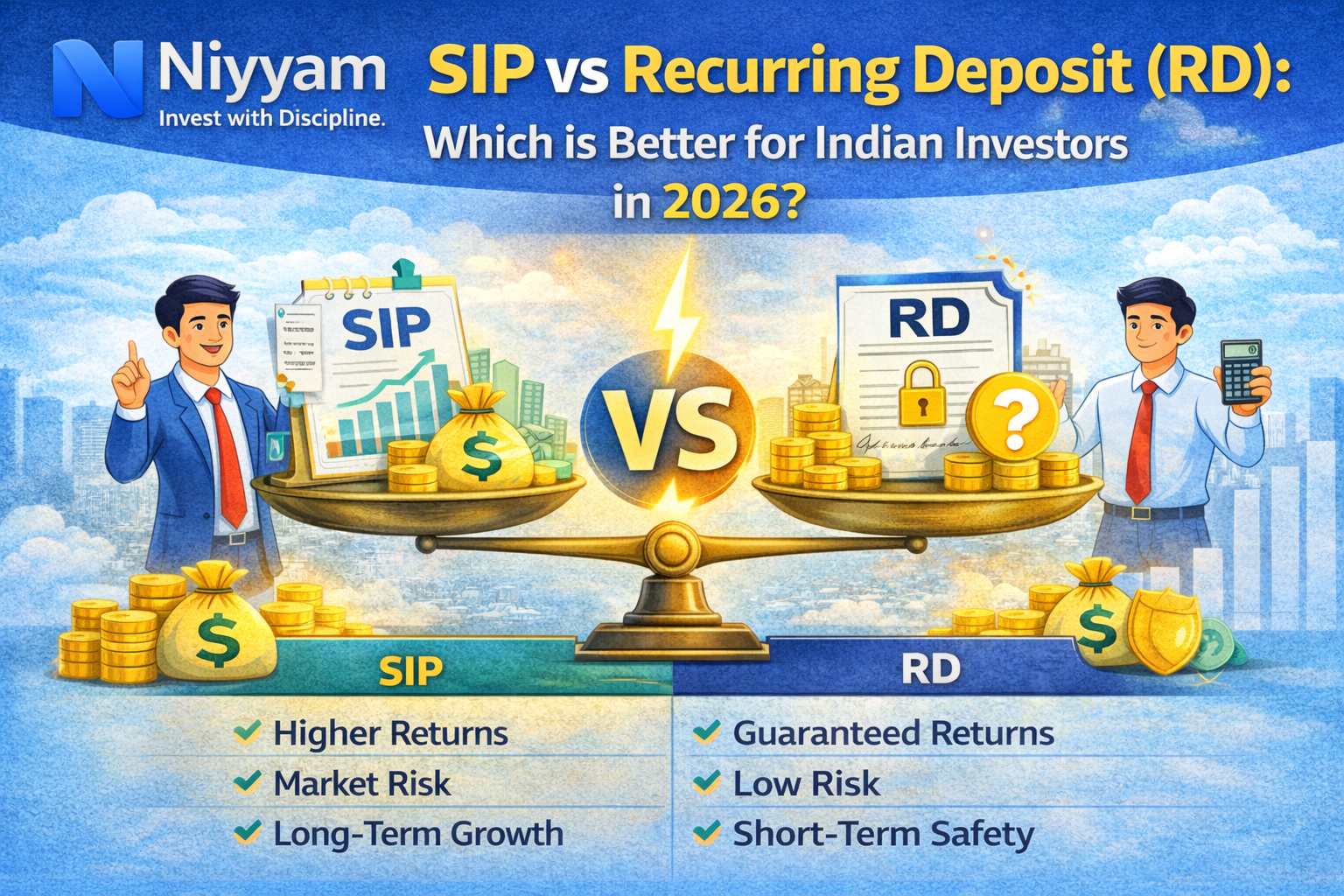
SIP is better for long-term wealth creation, while RD is better for short-term safety and guaranteed returns.
- Choose SIP if your goal is growth and you can stay invested for 5+ years
- Choose RD if your goal is capital protection and short-term savings
💡 Key Takeaways
- SIP offers higher return potential (10–12%), while RD provides fixed returns (5–7%)
- SIP is market-linked and volatile in the short term, but better for long-term wealth creation
- RD is safe and predictable, suitable for conservative investors
- SIP can beat inflation, while RD often struggles to maintain real returns
- SIP is more tax-efficient, whereas RD interest is fully taxable
- SIP works best for long-term goals (5+ years), RD is ideal for short-term needs (1–3 years)
- A balanced approach using both SIP (growth) and RD (stability) can be effective
SIP vs RD – Quick Comparison
| Feature | SIP | RD |
|---|---|---|
| Returns | Market-linked (10–12%) | Fixed (5–7%) |
| Risk | Moderate | Very low |
| Wealth Creation | High | Low |
| Capital Safety | Not guaranteed | Guaranteed |
| Inflation Protection | Strong | Weak |
| Best For | Long-term goals | Short-term savings |
Understanding SIP
SIP is an investment method where:
- You invest a fixed amount regularly in mutual funds
- Returns depend on market performance
Key Features of SIP
- Market-linked growth
- Compounding effect
- Cost averaging
- Suitable for long-term wealth creation
Understanding RD
Recurring Deposit is a fixed-income product where:
- You deposit a fixed amount monthly
- You earn a fixed interest rate
Key Features of RD
- Guaranteed returns
- No market risk
- Predictable maturity value
- Suitable for conservative investors
Returns Comparison: SIP vs RD
10-Year Example
| Investment Type | Monthly Investment | Total Invested | Final Value |
|---|---|---|---|
| SIP (12%) | ₹10,000 | ₹12 lakh | ~₹23–24 lakh |
| RD (6.5%) | ₹10,000 | ₹12 lakh | ~₹16–17 lakh |
20-Year Example
| Investment Type | Monthly Investment | Total Invested | Final Value |
|---|---|---|---|
| SIP (12%) | ₹10,000 | ₹24 lakh | ~₹1 crore |
| RD (6.5%) | ₹10,000 | ₹24 lakh | ~₹45–50 lakh |
Insight
SIP can generate significantly higher wealth over long periods.
Risk Comparison
| Factor | SIP | RD |
|---|---|---|
| Market risk | Yes | No |
| Capital safety | No | Yes |
| Volatility | High (short-term) | None |
Insight
- SIP involves short-term volatility
- RD offers stability and certainty
Inflation Impact
| Factor | SIP | RD |
|---|---|---|
| Inflation beating ability | High | Low |
| Real return | Positive | Often low |
Insight
RD may not protect your purchasing power effectively.
Taxation Comparison
| Factor | SIP | RD |
|---|---|---|
| Tax type | Capital gains | Interest income |
| Tax efficiency | Higher | Lower |
| Tax burden | Moderate | High |
Insight
SIP is more tax-efficient in the long term.
Time Horizon Suitability
| Time Horizon | SIP | RD |
|---|---|---|
| 1–3 years | Not ideal | Best |
| 3–5 years | Moderate | Good |
| 5–10 years | Good | Average |
| 10+ years | Excellent | Weak |
Who Should Choose SIP vs RD?
Choose SIP if:
- You want higher long-term returns
- You can stay invested for 5–20 years
- You can tolerate market fluctuations
- Your goal is wealth creation
Choose RD if:
- You want guaranteed returns
- You have short-term goals
- You prefer stability
- You cannot tolerate risk
SIP vs RD: Real-Life Comparison
| Investor | Investment Type | Duration | Outcome |
|---|---|---|---|
| Investor A | SIP | 20 years | ₹1 crore+ |
| Investor B | RD | 20 years | ₹45–50 lakh |
Balanced Strategy: SIP + RD
| Allocation | Purpose |
|---|---|
| SIP (60–80%) | Growth |
| RD (20–40%) | Stability |
Common Mistakes Investors Make
- Using RD for long-term wealth goals
- Avoiding SIP due to fear
- Ignoring the inflation impact
- Expecting SIP to be risk-free
To understand more, refer to why most SIP investors fail to build wealth.
SIP vs RD: Final Decision Snapshot
| If You Want | Choose |
|---|---|
| High returns | SIP |
| Safety | RD |
| Long-term wealth | SIP |
| Short-term savings | RD |
| Inflation protection | SIP |
Frequently Asked Questions (FAQs)
Which is better, SIP or RD in India?
SIP is better for long-term wealth creation, while RD is better for safety and guaranteed returns.
Can RD give better returns than SIP?
No, RD cannot outperform SIP in the long term due to lower fixed returns.
Is SIP riskier than RD?
Yes, SIP carries market risk, while RD offers guaranteed returns.
Should I invest in SIP or RD?
Choose SIP for long-term growth and RD for short-term stability based on your goals.
Final Verdict
SIP and RD are not competitors — they serve different purposes.
- SIP → Growth
- RD → Stability
The best strategy is:
Use SIP for wealth creation and RD for safety.
Final Thought
Smart investing is not about choosing one option.
It is about:
- Using the right tool for the right goal
If used correctly:
You can achieve both growth and financial security.
Disclaimer
This content is for educational purposes only and does not constitute investment advice.
Mutual fund investments are subject to market risks. Investors should read all scheme-related documents carefully before investing and consider their financial goals, risk tolerance, and investment horizon.
Share this guide with your friends, family, and colleagues to help them make better financial decisions.
If this article helped you, share it with at least one person who needs this guidance.
Leave a Reply