
By Ashok Prasad, Founder, Niyyam
Published: March 2026
When evaluating mutual fund performance, most investors rely on simple metrics such as point-to-point returns or CAGR (Compound Annual Growth Rate). While these metrics are widely used, they often fail to capture the complete reality of how a mutual fund performs over time.
💡 Key Takeaways
- Beyond CAGR: Unlike CAGR, which only looks at a fixed start and end date, Rolling Returns measure performance across every possible interval.
- Experience Reality: Rolling returns show the actual range of returns an investor might have experienced, including the “best” and “worst” times.
- Consistency Check: This metric helps you identify funds that deliver steady performance over time, rather than one-time “lucky” gains.
- Better Decision Making: Use rolling returns to set realistic expectations for your future portfolio growth and avoid chasing temporary peaks.
Financial markets are dynamic. Returns are not generated in a straight line, and investor experience varies depending on when the investment is made. This is where rolling returns become an essential concept.
Rolling returns provide a deeper and more realistic view of mutual fund performance by analysing returns across multiple time periods instead of a single fixed period.
In this guide, you will learn:
- What rolling returns mean in simple terms
- Why CAGR alone can be misleading
- How rolling returns provide better insights
- How to use rolling returns while comparing mutual funds
- Practical examples for better understanding
What is CAGR in Mutual Funds? (Quick Recap)
CAGR represents the average annual return of an investment over a specific time period, assuming the investment grows at a constant rate.
CAGR Formula
CAGR = (Final Value / Initial Value)1/n – 1
Where:
- Final Value = Investment value at the end
- Initial Value = Investment amount
- n = Number of years
While CAGR gives a simplified average return, it does not reflect how returns vary across different time periods. This is where rolling returns provide a more complete picture.
Example of CAGR Calculation
If you invest ₹1,00,000 and it becomes ₹1,80,000 in 5 years:
CAGR = (180000 / 100000)1/5 – 1
CAGR ≈ 12.47% per year
CAGR is useful because:
- It simplifies complex returns into a single number
- It helps compare investments over time
However, it has an important limitation:
- It considers only one starting point and one ending point
This limitation can lead to misleading conclusions.
Why CAGR Alone is Not Enough
Markets go through cycles:
- Bull phases
- Bear phases
- Volatile sideways movements
CAGR ignores everything that happens between the start and end dates.
Consider two investors:
- Investor A invests during a market low
- Investor B invests during a market peak
Even if the CAGR appears similar, their experience can be very different.
To understand how mutual fund returns actually behave in different market conditions, refer to
How Mutual Funds Generate Returns for Investors (With Simple Examples).
What are Rolling Returns?
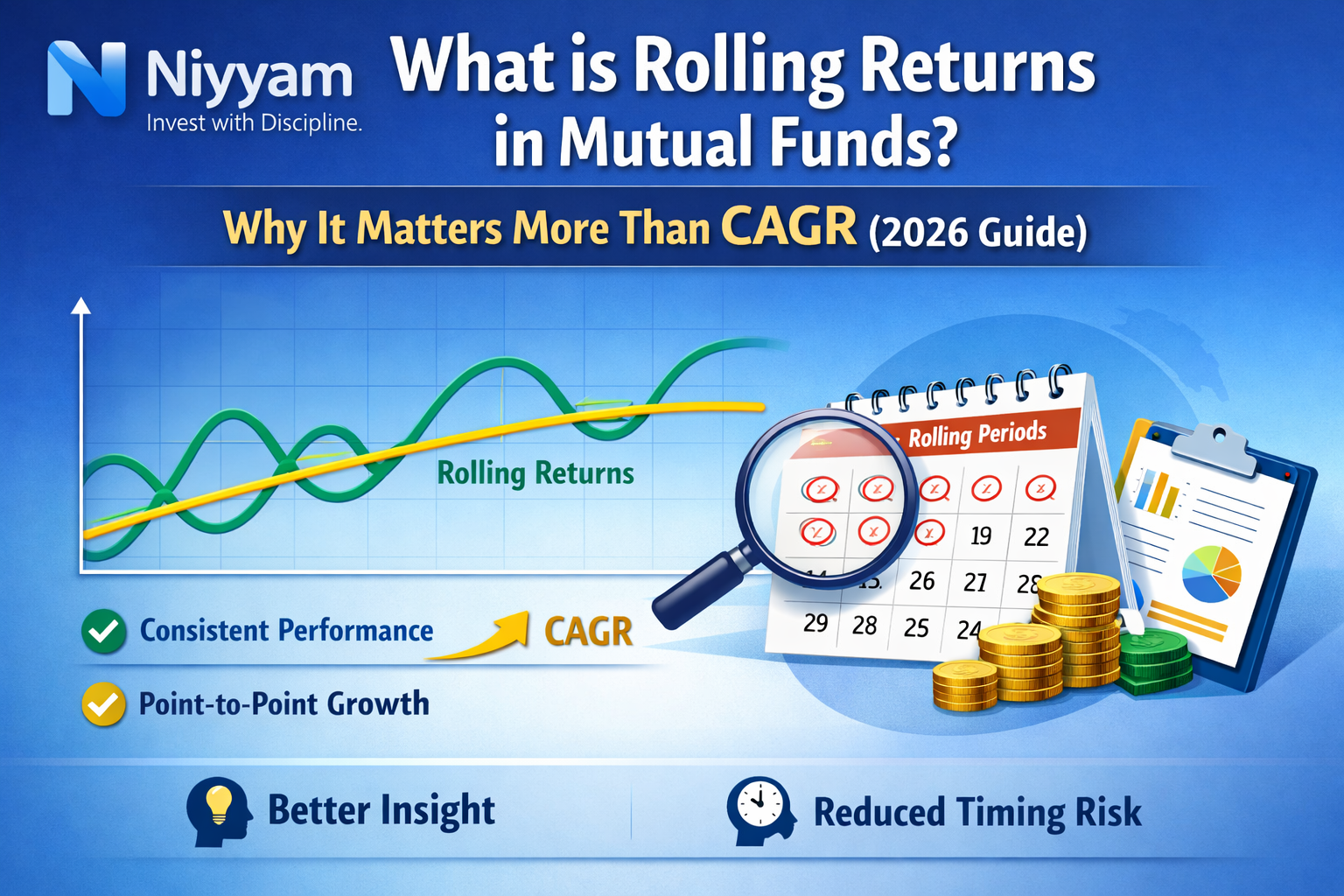
Rolling returns measure the average returns over multiple overlapping time periods, instead of a single fixed period.
Instead of calculating return from one date to another, rolling returns analysis:
- Every possible 1-year period
- Every possible 3-year period
- Every possible 5-year period
This approach generates multiple return data points, providing a more comprehensive performance view.
How Rolling Returns Work (Simple Explanation)
Suppose you want to evaluate a fund’s 5-year performance.
Instead of calculating:
- January 2020 to January 2025
Rolling returns calculate:
- February 2020 to February 2025
- March 2020 to March 2025
- April 2020 to April 2025
This continues across all possible periods.
The result is:
- A range of returns
- A pattern of consistency
- A more reliable performance measure
Why Rolling Returns Matter More Than CAGR
1. Shows Performance Consistency
CAGR can be influenced by favorable market timing.
Rolling returns show:
- Whether the fund performs consistently
- Whether returns fluctuate significantly
Consistency is more important than occasional high returns.
2. Reduces Timing Bias
CAGR depends heavily on when you start and end your investment.
Rolling returns eliminate this bias by analysing multiple time frames.
This makes the evaluation more reliable.
3. Reflects Real Investor Experience
Investors rarely invest at perfect times.
Rolling returns simulate:
- Different entry points
- Different exit points
This makes them more practical for real-world investing.
4. Helps in Better Fund Comparison
When comparing mutual funds, rolling returns provide:
- Stability comparison
- Risk-adjusted understanding
This aligns with the framework discussed in
How to Compare Mutual Funds in India (5 Key Metrics Every Investor Must Check).
Rolling Returns vs CAGR
| Feature | CAGR | Rolling Returns |
|---|---|---|
| Data Points | Single | Multiple |
| Timing Impact | High | Low |
| Consistency Insight | Limited | Strong |
| Reliability | Moderate | High |
How to Use Rolling Returns Effectively
1. Evaluate Multiple Time Periods
Check rolling returns across:
- 1-year periods
- 3-year periods
- 5-year periods
This provides a balanced understanding.
2. Compare with Benchmark Performance
Evaluate whether the fund:
- Consistently outperforms its benchmark
- Matches market trends
3. Observe Downside Performance
Check how the fund behaves:
- During market corrections
- During volatility
This helps assess risk management.
4. Focus on Stability Over Peaks
Avoid selecting funds based only on the highest returns.
Instead, focus on:
- Consistent performance
- Lower volatility
Rolling Returns and SIP Investors
Rolling returns are particularly useful for SIP investors.
SIP investments happen:
- Monthly
- Across different market conditions
This means each installment experiences different returns.
Rolling returns reflect this pattern more accurately.
To understand SIP investing in depth, refer to
How SIP Builds Wealth Through Compounding (With Simple Examples).
Rolling Returns vs XIRR (Important Distinction)
- Rolling returns evaluate fund performance
- XIRR evaluates your personal investment returns
Both are important but serve different purposes.
To understand XIRR in detail, refer to
What is XIRR in Mutual Funds? How to Calculate and Use It (Beginner to Advanced Guide).
Practical Example
Consider two funds:
Fund A
- CAGR: 12%
- Highly volatile
Fund B
- CAGR: 11%
- Consistent performance
CAGR suggests Fund A is better.
Rolling returns may reveal:
- Fund B delivers stable returns across periods
- Fund A has unpredictable performance
For long-term investors, consistency is often more valuable.
When Should You Use Rolling Returns?
Rolling returns should be used when:
- Comparing mutual funds
- Evaluating long-term consistency
- Building a diversified portfolio
This becomes important when structuring your investments, as explained in
How to Build a Mutual Fund Portfolio for Long-Term Wealth Creation (2026 Guide).
Limitations of Rolling Returns
While useful, rolling returns have some limitations:
- Data may not be easily available on all platforms
- Requires more effort to analyse
- May be complex for beginners initially
However, the insights provided are significantly more reliable than simple metrics.
Common Mistakes to Avoid
- Relying only on CAGR for decision-making
- Ignoring the consistency of returns
- Chasing the highest-performing funds
- Evaluating funds based on short-term performance
A structured evaluation approach leads to better outcomes.
Final Thoughts
Rolling returns provide a more accurate and realistic way to evaluate mutual fund performance.
While CAGR offers a simplified view, rolling returns give deeper insights into:
- Consistency
- Risk
- Reliability
For investors aiming to build long-term wealth, understanding rolling returns is an important step toward making informed decisions.
A disciplined investment approach involves:
- Evaluating performance correctly
- Avoiding short-term bias
- Focusing on consistency
Build a Stronger Investment Framework
If you want to understand how your investments grow and how returns are calculated in practical terms, you can refer to
SIP Return Calculator Explained: How to Calculate Your Mutual Fund Returns (With Examples).
Using the right tools along with proper analysis can significantly improve decision-making.
Frequently Asked Questions (FAQs)
1. Are rolling returns better than CAGR?
Rolling returns provide deeper insights into consistency, while CAGR gives a simplified overview. Both are useful, but rolling returns are more comprehensive.
2. Should beginners use rolling returns?
Yes. While slightly more advanced, understanding rolling returns helps investors make better long-term decisions.
3. Do all platforms provide rolling returns data?
Not all platforms display rolling returns. Investors may need to rely on detailed research tools or reports.
Disclaimer
This content is for educational purposes only and does not constitute investment advice.
Mutual fund investments are subject to market risks. Investors should read all scheme-related documents carefully before investing and consider their financial goals, risk tolerance, and investment horizon.
Share this guide with your friends, family, and colleagues to help them make better financial decisions.
If this article helped you, share it with at least one person who needs this guidance.
Leave a Reply