
By Ashok Prasad, Founder, Niyyam
Published: March 2026
Introduction
You invest in a mutual fund with a long-term goal.
You select the right fund, start your SIP, and stay consistent.
Everything looks fine — until the day you decide to withdraw.
You notice that the amount credited to your bank is slightly less than expected.
That’s when you see a term most investors ignore:
Exit Load
This leads to confusion:
Is this a penalty?
Why is it deducted?
Can it be avoided?
Many investors focus only on returns but ignore costs like exit load, which directly reduce profits.
So the real question is:
What exactly is exit load, and how does it affect your mutual fund returns?
Let’s understand this simply and practically.
Direct Answer
Exit load is a fee charged by a mutual fund when you redeem your investment before a specified holding period, which reduces your final returns.
- It discourages early withdrawal
- Typically ranges from 0.5% to 1%
- Applies only within a defined time period
💡 Key Takeaways
- Exit load is a fee, not a tax
- It applies only to early redemption
- Long-term investors usually avoid it
- Even 1% can significantly impact returns
- Each SIP installment has its own exit load period
- Always check the exit load before investing
- It plays a critical role in exit decisions
What is Exit Load in Mutual Funds?
Exit load is a charge deducted when you withdraw your money before a specified period set by the fund.
| Factor | Details |
|---|---|
| Type | Fee |
| Charged by | Asset Management Company (AMC) |
| Purpose | Discourage early exit |
| Applicability | Only on early redemption |
This ensures investors stay invested for the intended duration.
To understand the basics, refer to What is a Mutual Fund? A Simple Explanation for Beginners
Why Do Mutual Funds Charge Exit Load?
Exit load is not just a random fee. It serves a purpose.
| Reason | Explanation |
|---|---|
| Prevent frequent buying and selling | Reduces volatility |
| Protect long-term investors | Ensures stability |
| Maintain fund strategy | Avoids sudden withdrawals |
If investors keep entering and exiting frequently, fund managers cannot manage the portfolio effectively.
How Exit Load is Calculated
Basic Example
| Component | Value |
|---|---|
| Investment Value | ₹1,00,000 |
| Exit Load | 1% |
| Deduction | ₹1,000 |
| Amount Received | ₹99,000 |
Multiple Scenarios
| Investment | Exit Load % | Deduction | Final Amount |
|---|---|---|---|
| ₹50,000 | 1% | ₹500 | ₹49,500 |
| ₹1,50,000 | 1% | ₹1,500 | ₹1,48,500 |
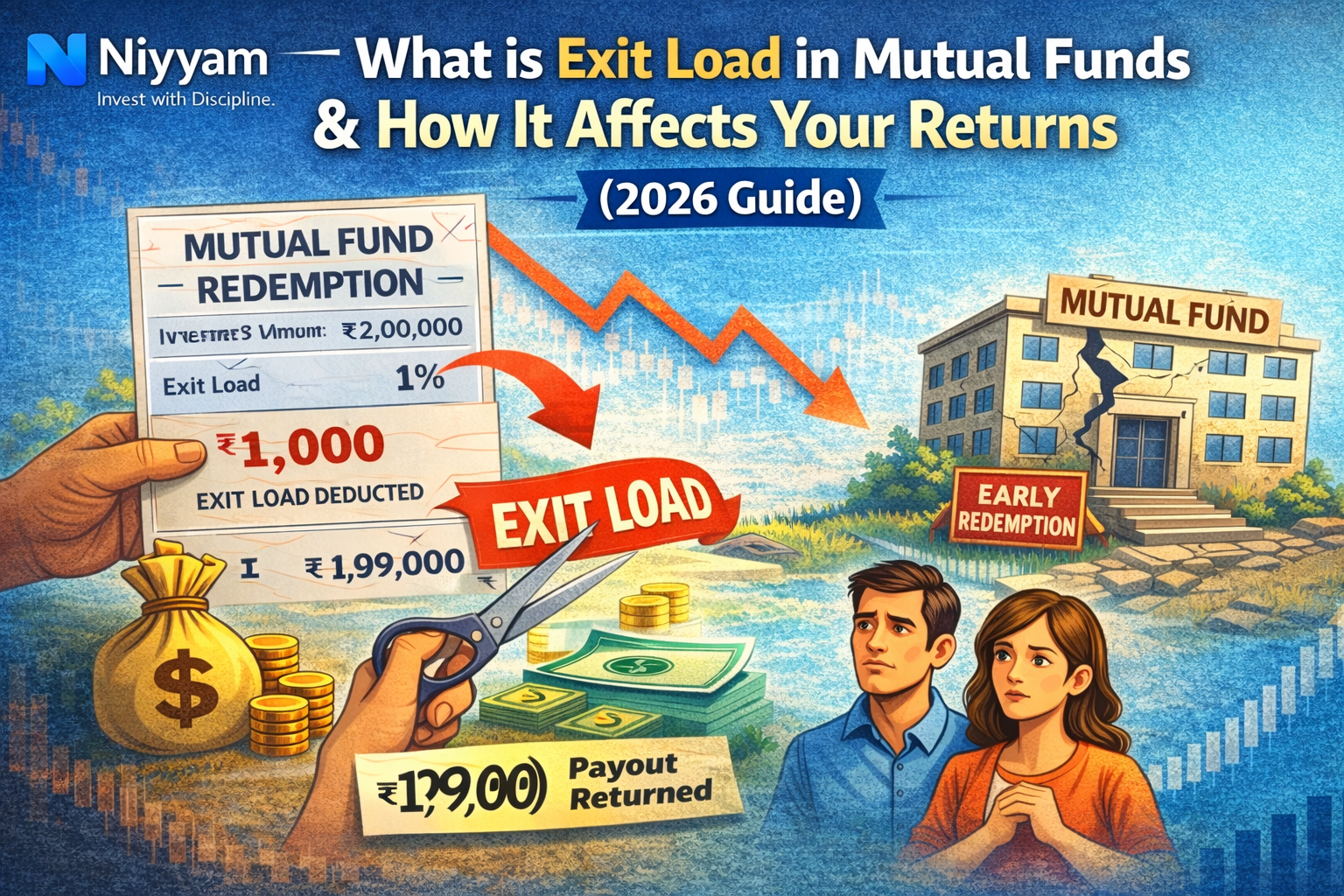
| ₹2,00,000 | 0.5% | ₹1,000 | ₹1,99,000 |
Even small percentages reduce your effective returns.
Exit Load Rules Across Fund Types
| Fund Type | Typical Exit Load Rule |
|---|---|
| Equity Funds | 1% if redeemed within 1 year |
| Debt Funds | 0%–0.5% depending on duration |
| Liquid Funds | Mostly 0% |
| ELSS Funds | No exit load (but 3-year lock-in) |
Different funds have different rules, so always check before investing.
Exit Load vs Lock-in Period
| Factor | Exit Load | Lock-in |
|---|---|---|
| Meaning | Fee for early exit | Restriction on withdrawal |
| Flexibility | Can exit with fee | Cannot exit |
| Example | Equity fund | ELSS fund |
Many investors confuse these two concepts.
How Exit Load Affects Your Returns
Exit load directly reduces your profit.
Example
| Detail | Value |
|---|---|
| Investment | ₹1,00,000 |
| Gain | ₹12,000 |
| Exit Load (1%) | ₹1,120 |
| Final Gain | ₹10,880 |
Impact Comparison
| Scenario | Without Exit Load | With Exit Load |
|---|---|---|
| Investment | ₹1,00,000 | ₹1,00,000 |
| Value | ₹1,12,000 | ₹1,12,000 |
| Deduction | ₹0 | ₹1,120 |
| Final Value | ₹1,12,000 | ₹1,10,880 |
Exit load silently reduces returns.
To understand return expectations, refer to Mutual Fund Returns in India: कितना Return मिलता है?
Exit Load in SIP Investments
This is where most investors get confused.
Each SIP installment is treated separately.
| SIP Month | Investment | Exit Load Status |
|---|---|---|
| January | ₹5,000 | No exit load (if completed 1 year) |
| February | ₹5,000 | Exit load applies |
| March | ₹5,000 | Exit load applies |
Key Rule
| Factor | Explanation |
|---|---|
| Each SIP installment | Has its own holding period |
| Exit load | Calculated individually |
| Redemption | Mixed impact |
For a deeper understanding, refer to What Happens When You Stop SIP? Complete Impact Explained
When Should You Avoid Exit Load?
| Situation | Action |
|---|---|
| Close to completion of 1 year | Wait |
| No urgent need | Continue |
| Minor underperformance | Hold |
Patience helps you avoid unnecessary costs.
When Paying Exit Load is Acceptable
| Scenario | Reason |
|---|---|
| Fund underperforming for years | Better to switch |
| Goal achieved early | Exit justified |
| Portfolio rebalancing | Strategic decision |
You can refer to When to Exit a Mutual Fund? 7 Clear Signals Every Investor Should Know
Exit Load vs Expense Ratio
| Factor | Exit Load | Expense Ratio |
|---|---|---|
| Type | One-time fee | Recurring cost |
| Charged when | Redemption | Throughout investment |
| Impact | Immediate | Long-term |
Also refer to What is Expense Ratio in Mutual Funds?
Hidden Cost Impact Over Time
| Scenario | Without Exit Load | With Exit Load |
|---|---|---|
| Investment | ₹5,00,000 | ₹5,00,000 |
| Gain (10%) | ₹50,000 | ₹50,000 |
| Exit Load | ₹0 | ₹5,500 |
| Final Gain | ₹50,000 | ₹44,500 |
This shows how costs reduce compounding.
Common Mistakes Investors Make
- Ignoring exit load before investing
- Redeeming funds too early
- Frequent switching between funds
- Confusing exit load with tax
- Not understanding SIP-wise exit load
Decision Framework (MOST IMPORTANT)
| Scenario | Action |
|---|---|
| Within exit load period | Avoid exit |
| Short-term loss | Hold |
| Consistent underperformance | Switch |
| Goal achieved | Exit |
Tax vs Exit Load (Important Difference)
| Factor | Exit Load | Tax |
|---|---|---|
| Charged by | AMC | Government |
| Type | Fee | Tax |
| Applicability | Early exit | On gains |
Frequently Asked Questions (FAQs)
What is exit load in mutual funds?
It is a fee charged when you redeem your investment before a specified period.
Can an exit load be avoided?
Yes, by holding the investment beyond the defined duration.
Is the exit load charged on profit or the total amount?
It is charged on the total redemption value.
Does SIP have an exit load?
Yes, each installment is treated separately.
Is exit load the same as tax?
No, it is a fee, not a tax.
Final Verdict
Exit load may seem small, but it has a direct impact on your returns.
- Avoid unnecessary early exits
- Understand fund-specific rules
- Align investments with your time horizon
Smart investing is not just about choosing the right fund — it is also about exiting at the right time.
Final Thought
Most investors focus only on returns.
But successful investors also focus on costs and discipline.
Exit load is a small detail that can make a meaningful difference in your long-term wealth.
Understanding it today will help you make better decisions tomorrow.
Disclaimer
This content is for educational purposes only and does not constitute investment advice.
Mutual fund investments are subject to market risks. Investors should read all scheme-related documents carefully before investing and consider their financial goals, risk tolerance, and investment horizon.
Share this guide with your friends, family, and colleagues to help them make better financial decisions.
If this article helped you, share it with at least one person who needs this guidance.
Leave a Reply