
By Ashok Prasad, Founder, Niyyam
Published: March 2026
One of the biggest fears investors have is:
“What if I invest at the wrong time?”
This fear often stops people from investing or leads them to delay decisions while waiting for the “perfect market level.”
This is exactly where Rupee Cost Averaging (RCA) becomes powerful.
Rupee Cost Averaging is one of the biggest advantages of SIP (Systematic Investment Plan). It allows investors to invest consistently without worrying about market timing and helps reduce the impact of volatility over time.
In this guide, you will learn what rupee cost averaging is, how it works, and how you can use it effectively to build long-term wealth.
💡 Key Takeaways
- Rupee Cost Averaging Reduces Timing Risk: You invest consistently regardless of market conditions.
- More Units When Prices Fall: SIP buys more units during market downturns.
- Lower Average Cost Over Time: Your overall cost per unit becomes balanced.
- Works Best for Long-Term Investors: Time enhances the benefit of averaging.
- Removes Emotional Decision-Making: You don’t need to predict the market.
What is Rupee Cost Averaging?
Rupee Cost Averaging is an investment strategy where you invest a fixed amount regularly, regardless of market conditions.
Core Concept:
- When prices are high → you buy fewer units
- When prices are low → you buy more units
Over time, this results in:
- Balanced purchase cost
- Reduced volatility impact
Important Insight:
- Rupee Cost Averaging protects you from investing at the wrong time
Refer:
What is SIP in Mutual Funds? A Complete Beginner’s Guide (2026)
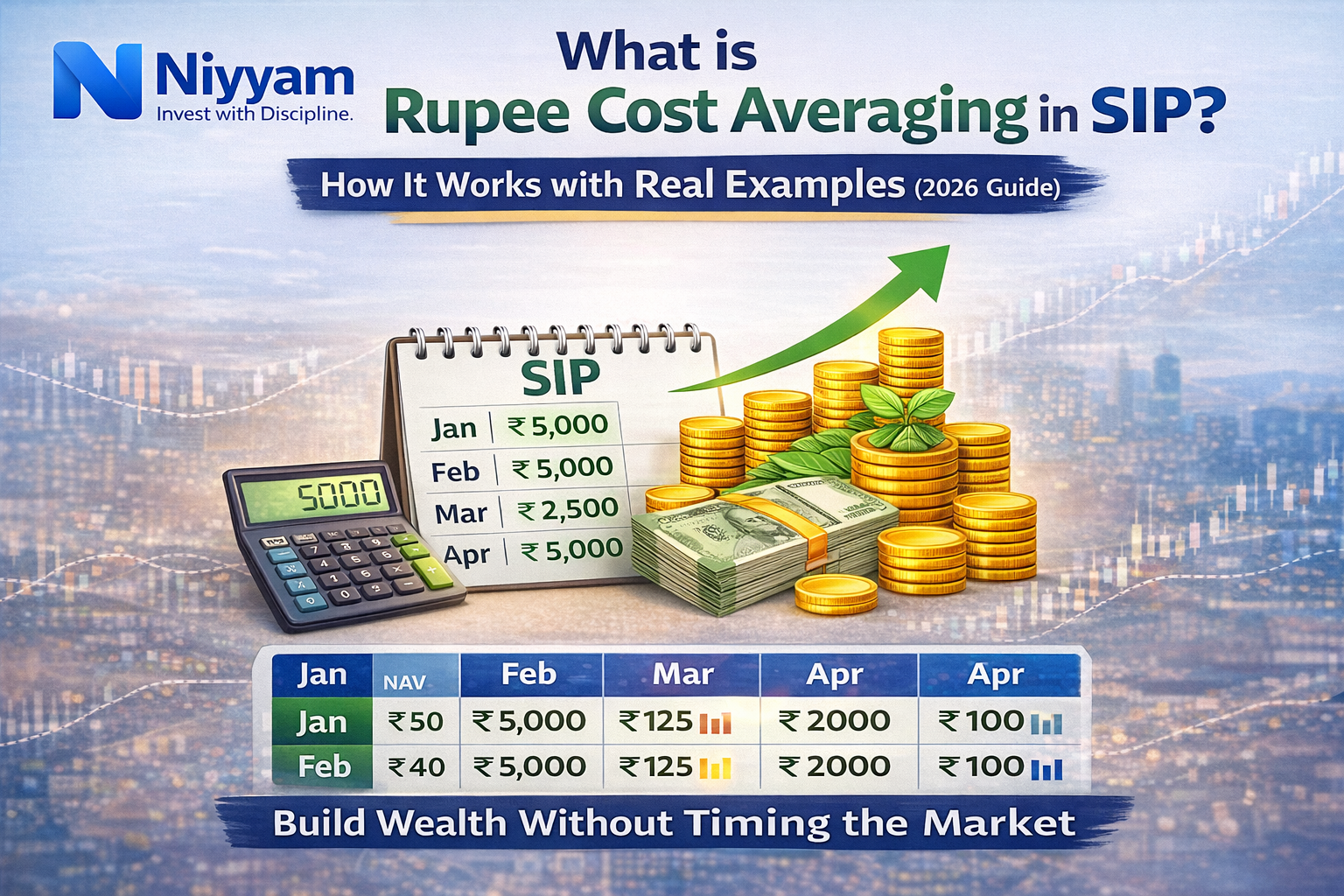
How Rupee Cost Averaging Works (Simple Example)
Let’s understand this with a practical example.
Monthly SIP: ₹5,000
| Month | NAV | Units Bought |
|---|---|---|
| Jan | ₹50 | 100 units |
| Feb | ₹40 | 125 units |
| Mar | ₹25 | 200 units |
| Apr | ₹50 | 100 units |
Total Investment: ₹20,000
Total Units: 525 units
Average Cost per Unit:
₹20,000 ÷ 525 = ₹38.09
Key Observation:
Even though the NAV ranged between ₹25 and ₹50:
Your average cost becomes ₹38.09
Key Insight:
- You didn’t need to time the market — averaging did it automatically
Why Rupee Cost Averaging is Powerful
1. Eliminates Market Timing Risk
You don’t need to predict market highs or lows.
2. Buys More Units During Market Fall
Market downturn becomes an advantage.
3. Creates Cost Efficiency
Your average purchase price stabilizes over time.
4. Reduces Emotional Investing
No panic buying or selling decisions.
Important Insight:
- Consistency beats timing in mutual fund investing
Refer:
How SIP Builds Wealth Through Compounding (With Simple Examples)
Rupee Cost Averaging vs Lump Sum Investing
| Feature | SIP (RCA) | Lump Sum |
|---|---|---|
| Timing Risk | Low | High |
| Market Dependency | Low | High |
| Emotional Stress | Low | High |
| Best For | Regular investors | Experienced investors |
Key Insight:
- SIP with averaging is safer than lump sum investing in volatile markets
Refer:
Lump Sum Investment Strategy in Mutual Funds: When and How to Invest (2026 Guide)
When Does Rupee Cost Averaging Work Best?
Ideal Conditions:
- Volatile markets
- Long-term investing
- Regular disciplined investing
Less Effective When:
- Markets rise continuously
- The investment horizon is short
Important Insight:
- Rupee Cost Averaging performs best in fluctuating markets
Real-Life Scenario
Investor A (Lump Sum)
- Invests ₹1 lakh at market peak
Investor B (SIP)
- Invests ₹5,000 monthly
Market Falls:
- Investor A → Faces losses
- Investor B → Buys more units
Market Recovers:
- Investor B benefits significantly
Key Insight:
- SIP investors benefit from volatility, while lump sum investors are exposed to timing risk
Practical Strategy to Use Rupee Cost Averaging
Step 1: Start SIP Early
The earlier you start, the better the averaging effect.
Step 2: Stay Consistent
Do not stop SIP during market downturns.
Step 3: Increase SIP Over Time
As income grows, increase your SIP amount.
Step 4: Avoid Market Timing
Let the averaging process work automatically.
Important Insight:
- Discipline is more important than strategy in long-term investing
Practical Example with Long-Term Impact
Scenario:
- ₹10,000 monthly SIP
- Investment duration: 10 years
Outcome:
- Market ups and downs are balanced
- Cost averaged efficiently
- Wealth created steadily
Key Insight:
- Small, consistent investments create powerful long-term outcomes
How to Use Rupee Cost Averaging Effectively (Practical Framework)
Understanding the concept is important, but applying it correctly makes the real difference.
Step 1: Choose a Long-Term Horizon
Rupee Cost Averaging works best over 5–10 years across multiple market cycles.
Step 2: Stay Invested During Market Falls
Do not stop your SIP when markets decline — this is when you accumulate more units.
Step 3: Increase SIP Gradually
Step up SIP annually to accelerate wealth creation.
Step 4: Avoid Frequent Changes
Switching funds frequently disrupts the averaging process.
Step 5: Align with Financial Goals
Link your SIP to goals like retirement, education, or wealth creation.
Key Insight:
- Rupee Cost Averaging works best with discipline, time, and consistency
When Should You Combine RCA with Other Strategies?
Combine with STP:
- For managing lump sum investments
Combine with Asset Allocation:
- For balancing risk
Combine with Goal-Based Investing:
- For structured wealth creation
Important Insight:
- Rupee Cost Averaging becomes more powerful when integrated into a complete financial plan
Refer:
SIP vs SWP vs STP: What is the Difference and When Should You Use Each? (2026 Complete Guide)
Common Mistakes to Avoid
1. Stopping SIP During Market Fall
This removes the core benefit of averaging.
2. Expecting Quick Results
Averaging works over time, not instantly.
3. Investing for Short-Term
Less effective for short durations.
4. Trying to Time SIP
Defeats the entire purpose of RCA.
Important Insight:
- Patience is essential for Rupee Cost Averaging to work
Refer:
Why Most SIP Investors Fail to Build Wealth (And How to Avoid It in 2026)
Frequently Asked Questions (FAQs)
1. Is Rupee Cost Averaging guaranteed to give profits?
No, but it reduces risk and improves consistency.
2. Does it work in all markets?
Works best in volatile markets.
3. Is SIP always better than a lump sum?
Not always, but safer for most investors.
4. Can I stop SIP anytime?
Yes, but consistency is important.
5. How long should I continue SIP?
Ideally 5–10+ years.
6. Is this suitable for beginners?
Yes, highly suitable.
Final Thought
Rupee Cost Averaging is not a shortcut to quick profits.
It is a disciplined and structured approach to long-term wealth creation.
Most investors fail because they try to time the market.
Successful investors focus on:
- Consistency
- Discipline
- Long-term perspective
If you follow SIP consistently,
Rupee Cost Averaging will work in your favor over time.
Disclaimer
This content is for educational purposes only and does not constitute investment advice.
Mutual fund investments are subject to market risks. Investors should read all scheme-related documents carefully before investing and consider their financial goals, risk tolerance, and investment horizon.
Share this guide with your friends, family, and colleagues to help them make better financial decisions.
If this article helped you, share it with at least one person who needs this guidance.
Leave a Reply