
By Ashok Prasad, Founder, Niyyam
One of the most difficult decisions in mutual fund investing is knowing when to exit.
Most investors focus heavily on when to invest, but very few have a clear strategy for exiting. As a result, they either:
- Exit too early and miss long-term growth
- Stay invested in underperforming funds for too long
A disciplined exit strategy is essential for long-term success.
Exiting a mutual fund is not about reacting to short-term market movements. It is about making structured, informed decisions based on clear signals.
In this guide, you will learn:
- When you should consider exiting a mutual fund
- 7 clear signals that indicate exit
- Common mistakes to avoid
- How to exit without disrupting your financial plan
Why an Exit Strategy is Important
Mutual fund investing is not a “buy and forget” activity.
Markets change. Fund performance changes. Your financial goals also evolve.
Without an exit strategy:
- You may stay invested in underperforming funds
- Your portfolio may drift away from your goals
- Risk levels may increase unintentionally
A structured exit approach ensures:
- Better portfolio quality
- Alignment with goals
- Controlled risk
When Should You NOT Exit a Mutual Fund
Before understanding exit signals, it is important to know when not to exit.
Do not exit based on:
- Short-term market corrections
- Temporary underperformance
- News or market noise
- Fear or panic
Market volatility is normal. Long-term investing requires patience.
To understand long-term investing better, refer to
How SIP Builds Wealth Through Compounding (With Simple Examples).
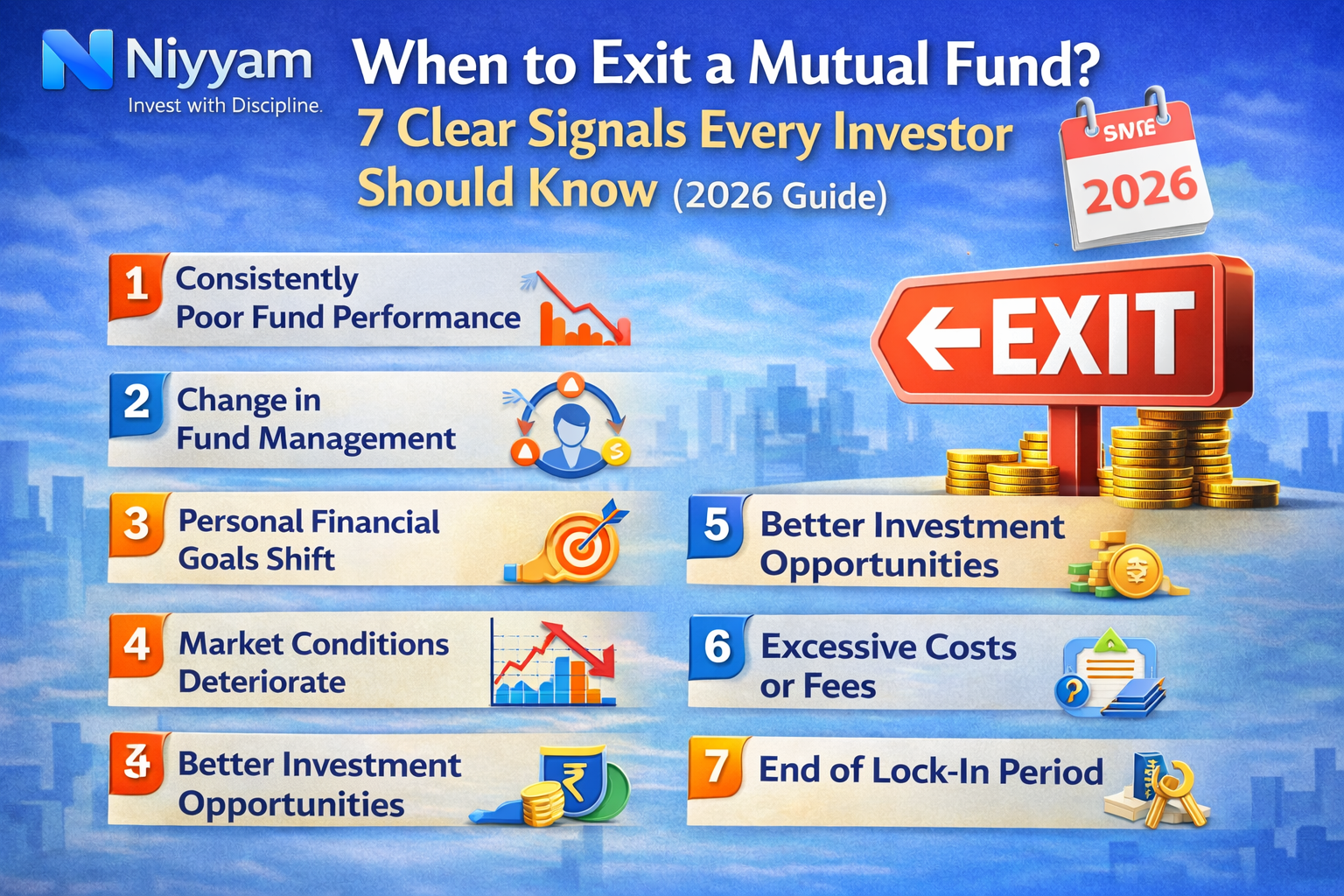
7 Clear Signals to Exit a Mutual Fund
1. Consistent Underperformance vs Benchmark
If a fund consistently underperforms its benchmark over a long period (2–3 years), it may be a concern.
Key point:
- Occasional underperformance is normal
- Consistent underperformance indicates structural issues
To evaluate performance correctly, refer to
How to Compare Mutual Funds in India (5 Key Metrics Every Investor Must Check).
2. Change in Fund Strategy or Objective
Sometimes, funds change their:
- Investment strategy
- Asset allocation approach
- Risk profile
If the new strategy no longer matches your investment goals, it may be time to review your investment.
3. Fund Manager Change with Performance Impact
A change in fund manager does not always mean you should exit.
However, consider reviewing if:
- Performance declines after the change
- Investment style shifts significantly
4. Your Financial Goals Have Changed
Your investment should always align with your goals.
Examples:
- You are nearing a financial goal
- Your risk tolerance has reduced
- Your time horizon has shortened
In such cases, exiting or reallocating may be necessary.
Refer to
Goal-Based Investing in Mutual Funds: How to Plan SIPs for Financial Goals (2026 Guide).

5. Portfolio Allocation is No Longer Balanced
Over time, your portfolio allocation may change due to market movements.
If one category becomes overexposed:
- Risk increases
- Balance reduces
Instead of a full exit, partial reallocation may be required.
To understand this better, refer to
Mutual Fund Portfolio Allocation Strategy (Equity vs Debt vs Hybrid – 2026 Guide).
6. Better Alternatives Available (Within Same Category)
If a fund consistently underperforms peers with similar risk levels, it may indicate inefficiency.
However:
- Do not switch frequently
- Avoid chasing top-performing funds
The decision should be based on long-term consistency, not short-term ranking.
7. High Expense Ratio Without Justification
Expense ratio affects your returns.
If a fund has:
- High costs
- No consistent outperformance
It may reduce long-term returns.
To understand this impact, refer to
What is Expense Ratio in Mutual Funds? How It Affects Your Returns (2026 Guide).
Quick Exit Decision Framework
| Situation | Action |
|---|---|
| Short-term market fall | Do not exit |
| Consistent underperformance | Review and consider exit |
| Goal nearing completion | Gradual exit |
| Asset allocation imbalance | Rebalance |
| Emotional reaction | Avoid action |
This framework helps avoid impulsive decisions.
Real-World Scenario
Consider two investors:
Investor A
- Exits during market correction
- Reacts to short-term volatility
- Switches funds frequently
Investor B
- Reviews performance periodically
- Exits only based on clear signals
- Maintains long-term discipline
Over time:
- Investor B achieves more stable and consistent results
- Investor A faces losses due to poor timing and frequent switching
This highlights the importance of a structured exit approach.
How to Exit a Mutual Fund Properly
1. Avoid Lump Sum Exit in Volatile Markets
Instead:
- Exit gradually
- Use systematic withdrawal if required
2. Consider Tax Implications
Exiting a mutual fund may trigger capital gains tax.
Plan exits accordingly.
3. Reinvest Strategically
Do not keep funds idle.
Reallocate based on:
- Asset allocation
- Financial goals
4. Avoid Frequent Switching
Frequent exits and entries can:
- Increase costs
- Reduce long-term returns
Common Mistakes While Exiting
- Exiting during market panic
- Following herd behavior
- Switching based on recent performance
- Ignoring tax implications
- Not having a reinvestment plan
Avoiding these mistakes improves outcomes.
Exit vs Rebalance (Important Difference)
Many investors confuse exiting with rebalancing.
| Exit | Rebalance |
|---|---|
| Complete withdrawal | Partial adjustment |
| Used for underperforming funds | Used for allocation control |
| Strategic decision | Maintenance activity |
To understand rebalancing, refer to
How to Rebalance Your Mutual Fund Portfolio (When, Why & How – 2026 Guide).
Final Thoughts
Exiting a mutual fund is not about reacting to market conditions. It is about making structured, informed decisions based on clear signals.
A disciplined investor:
- Does not panic during volatility
- Does not chase short-term trends
- Follows a defined strategy
Knowing when to exit is just as important as knowing when to invest.
Build a Structured Investment Approach
If you want to understand how your investments grow and how returns behave over time, you can explore
SIP Return Calculator Explained: How to Calculate Your Mutual Fund Returns (With Examples).
A structured approach helps you make better decisions across all stages of investing.
Frequently Asked Questions (FAQs)
1. Should I exit a mutual fund if returns are low?
Not immediately. Evaluate performance over a longer period before deciding.
2. Is it good to switch mutual funds frequently?
No. Frequent switching can increase costs and reduce returns.
3. When is the best time to exit a mutual fund?
There is no perfect time. Decisions should be based on goals, performance, and portfolio alignment.
Disclaimer
This content is for educational purposes only and does not constitute investment advice.
Mutual fund investments are subject to market risks. Investors should read all scheme-related documents carefully before investing and consider their financial goals, risk tolerance, and investment horizon.
Share this guide with your friends, family, and colleagues to help them make better financial decisions.
If this article helped you, share it with at least one person who needs this guidance.
Leave a Reply