
By Ashok Prasad, Founder, Niyyam
Published: March 2026
Introduction
Index funds vs actively managed funds is one of the most important decisions every investor faces when starting their mutual fund journey.
If you’re planning to invest in mutual funds, you will quickly come across these two options:
- Index Funds
- Actively Managed Funds
And naturally, the question arises:
Which one is better for me?
Many beginners:
- Hear that index funds are safe
- See active funds showing higher returns
- Get confused about what to choose
The truth is:
There is no universal “better” option.
The right choice depends on:
- Your financial goals
- Your risk tolerance
- Your investment horizon
This guide will break everything down in a simple, practical way so you can make a confident decision.
💡 Key Takeaways
- Index funds offer low-cost, stable, market-linked returns
- Active funds aim to outperform but come with higher risk
- Expense ratio significantly impacts long-term returns
- Index funds work well in large-cap markets
- Active funds perform better in mid/small-cap segments
- A combination strategy works best for most investors
- Discipline matters more than fund selection
Direct Answer
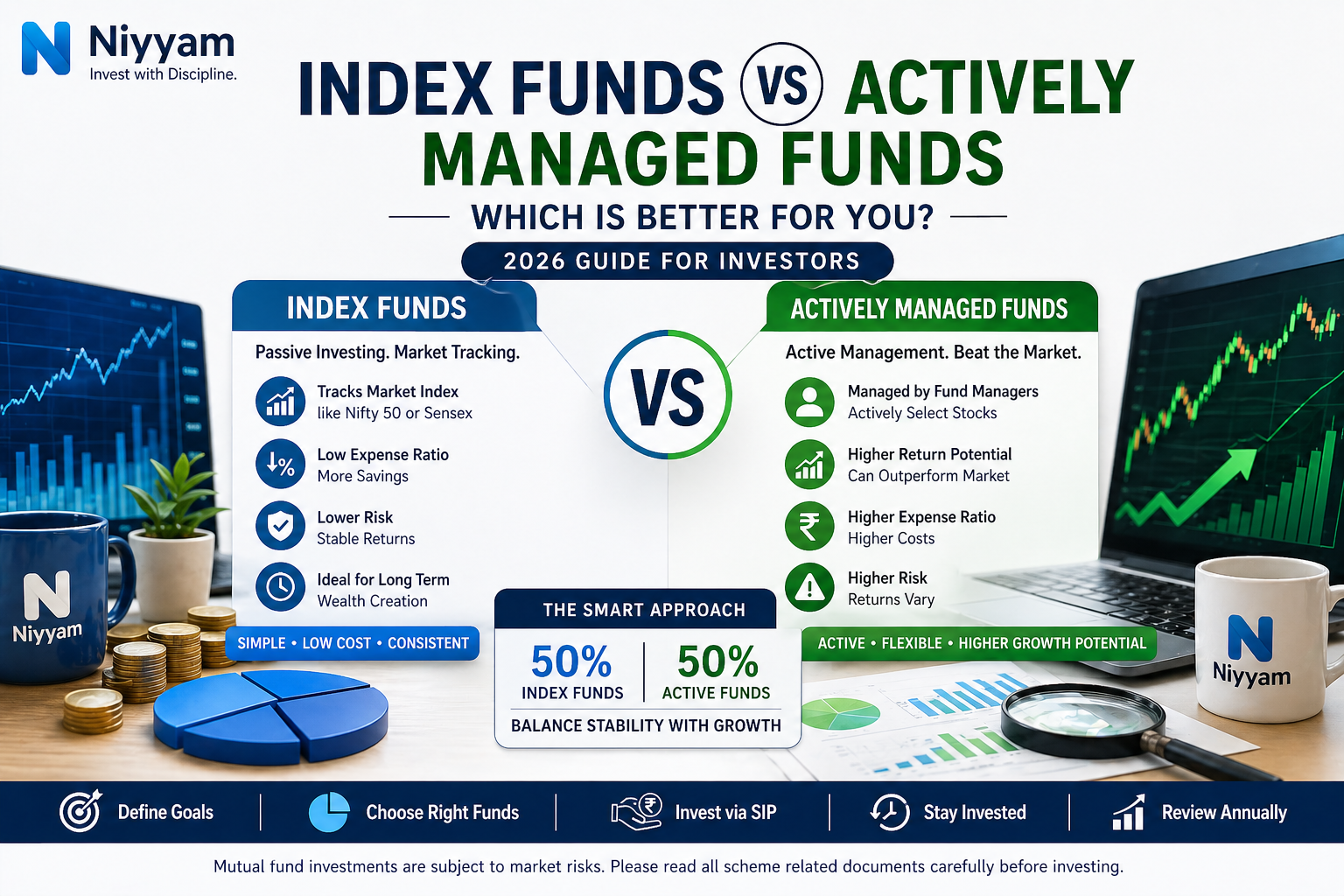
Index funds and actively managed funds both have their advantages:
- Index Funds are best for low-cost, long-term, stable investing
- Active Funds are suitable for higher return potential with higher risk
For most investors, a balanced combination of both provides the best results.
What Are Index Funds?
Index funds are mutual funds that track a market index such as:
- Nifty 50
- Sensex
They do not try to beat the market — they simply replicate it.
Example
If the Nifty 50 grows by 12%:
An index fund will deliver approximately 11–12% after expenses.
Key Features
- Passive investing
- Low cost
- No fund manager dependency
- Predictable long-term performance
Key Insight
Index funds are ideal for investors who prefer simplicity and consistency.
What Are Actively Managed Funds?
Actively managed funds are handled by professional fund managers.
Their goal is to outperform the market.
How They Work
- Select stocks actively
- Adjust portfolios based on market conditions
- Aim to beat benchmark returns
Example
If the market returns 12%:
- A good fund may deliver 14–16%
- A poor fund may deliver 8–10%
Key Features
- Higher return potential
- Active decision-making
- Higher expense ratio
- Performance variability
Key Insight
Active fund performance depends on the fund manager’s skill and consistency.
Key Differences Between Index and Active Funds
| Factor | Index Funds | Active Funds |
|---|---|---|
| Strategy | Follow market | Beat market |
| Risk | Lower | Moderate to High |
| Cost | Low | Higher |
| Returns | Market returns | Variable |
| Management | Passive | Active |
When Do Index Funds Perform Better?
Index funds perform well when:
- Markets are efficient
- Fund managers struggle to beat benchmarks
- Investment horizon is long (10+ years)
Indian Market Insight
In large-cap categories, many active funds fail to consistently outperform index funds.
Key Insight
Index funds are highly effective for long-term wealth creation with minimal effort.
When Do Active Funds Perform Better?
Active funds perform better when:
- Markets are volatile
- Opportunities exist in mid and small caps
- Skilled fund managers identify undervalued stocks
Key Insight
Active funds are more suitable for growth-oriented investors.
Expense Ratio: The Hidden Factor
One of the most important factors is cost.
Index Funds
- Very low expense ratio
Active Funds
- Higher cost due to management
Impact
Even a small difference (1–2%) can significantly affect long-term wealth.
To understand this deeply:
What is Expense Ratio in Mutual Funds? How It Affects Your Returns (2026 Guide)
Real-Life Scenario
Investor A (Index Only)
- SIP: ₹10,000
- Return: ~11–12%
- Outcome: Stable
Investor B (Active Only)
- SIP: ₹10,000
- Return: 10–15%
- Outcome: Volatile
Investor C (Balanced)
- Mix of both
Outcome
- Stability + growth
- Better consistency
Key Insight
Balanced investing reduces risk while maintaining growth.
The Smart Approach (Recommended Strategy)
Instead of choosing one, combine both.
Suggested Allocation
- 50% → Index Funds
- 50% → Active Funds
Why This Works
- Stability from index funds
- Growth from active funds
Key Insight
Asset allocation matters more than fund selection.
How This Impacts Your SIP Strategy
When investing via SIP:
- Consistency is key
- Fund selection influences outcomes
If exploring SIP funds:
Best Mutual Funds for SIP in India (2026 Guide for Beginners)
How to Evaluate an Active Fund Before Investing
Not all active funds are worth investing in.
What You Should Check
- Performance consistency (5–10 years)
- Performance during market downturns
- Fund manager track record
- Expense ratio compared to peers
Key Insight
A consistent fund is better than a high-return but unstable fund.
When Should You Prefer Index Funds Completely?
Index funds alone can be sufficient if:
- You want simplicity
- You do not want to track performance actively
- You have a long-term horizon (10–15 years)
- You prefer low-cost investing
Key Insight
For many investors, index funds alone can create strong long-term wealth.
When Should You Prefer Active Funds?
Active funds are useful when:
- You are investing in mid-cap or small-cap segments
- You are comfortable with higher volatility
- You can monitor performance periodically
Key Insight
Active funds require discipline, patience, and periodic review.
How to Decide What’s Right for You
Ask yourself:
- Do I want simplicity or higher returns?
- Can I handle market volatility?
- What is my time horizon?
If unsure:
How to Choose the Right Mutual Fund in India (A Beginner’s Practical Guide)
Common Mistakes to Avoid
- Assuming index funds are risk-free
- Chasing high returns in active funds
- Ignoring expense ratio
- Over-diversifying across too many funds
Key Insight
Investor behavior impacts returns more than fund choice.
Role of SIP in Both Strategies
SIP works effectively for both fund types.
It helps:
- Reduce market timing risk
- Build discipline
- Benefit from compounding
To understand compounding:
→ How SIP Builds Wealth Through Compounding (With Simple Examples)
Practical Strategy (What You Should Do Now)
If starting today:
Step 1
Start with:
- 1 Index Fund
- 1 Active (Flexi Cap) Fund
Step 2
Invest through SIP
Step 3
Stay invested for 5–10 years
Step 4
Review annually
Key Insight
Consistency matters more than complexity.
Frequently Asked Questions (FAQs)
1. Which is better: index funds or active funds?
Both are useful. A combination works best.
2. Are index funds safer?
They are less volatile but still market-linked.
3. Can active funds beat index funds?
Yes, but not consistently.
4. Should beginners start with index funds?
Yes, they are simple and cost-effective.
5. How many funds should I invest in?
Start with 1–2 funds.
Final Thoughts
There is no single correct answer.
- Index Funds = Simplicity and stability
- Active Funds = Growth and opportunity
Final Insight
Wealth is not created by choosing the perfect fund —
it is created by staying invested consistently.
Soft CTA
If you want to invest with clarity instead of confusion, structure matters.
Niyyam helps you simplify mutual fund investing and stay consistent with your financial goals.
Start your investment journey with confidence.
Disclaimer
This content is for educational purposes only and does not constitute investment advice.
Mutual fund investments are subject to market risks. Investors should read all scheme-related documents carefully before investing and consider their financial goals, risk tolerance, and investment horizon.
Share this guide with your friends, family, and colleagues to help them make better financial decisions.
If this article helped you, share it with at least one person who needs this guidance.
Leave a Reply