
By Ashok Prasad, Founder, Niyyam
Published: March 2026
When it comes to investing in mutual funds, one of the most common questions investors ask is:
“Should I choose active funds or passive funds?”
With the growing popularity of index funds and ETFs, passive investing is gaining attention in India. At the same time, actively managed funds continue to remain widely used and trusted.
So which strategy actually works better over the long term?
The answer is not about choosing one over the other. It is about understanding how each strategy works and where it fits into your financial journey.
Understanding the Basics
Before comparing both approaches, it is important to understand them clearly.
What is Active Investing?
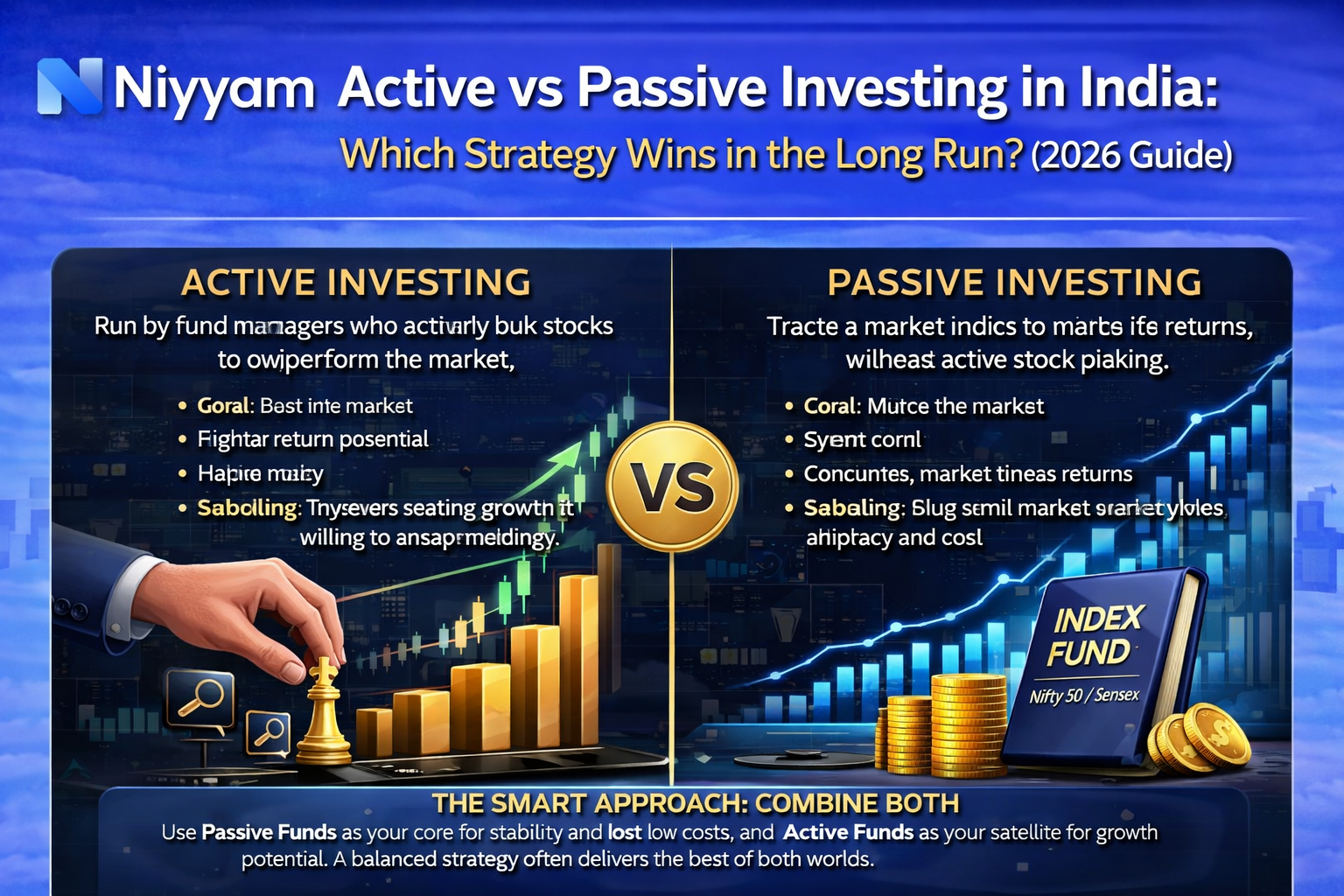
Active investing involves a fund manager making decisions to outperform the market.
Key characteristics:
- Stock selection based on detailed research
- Frequent portfolio adjustments
- Objective to beat benchmark indices such as Nifty 50 or Sensex
What is Passive Investing?
Passive investing focuses on replicating the performance of a market index.
Key characteristics:
- No active stock selection
- Tracks indices such as Nifty 50 or Sensex
- Objective to match market returns
The Core Difference
| Factor | Active Investing | Passive Investing |
|---|---|---|
| Objective | Beat the market | Match the market |
| Management | Fund manager driven | Rule-based |
| Cost | Higher | Lower |
| Risk | Higher variability | Market-level risk |
How Returns Differ
Active Funds: Opportunity with Uncertainty
Active funds offer the potential to outperform the market, but this is not guaranteed.
- Ability to identify high-growth companies
- Flexibility to adjust based on market conditions
- Potential to avoid underperforming sectors
However:
- Performance depends on the fund manager’s skill
- Consistency is difficult to maintain over long periods
Passive Funds: Stability with Limits
Passive funds aim to deliver returns aligned with the market.
- No dependency on fund manager decisions
- Predictable performance relative to the index
However:
- No opportunity to outperform the market
- Fully exposed to market movements
The Reality in India
The Indian market presents a unique situation.
- Markets are still evolving and not fully efficient
- Information gaps create opportunities
- Mid-cap and small-cap segments often provide alpha opportunities
This means:
- Skilled active fund managers can outperform in certain phases
- However, this outperformance is not consistent across time
The Impact of Costs
Cost plays a crucial role in long-term investing.
- Active Funds: 1% to 2.25% expense ratio
- Passive Funds: 0.1% to 0.5% expense ratio
Even a small difference in cost can significantly impact long-term wealth due to compounding.
For a deeper understanding, refer to:
What is Expense Ratio in Mutual Funds? How It Affects Your Returns (2026 Guide)
Performance Over the Long Term
There is no single winner. Each strategy performs better under different conditions.
Active Investing Performs Better When:
- Markets are volatile
- Fund managers identify strong opportunities
- Mid-cap and small-cap segments are growing
Passive Investing Performs Better When:
- Markets are efficient
- Most active funds fail to outperform benchmarks
- Long-term discipline is maintained
- Cost savings compound over time
Quick Allocation Rule of Thumb
A balanced approach often works best.
Beginner Investors
- 70% Passive Funds
- 30% Active Funds
Focus: Stability and simplicity
Moderate Investors
- 60% Passive Funds
- 40% Active Funds
Focus: Balanced growth and cost control
Aggressive Investors
- 40% Passive Funds
- 60% Active Funds
Focus: Higher return potential with higher risk
A simple guiding principle:
- Use passive funds as the foundation
- Use active funds to enhance growth potential
The Biggest Risk: Expectations
Many investors make decisions based on incorrect expectations.
Common mistakes include:
- Expecting guaranteed outperformance from active funds
- Switching strategies frequently
- Reacting to short-term market movements
- Following trends instead of a structured plan
How This Connects to Your Mutual Fund Understanding
To make better decisions, it is important to understand the fundamentals.
- How your money works inside a mutual fund
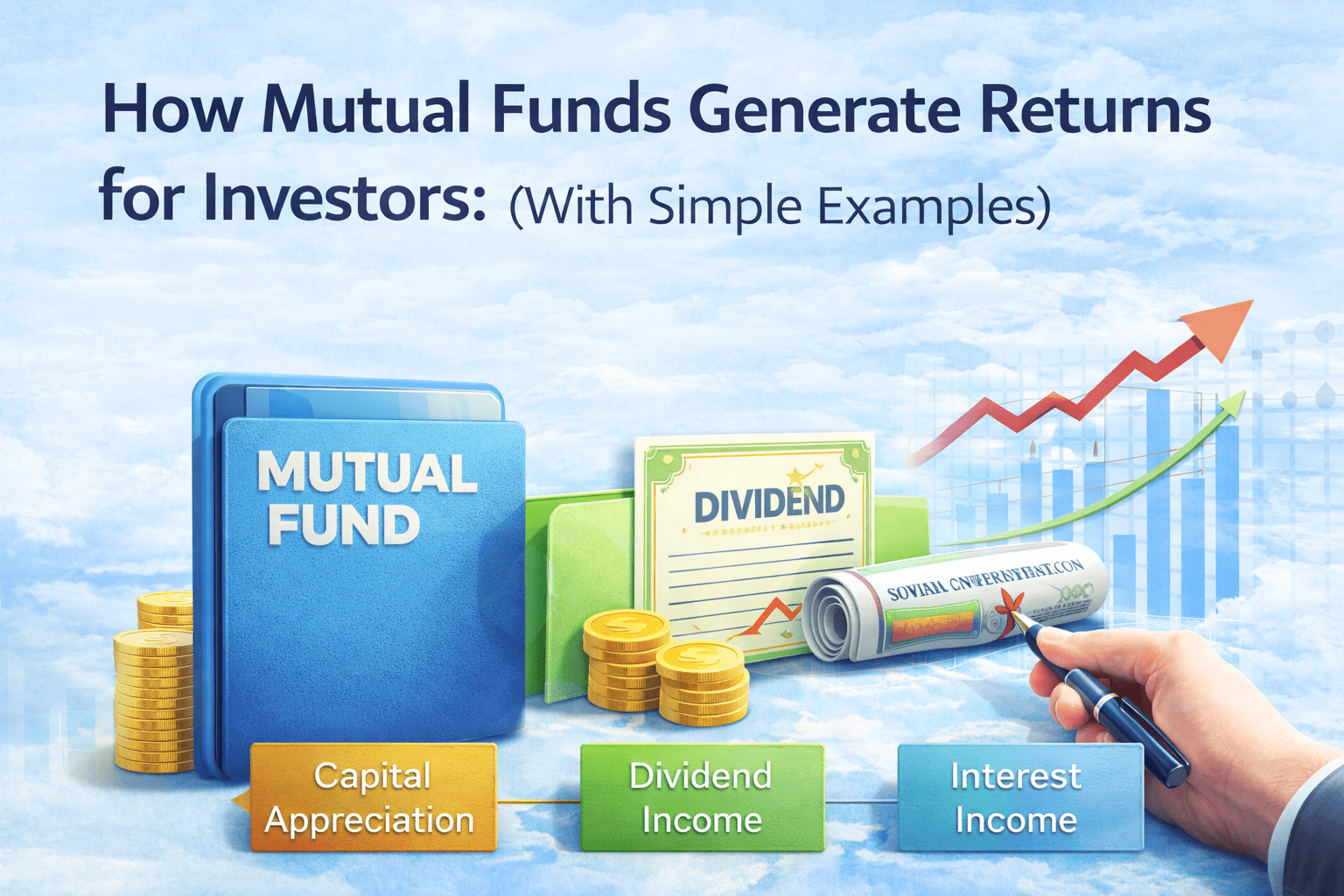
- How returns are generated
How Mutual Funds Generate Returns for Investors (With Simple Examples) - Portfolio allocation strategies
Mutual Fund Portfolio Allocation Strategy (Equity vs Debt Explained)
Risk Comparison
Risks in Active Funds
- Dependence on fund manager decisions
- Possibility of underperformance
- Higher costs impacting returns
Risks in Passive Funds
- Full exposure to market downturns
- No downside protection
- No opportunity for outperformance
A Practical Approach: Combining Both
A combination strategy can provide balance.
- Core Portfolio (60% to 70%)
- Passive funds
- Focus on stability and cost efficiency
- Satellite Portfolio (30% to 40%)
- Active funds
- Focus on higher return potential
This approach allows:
- Diversification across strategies
- Better cost control
- Improved long-term outcomes
Real-World Perspective
Consider two investors:
- One invests only in active funds and depends heavily on fund manager performance
- Another uses a mix of passive and selected active funds
Over time:
- The first investor may face inconsistent returns
- The second investor benefits from both stability and growth
Long-Term Wealth Creation Principle
A key principle to remember:
Consistency matters more than strategy complexity.
- Stay invested
- Avoid unnecessary changes
- Focus on long-term compounding
Refer to:
How SIP Builds Wealth Through Compounding (With Simple Examples)
When to Choose Active Investing
Active investing may suit you if:
- You seek higher return potential
- You can handle market volatility
- You are investing in mid-cap or small-cap segments
- You are willing to monitor performance periodically
When to Choose Passive Investing
Passive investing may suit you if:
- You prefer simplicity
- You want low-cost investing
- You do not want to track markets actively
- You believe in long-term market growth
Decision Framework
A simple way to decide:
- Preference for simplicity → Passive investing
- Preference for higher return potential → Active investing
- Preference for balance → Combination of both
Key Takeaways
- Active investing aims to outperform, but is not guaranteed
- Passive investing offers consistency and lower costs
- Costs significantly impact long-term returns
- India still offers opportunities for active investing
- A hybrid approach often works best
- Investor discipline is more important than strategy choice
Final Perspective
There is no universal winner between active and passive investing.
- Passive investing provides consistency and cost efficiency
- Active investing offers flexibility and potential outperformance
Ultimately:
The investor who stays disciplined and consistent is the one who benefits the most.
Frequently Asked Questions (FAQs)
1. Are passive funds safer than active funds?
Both are market-linked. Passive funds remove fund manager risk but still carry market risk.
2. Can active funds consistently outperform the market?
Very few funds manage to do this consistently over long periods.
3. Are passive funds suitable for beginners?
Yes. They are simple, transparent, and cost-effective.
4. Is it advisable to combine both strategies?
Yes. A combination approach is often practical and balanced.
Disclaimer
This content is for educational purposes only and does not constitute investment advice.
Mutual fund investments are subject to market risks. Investors should read all scheme-related documents carefully before investing and consider their financial goals, risk tolerance, and investment horizon.
Share this guide with your friends, family, and colleagues to help them make better financial decisions.
If this article helped you, share it with at least one person who needs this guidance.
Leave a Reply