
By Ashok Prasad, Founder, Niyyam
Published: April 2026
Introduction
Why do some mutual funds give higher returns but feel more risky?
The answer lies in alpha and beta in mutual funds—two key metrics that most investors ignore.
Understanding alpha and beta in mutual funds helps investors evaluate both performance and risk effectively.
When most investors in India choose mutual funds, they focus only on past returns. They compare 1-year or 3-year returns and simply pick the fund that shows the highest numbers.
At first glance, this seems logical. After all, higher returns should mean a better investment.
Not necessarily.
This approach is incomplete and often dangerous.
Two mutual funds can deliver similar returns, yet one may be taking significantly higher risk than the other. If you ignore this difference, you may unknowingly invest in a fund that looks attractive on paper but is actually misaligned with your risk tolerance.
This is exactly where alpha and beta in mutual funds become critical.
At first glance, this seems logical. After all, higher returns should mean a better investment.
Not necessarily.
This approach is incomplete and often dangerous.
Two mutual funds can deliver similar returns, yet one may be taking significantly higher risk than the other. If you ignore this difference, you may unknowingly invest in a fund that looks attractive on paper but is actually misaligned with your risk tolerance.
This is exactly where alpha and beta in mutual funds become critical.
These two metrics go beyond surface-level returns and help answer deeper questions:
- Is the fund genuinely outperforming the market?
- How much risk is the fund taking to generate those returns?
- Is the performance sustainable or just temporary?
In this guide, you will not only understand what alpha and beta mean, but more importantly, how to use them in real-life investment decisions.
💡 Key Takeaways
- Alpha measures excess return over the benchmark
- Beta measures volatility compared to the market
- A good fund should have a consistent positive alpha
- High beta means higher risk and fluctuation
- Alpha without consistency is misleading
- Beta should always match your risk profile
- The best funds combine strong alpha with controlled beta
Direct Answer
Alpha and beta in mutual funds are key performance metrics used to evaluate returns and risk. Alpha measures how much extra return a fund generates compared to its benchmark, while beta indicates how volatile the fund is relative to the market. Investors should focus on funds with consistent positive alpha and a beta aligned with their risk tolerance.
What is Alpha in Mutual Funds?
Alpha represents the extra return a mutual fund generates compared to its benchmark index.
Simple Definition
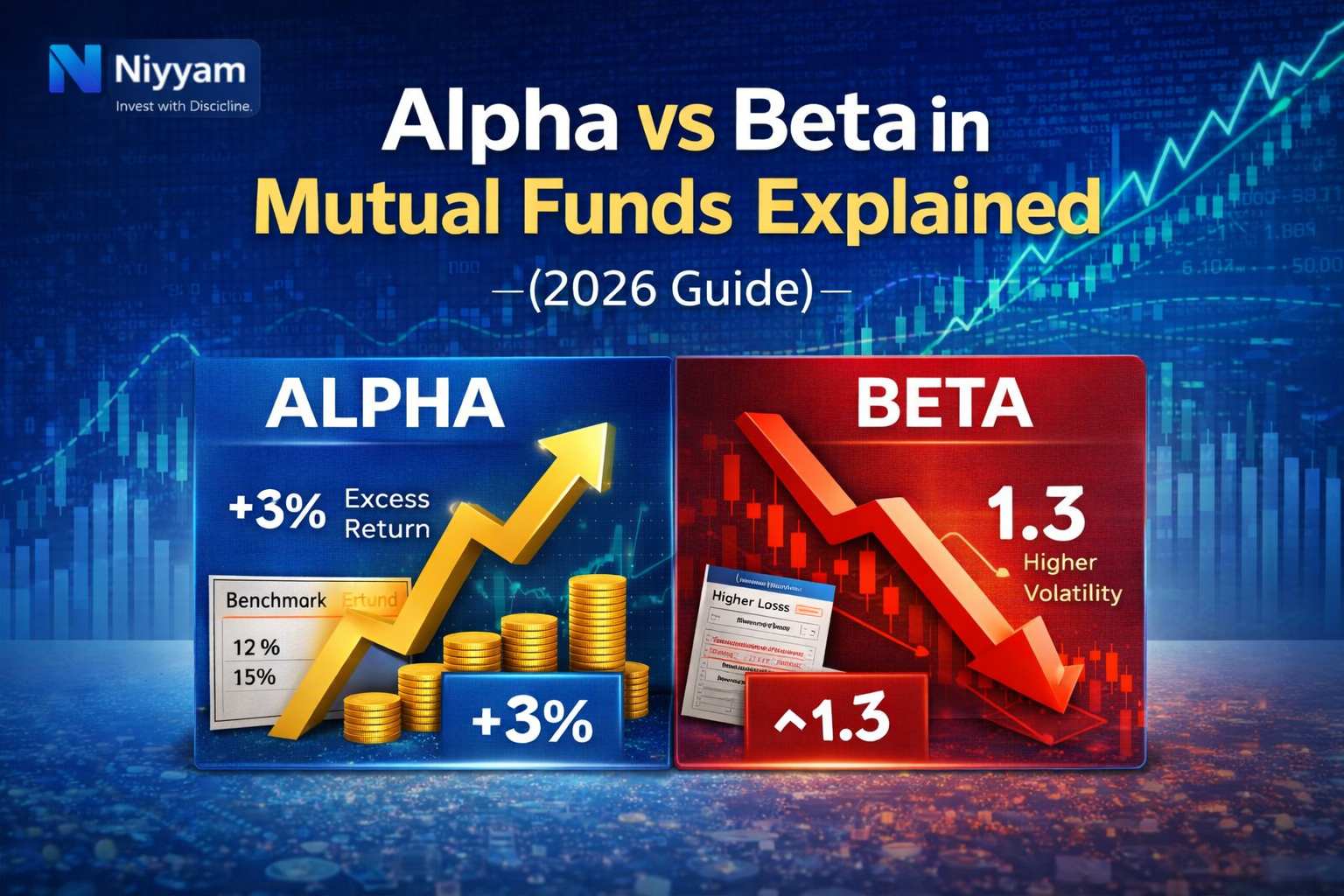
Alpha = Fund Return – Benchmark Return
Example
| Fund | Return | Benchmark | Alpha |
|---|---|---|---|
| Fund A | 15% | 12% | +3% |
| Fund B | 10% | 12% | -2% |
- Fund A is outperforming the market
- Fund B is underperforming
Why Alpha Matters
Alpha tells you whether the fund manager is actually adding value through active decisions like stock selection, sector allocation, and timing.
However, one-time alpha is not enough.
Consistent alpha over multiple years is what truly matters.
A fund may generate high alpha in one year due to a specific sector rally, but that does not mean it will sustain that performance.
What is Beta in Mutual Funds?
Beta measures how much a mutual fund’s returns move compared to the overall market.
It reflects the volatility or risk level of the fund.
Beta Interpretation
| Beta | Meaning |
|---|---|
| 1 | Moves exactly like the market |
| >1 | More volatile than the market |
| <1 | Less volatile than the market |
Example
| Fund | Beta | Meaning |
|---|---|---|
| Fund A | 1.3 | High volatility |
| Fund B | 0.8 | Lower risk |
Why Beta Matters
Beta helps you understand:
- How much your investment may fluctuate
- How deep losses could be during market corrections
- Whether the fund matches your risk tolerance
A high-beta fund may give higher returns, but it will also fall harder during market downturns.
Alpha vs Beta in Mutual Funds: What Should You Focus On?
| Factor | Alpha | Beta |
|---|---|---|
| Measures | Performance | Risk |
| Focus | Excess return | Volatility |
| Ideal Value | Positive | Depends on investor |
| Use | Fund selection | Risk alignment |
How to Actually Use Alpha and Beta (The Practical Framework)
This is where most investors fail—not in understanding the concepts, but in applying them correctly.
Step 1: Never Look at Alpha Alone
A fund with high alpha may:
- Be taking excessive risk
- Be concentrated in a single sector
- Perform well only in a bull market
Always evaluate alpha alongside beta.
Step 2: Match Beta with Your Risk Profile
| Investor Type | Ideal Beta Range |
|---|---|
| Conservative | 0.7 – 0.9 |
| Moderate | 0.9 – 1.1 |
| Aggressive | 1.1 – 1.3 |
Choosing the wrong beta is one of the biggest reasons investors panic and exit at the wrong time.
Step 3: Evaluate Alpha Consistency
Instead of checking short-term alpha:
- Look at 3-year and 5-year performance
- Observe performance across market cycles
- Check if alpha is stable or fluctuating
Consistency is more important than short-term spikes.
Step 4: Combine Alpha + Beta (Decision Matrix)
| Scenario | Interpretation |
|---|---|
| High Alpha + Low Beta | Excellent fund |
| High Alpha + High Beta | Risky but rewarding |
| Low Alpha + High Beta | Avoid |
| Low Alpha + Low Beta | Safe but low returns |
Real-Life Investor Behavior (Critical Insight)
Investor 1 (Common Mistake)
- Chooses a fund based on recent high returns
- Ignores beta
- Panics during market fall
- Sells at a loss
Result: Wealth destruction and frustration
Investor 2 (Smart Approach)
- Evaluates alpha over 5 years
- Chooses moderate beta
- Understands volatility
- Stays invested
Result: Stable wealth creation
Advanced Insights (Authority Section)
Alpha Can Be Misleading
High alpha may result from:
- Sector concentration
- Temporary trends
- Small-cap rallies
Always verify sustainability.
Beta is Not Fixed
Beta changes over time due to:
- Market conditions
- Portfolio rebalancing
- Strategy shifts
Do not assume beta is permanent.
Category Matters
| Fund Type | Alpha Importance | Beta Importance |
|---|---|---|
| Large Cap | Medium | High |
| Mid Cap | High | High |
| Small Cap | Very High | Very High |
| Index Funds | Low | Very High |
For index funds, beta matters more because alpha is minimal.
Common Mistakes Investors Make
- Selecting funds based on short-term alpha
- Ignoring beta completely
- Comparing funds across different categories
- Not checking benchmark relevance
- Overreacting to volatility
Pro Tips
- Always evaluate 3–5 year data
- Use beta to understand risk, not fear it
- Avoid extreme beta funds as a beginner
- Combine with other metrics like expense ratio and Sharpe ratio
- Focus on consistency, not short-term returns
Conclusion
Understanding alpha and beta transforms you from a return-chasing investor into a strategy-driven investor.
Alpha tells you whether a fund is outperforming.
Beta tells you how much risk it is taking.
The goal is not to find the highest alpha or lowest beta.
The goal is to find the right balance between return and risk based on your financial goals.
Investing is not about chasing returns.
It is about making consistent and well-informed decisions over time.
Frequently Asked Questions (FAQs)
What is a good alpha in mutual funds?
A positive alpha is good, but consistency over multiple years is more important.
Is high beta always risky?
High beta means higher volatility and can lead to both higher gains and deeper losses.
Should beginners focus on alpha or beta?
Beginners should focus more on beta and risk control.
Do index funds have alpha?
Index funds aim to match the market, so alpha is usually close to zero.
How often should I check alpha and beta?
Review once every 6–12 months.
Disclaimer
This content is for educational purposes only and does not constitute investment advice.
Mutual fund investments are subject to market risks. Investors should read all scheme-related documents carefully before investing and consider their financial goals, risk tolerance, and investment horizon.
Share this guide with your friends, family, and colleagues to help them make better financial decisions.
If this article helped you, share it with at least one person who needs this guidance.
Leave a Reply