By Ashok Prasad, Founder, Niyyam
Published: March 2026
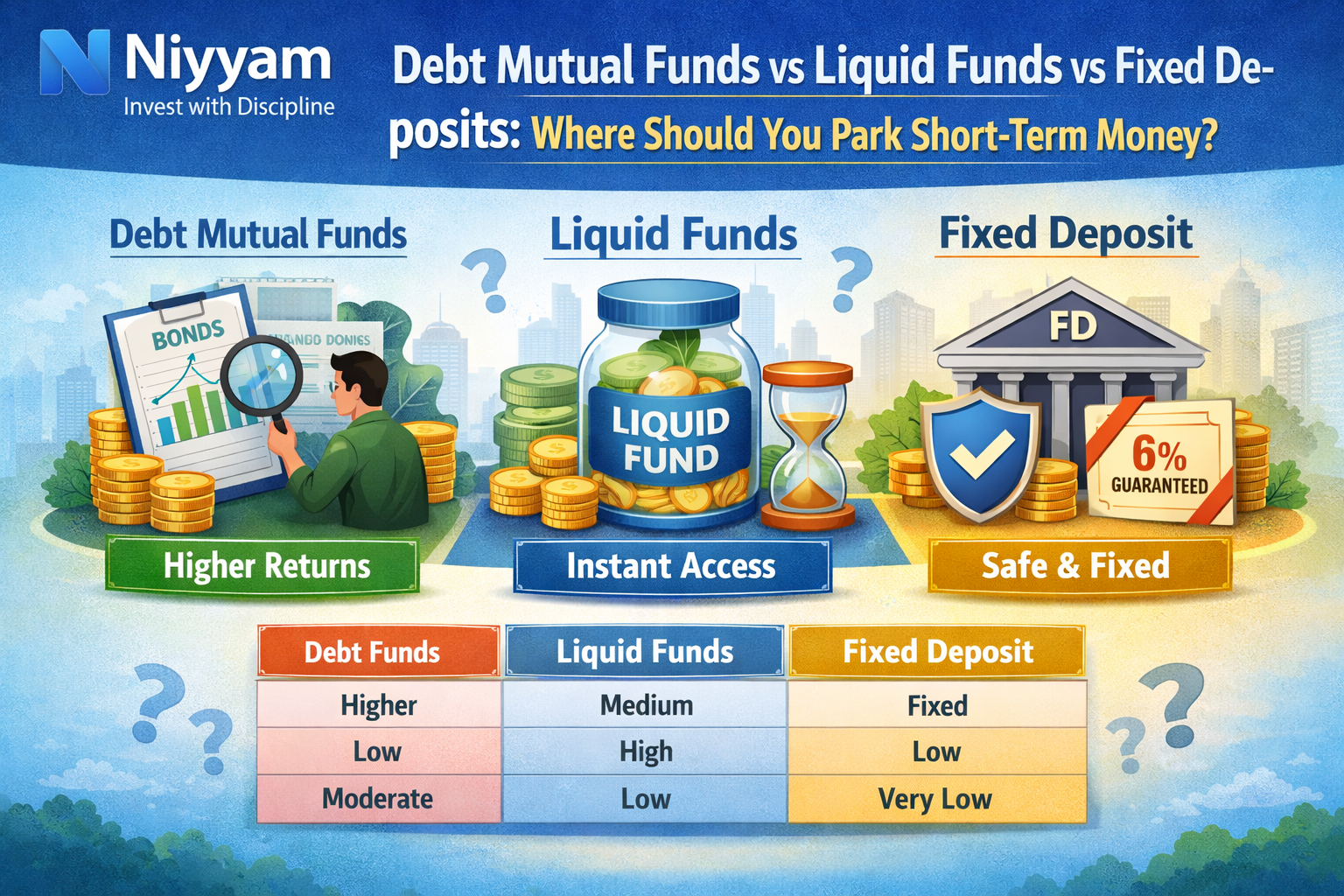
Fixed deposit vs liquid funds vs debt funds is one of the most important decisions for short-term investing, where the goal is to balance safety, liquidity, and reasonable returns.
When it comes to short-term money (typically 1–3 years), investors often face a common confusion:
- Should you choose fixed deposits for safety?
- Use liquid funds for flexibility?
- Or consider debt mutual funds for better returns?
This decision is critical because:
- You cannot afford high risk in short-term goals
- You still want better returns than a savings account
- You need liquidity and safety together
Choosing the wrong option can lead to:
- Capital loss
- Liquidity issues
- Missed opportunities
The correct approach is not choosing one blindly, but understanding where each option fits best.
💡 Key Takeaways
- Fixed deposits offer guaranteed returns and maximum safety
- Liquid funds provide high liquidity with low risk
- Debt funds offer slightly higher returns with moderate risk
- Short-term investing should prioritize safety over returns
- A combination approach often works best
Direct Answer
Which is best for short-term investment: FD, liquid fund, or debt fund?
For short-term investing, liquid funds are best for liquidity, debt funds are suitable for slightly higher returns over 6–24 months, and fixed deposits are ideal for guaranteed returns. The best option depends on your time horizon and liquidity needs.
Understanding the Three Options Clearly
1. Fixed Deposits (FDs)
Fixed deposits are one of the most traditional and widely used investment options.
Key Features
- Guaranteed returns
- Fixed tenure
- Very low risk
Advantages
- Predictable income
- No market volatility
- Simple and easy to understand
Limitations
- Premature withdrawal penalty
- Limited liquidity
- Returns may not beat inflation
2. Liquid Funds
Liquid funds are mutual funds that invest in short-term instruments.
Key Features
- High liquidity
- Low risk
- Slightly better returns than savings accounts
Advantages
- Quick withdrawal (usually within 24 hours)
- No lock-in
- Efficient for short-term parking
Ideal Duration
- 1 day to 6 months
3. Debt Mutual Funds
Debt funds invest in bonds, government securities, and corporate instruments.
Key Features
- Moderate returns
- Low to moderate risk
- Better flexibility than FDs
Advantages
- Potential for higher returns than FDs
- Suitable for short to medium duration
- Diversification
Ideal Duration
- 6 months to 3 years
Quick Comparison Table
| Feature | FD | Liquid Fund | Debt Fund |
|---|---|---|---|
| Returns | Fixed | Low | Moderate |
| Risk | Very low | Low | Moderate |
| Liquidity | Low | High | Medium |
| Flexibility | Low | High | Medium |
Best Option Based on Your Goal
Choosing the right option depends on your objective.
Goal-Based Recommendation
| Goal Type | Best Option |
|---|---|
| Emergency fund | Liquid fund |
| Parking money (few months) | Liquid fund |
| Short-term goal (6–12 months) | Debt fund |
| Guaranteed return need | FD |
When Should You Choose Fixed Deposits?
Ideal Scenarios
- Capital safety is your highest priority
- You want guaranteed returns
- You have a fixed time horizon
- You prefer predictable outcomes
FDs are best suited for conservative investors.
When Should You Choose Liquid Funds?
Ideal Scenarios
- Emergency funds
- Temporary parking of money
- Very short-duration investments
Liquid funds provide flexibility and quick access.
When Should You Choose Debt Funds?
Ideal Scenarios
- Investment horizon of 6–24 months
- Slightly higher return expectations
- Moderate risk tolerance
Debt funds provide a balance between return and safety.
Returns Comparison (2026 Expectations)
| Investment Type | Expected Return |
|---|---|
| Savings Account | 2.5–4% |
| Fixed Deposit | 6–7.5% |
| Liquid Fund | 5–6.5% |
| Debt Fund | 6–8% |
Key Insight
Higher returns usually come with slightly higher risk.
Real-Life Allocation Examples
₹1 Lakh Portfolio
| Type | Allocation | Amount |
|---|---|---|
| FD | 50% | ₹50,000 |
| Liquid Fund | 30% | ₹30,000 |
| Debt Fund | 20% | ₹20,000 |
₹5 Lakh Portfolio
| Type | Allocation | Amount |
|---|---|---|
| FD | 40% | ₹2,00,000 |
| Liquid Fund | 30% | ₹1,50,000 |
| Debt Fund | 30% | ₹1,50,000 |
₹10 Lakh Portfolio
| Type | Allocation | Amount |
|---|---|---|
| FD | 35% | ₹3,50,000 |
| Liquid Fund | 35% | ₹3,50,000 |
| Debt Fund | 30% | ₹3,00,000 |
Interest Rate Impact (Important Insight)
Interest rates affect different instruments differently.
Impact Comparison
| Scenario | FD | Debt Fund |
|---|---|---|
| Interest rates rise | No impact | Prices may fall |
| Interest rates fall | No impact | Prices may rise |
Key Insight
Debt funds are sensitive to interest rate changes, while FDs are not.
Taxation Comparison
| Investment | Tax Treatment |
|---|---|
| FD | As per income slab |
| Liquid Fund | As per income slab |
| Debt Fund | As per income slab |
Risk Comparison
| Risk Type | FD | Liquid Fund | Debt Fund |
|---|---|---|---|
| Credit Risk | No | Low | Moderate |
| Interest Rate Risk | No | Low | Medium |
| Liquidity Risk | Medium | Low | Medium |
Quick Rule of Thumb
- 0–6 months → Liquid funds
- 6–24 months → Debt funds
- Need guaranteed returns → FD
How to Decide the Right Option (Step-by-Step Framework)
Choosing between FD, liquid funds, and debt funds can be confusing.
Use this simple framework:
Step 1: Identify Time Horizon
- Less than 6 months → Liquid fund
- 6 to 24 months → Debt fund
- Fixed duration → FD
Step 2: Check Liquidity Needs
- Need instant access → Liquid fund
- Can wait → Debt fund
- No liquidity needed → FD
Step 3: Understand Risk Tolerance
- Very low risk → FD
- Low risk → Liquid fund
- Moderate risk → Debt fund
Step 4: Define Purpose
- Emergency fund → Liquid fund
- Short-term goal → Debt fund
- Guaranteed returns → FD
Key Insight
The right investment depends on your situation, not just returns.
Real-Life Scenario: Choosing the Right Option
Let’s simplify this with practical examples.
Scenario 1: Emergency Fund (₹2 Lakh)
- Requirement: Immediate access
- Best Option: Liquid fund
Scenario 2: Vacation in 1 Year (₹3 Lakh)
- Requirement: Safety + moderate returns
- Best Option: Debt fund
Scenario 3: Fixed Goal After 2 Years (₹5 Lakh)
- Requirement: Guaranteed return
- Best Option: FD
Key Insight
Different goals require different instruments.
There is no single “best” option.
Common Mistakes Investors Make
- Chasing higher returns
- Ignoring liquidity
- Using equity for short-term goals
- Locking money without planning
To reduce risk, refer to How to Reduce Risk in Mutual Fund Investing (2026 Guide).
When NOT to Use Debt Funds
Debt funds are not suitable when:
- Investment horizon is less than 3 months
- You need emergency access
- You have very low risk tolerance
Advanced Insight: Ladder Strategy
Instead of choosing one option, combine all three.
Ladder Approach
| Duration | Instrument |
|---|---|
| 0–3 months | Liquid fund |
| 3–12 months | Debt fund |
| 1–3 years | FD |
Why This Works
- Improves liquidity
- Balances returns
- Reduces risk
How to Build a Smart Short-Term Portfolio
A well-balanced strategy is essential.
Suggested Approach
- Emergency fund → Liquid funds
- Short-term goals → Debt funds
- Safety needs → FDs
To understand allocation, refer to Mutual Fund Portfolio Allocation Strategy (Equity vs Debt vs Hybrid – 2026 Guide).
For low-risk strategies, refer to Best Low-Risk Mutual Funds Strategy in India (2026 Guide).
For short-term planning, refer to How to Choose Mutual Funds for Short-Term Goals (1–3 Years Investment Strategy 2026 Guide).
Advanced Insight: Behavior Matters
Successful short-term investing depends on:
- Planning
- Liquidity management
- Risk control
It is not about maximizing returns.
It is about protecting capital.
Conclusion
Choosing between fixed deposits, liquid funds, and debt funds is not about selecting the highest return option.
It is about:
- Matching investment with your goal
- Prioritizing safety and liquidity
- Maintaining discipline
Final Verdict
- FD = Safety
- Liquid Fund = Liquidity
- Debt Fund = Balance
Final Thought
Short-term investing is about protecting your money while keeping it accessible.
Frequently Asked Questions (FAQs)
1. Which is safest: FD, liquid fund, or debt fund?
FD is the safest.
2. Are liquid funds better than savings accounts?
Yes, generally.
3. Can debt funds give negative returns?
Yes, in certain cases.
4. Should I use equity for short-term goals?
No.
5. Which is best for emergency funds?
Liquid funds.
Disclaimer
This content is for educational purposes only and does not constitute investment advice.
Mutual fund investments are subject to market risks. Investors should read all scheme-related documents carefully before investing and consider their financial goals, risk tolerance, and investment horizon.
Share this guide with your friends, family, and colleagues to help them make better financial decisions.
If this article helped you, share it with at least one person who needs this guidance.
Leave a Reply