
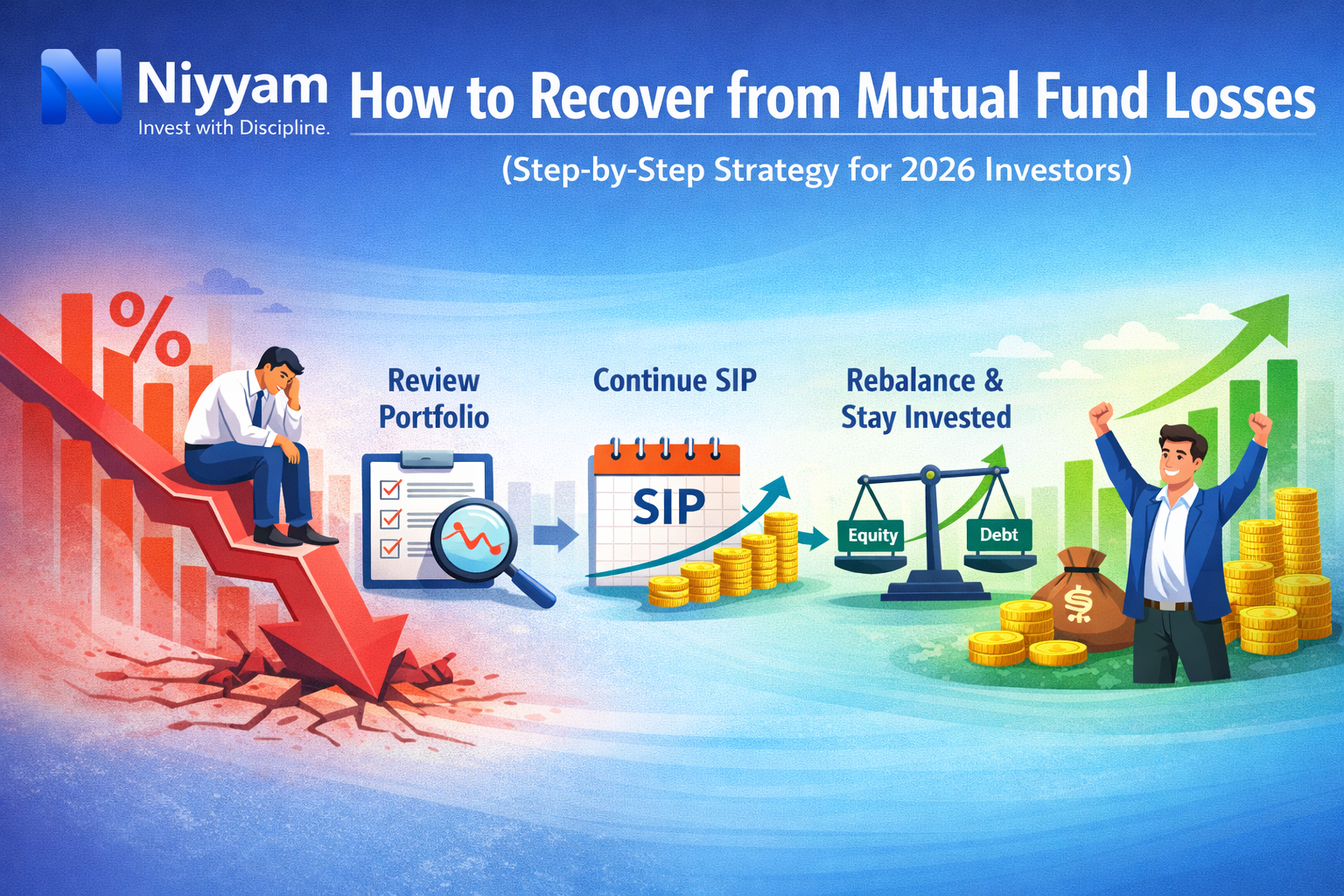
By Ashok Prasad, Founder, Niyyam
Published: March 2026
Seeing your mutual fund portfolio in loss can be stressful.
You open your investment dashboard expecting growth, but instead, you see negative returns. Naturally, doubts begin to arise:
- “Did I choose the wrong fund?”
- “Should I exit now?”
- “Will the market recover?”
This is exactly where most investors make their biggest mistake — they react emotionally instead of thinking strategically.
The truth is simple:
Losses in mutual funds are normal — permanent losses happen only when investors take wrong decisions during downturns.
In this guide, you will learn how to recover from mutual fund losses using a structured, step-by-step approach.
💡 Key Takeaways
- Most Losses Are Temporary: Market volatility is normal and usually reverses over time.
- Avoid Panic Selling: Selling during losses converts temporary decline into permanent damage.
- Analyze Before Acting: Identify whether the issue is market-driven or fund-specific.
- Use SIP to Accelerate Recovery: Investing during a downturn lowers average cost.
- Time is the Biggest Factor: Recovery depends on staying invested.
Why Do Mutual Fund Losses Happen?
Understanding the reason behind losses is the first step toward recovery.
Common Causes:
- Market corrections
- Economic slowdowns
- Global events
- Sector-specific decline
Important Insight:
- Most mutual fund losses are temporary and driven by market cycles
Refer:
How Inflation Impacts Your Mutual Fund Returns (And How to Beat It in 2026)
Types of Losses (Very Important)
1. Temporary Loss (Market-Based)
- Caused by the overall market decline
- Usually recovers over time
2. Structural Loss (Fund-Based)
- Poor fund performance
- Wrong fund selection
Key Insight:
- Your recovery strategy depends on identifying the type of loss
Step-by-Step Strategy to Recover from Losses
Step 1: Do Not Panic Sell
This is the most critical rule.
Why?
- Markets are cyclical
- Recovery is common
Important Insight:
- Patience is the first step toward recovery
Step 2: Identify the Reason for Loss
Ask yourself:
- Is the entire market down?
- Or is it only your fund underperforming?
Action:
- Market-based loss → Stay invested
- Fund-specific issue → Review and consider switching
Key Insight:
- Correct diagnosis leads to correct decisions
Step 3: Continue or Start SIP
SIP is one of the most powerful recovery tools.
Why SIP Helps:
- Buys more units at lower prices
- Reduces average cost
Important Insight:
- SIP accelerates recovery during market downturns
Refer:
What is Rupee Cost Averaging in SIP? How It Works with Real Examples (2026 Guide)
Step 4: Rebalance Your Portfolio
Market declines can disturb your asset allocation.
Example:
- Equity allocation reduces after a fall
Action:
- Gradually rebalance to maintain target allocation
Key Insight:
- Rebalancing improves long-term performance
Refer:
How to Rebalance Your Mutual Fund Portfolio (When, Why & How – 2026 Guide)
Step 5: Avoid Frequent Portfolio Checking
Checking daily movements increases stress.
Impact:
- Emotional reactions
- Poor decisions
Important Insight:
- Long-term investors should ignore short-term fluctuations
Step 6: Stay Focused on Financial Goals
Your investment is for goals, not daily returns.
Examples:
- Retirement planning
- Children’s education
- Wealth creation
Key Insight:
- Goals matter more than temporary losses
Practical Recovery Plan (Step-by-Step)
Step 1:
Continue SIP without interruption
Step 2:
Invest additional funds if possible
Step 3:
Review fund performance
Step 4:
Rebalance allocation
Step 5:
Stay invested for the long term
Important Insight:
- A structured plan improves recovery outcomes
Real-Life Example
Investor A
- Invests ₹2 lakh lump sum
- Market falls 20%
- Panics and exits
Result:
- Loss becomes permanent
Investor B
- Continues SIP
- Invests more during a downturn
Result:
- Faster recovery
- Higher long-term returns
Key Insight:
- Behavior determines investment success
How to Decide Whether to Hold, Switch, or Exit a Mutual Fund
One of the most important decisions during a loss phase is what action to take.
Hold the Fund If:
- The overall market is down
- The fund has a strong long-term track record
- The fund strategy remains consistent
Switch the Fund If:
- The fund underperforms consistently compared to peers
- Fund management or strategy has changed
- Risk level does not match your profile
Exit the Fund If:
- Your financial goal is near
- You need liquidity
- The investment no longer aligns with your plan
Key Insight:
- Decisions should be based on logic and long-term data, not short-term emotions
When Should You Exit?
Exit Only If:
- Fund consistently underperforms
- Investment goals change
- Risk tolerance shifts
Do NOT Exit If:
- The market is temporarily down
- Short-term losses occur
Important Insight:
- Exit decisions should be strategic, not emotional
Common Mistakes to Avoid
1. Panic Selling
Locks in losses
2. Stopping SIP
Slows down recovery
3. Frequent Switching
Reduces long-term returns
4. Following Market Noise
Leads to poor decisions
Key Insight:
- Consistency and patience are critical for recovery
Refer:
Why Most SIP Investors Fail to Build Wealth (And How to Avoid It in 2026)
How Long Does Recovery Take?
Depends On:
- Market cycle
- Investment horizon
- Fund quality
General Timeline:
- 1–3 years for recovery
- Longer for full growth
Important Insight:
- Time is the most powerful recovery tool
Advanced Strategy: Turn Loss into Opportunity
During Market Decline:
- Increase SIP contributions
- Invest a lump sum gradually
- Focus on quality funds
Key Insight:
- Market downturns create the best long-term opportunities
Refer:
How to Invest During a Market Crash in Mutual Funds (Smart Strategy for 2026 Investors)
Frequently Asked Questions (FAQs)
1. Should I exit mutual funds in loss?
No, unless there is a strong reason.
2. How can I recover losses faster?
Continue SIP and stay invested.
3. Are losses normal?
Yes, temporary losses are part of investing.
4. Should I switch funds?
Only if performance is consistently poor.
5. Can SIP recover losses?
Yes, effectively over time.
6. What is the biggest mistake?
Panic selling.
Final Thought
Losses are not failures.
They are part of the investment journey.
Most investors lose money not because markets fall,
but because they make poor decisions during those falls.
If you stay disciplined, patient, and consistent,
you can recover losses and build stronger wealth over time.
Disclaimer
This content is for educational purposes only and does not constitute investment advice.
Mutual fund investments are subject to market risks. Investors should read all scheme-related documents carefully before investing and consider their financial goals, risk tolerance, and investment horizon.
Share this guide with your friends, family, and colleagues to help them make better financial decisions.
If this article helped you, share it with at least one person who needs this guidance.
Leave a Reply