
By Ashok Prasad, Founder, Niyyam
Published: April 2026
Introduction
A mutual fund portfolio allocation strategy is the foundation of successful investing and long-term wealth creation.
Most investors begin by asking:
- Which mutual fund should I invest in?
- Which fund gives the highest returns?
- Which fund is best right now?
But experienced investors focus on a much more important question:
How should I allocate my portfolio?
Because over time, one truth becomes clear:
Wealth is not created by selecting one great fund. It is created by building a well-structured portfolio.
Many investors invest in multiple mutual funds without a clear allocation strategy. This leads to:
- Portfolio overlap
- Over-diversification
- Unnecessary risk
- Inconsistent returns
A well-structured portfolio, on the other hand:
- Aligns with your financial goals
- Balances risk and return
- Helps you stay invested during market volatility
- Creates long-term wealth through discipline
If you are new, first understand What is a Mutual Fund? A Simple Explanation for Beginners.
To learn how to select funds correctly, refer to How to Choose the Best Mutual Fund in India (Complete 2026 Framework).
💡 Key Takeaways
- Asset allocation drives the majority of long-term returns
- Portfolio structure matters more than fund selection
- Diversification should be controlled, not excessive
- 3–5 funds are enough for most investors
- Rebalancing is essential to maintain allocation
- Discipline and consistency drive wealth creation
Direct Answer
A mutual fund portfolio allocation strategy is the process of dividing investments across equity, debt, and hybrid mutual funds based on your goals, risk tolerance, and time horizon to achieve optimal returns while managing risk effectively.
PART 1: FOUNDATION (BEGINNER LEVEL)
What is Portfolio Allocation in Mutual Funds?
Portfolio allocation means distributing your investments across different types of mutual funds instead of putting all your money into a single category.
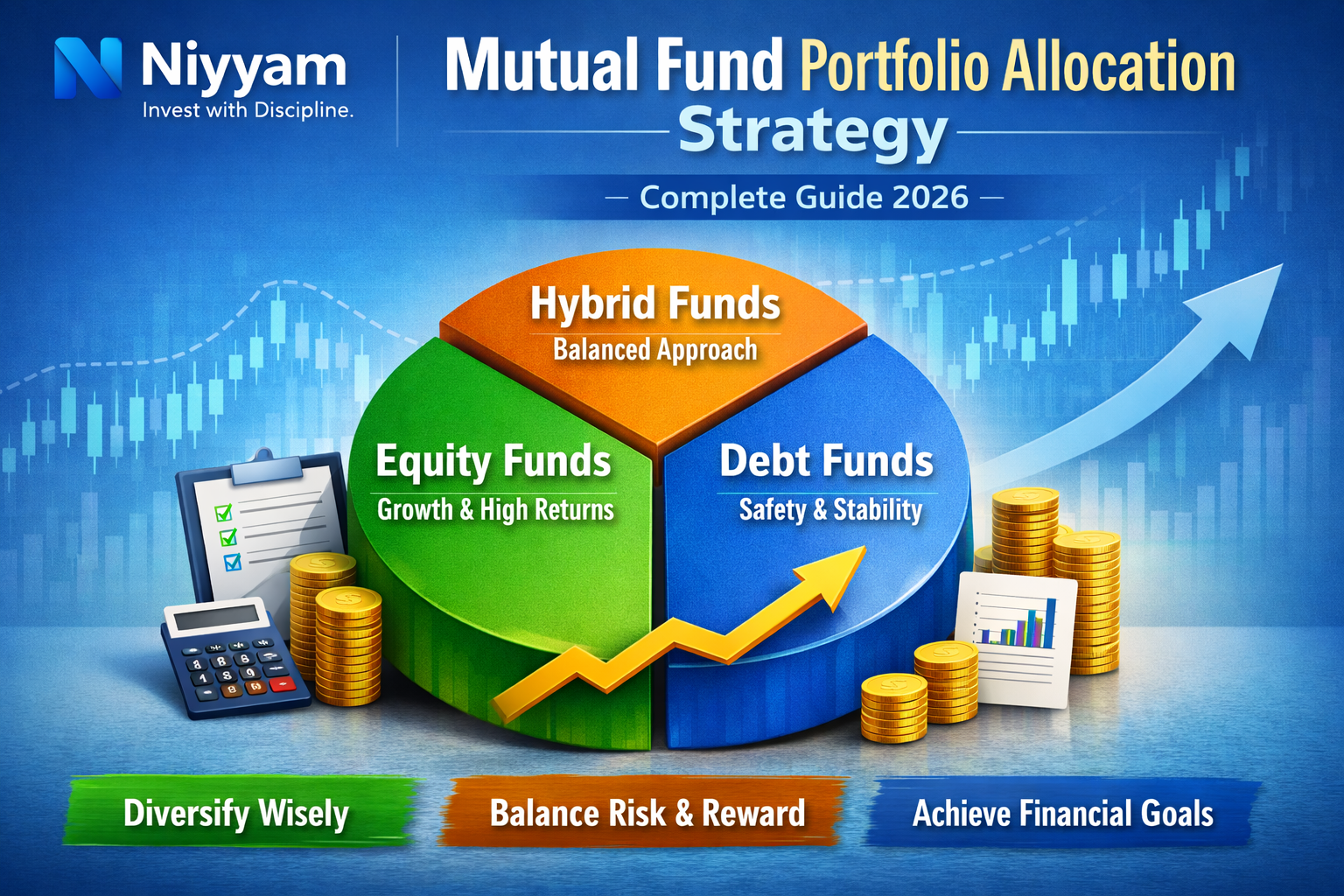
A balanced portfolio typically includes:
- Equity funds for growth
- Debt funds for stability
- Hybrid funds for balance
This diversification helps reduce risk and improve consistency.
To understand fund categories, read Types of Mutual Funds in India: Equity, Debt, and Hybrid Explained.
Why Portfolio Allocation Matters More Than Fund Selection
Most beginners believe that selecting the best-performing mutual fund is enough.
However, research and practical experience show that:
Asset allocation contributes nearly 70–80% of portfolio performance.
However, one critical factor that investors often ignore while building their portfolio is taxation.
Even a perfectly structured portfolio can deliver lower real returns if taxation is not taken into account. Different asset classes, such as equity and debt funds, are taxed differently, and frequent portfolio changes can significantly increase tax liability.
This is why understanding taxation is essential while designing your allocation strategy. A tax-efficient portfolio not only improves returns but also enhances long-term wealth creation.
To understand this in detail, refer to Mutual Fund Taxation in India (Complete 2026 Guide).
This means:
- Even average funds can perform well in a strong allocation
- Even top-performing funds can underperform in a poor allocation
For example:
Two investors invest in the same mutual funds.
- Investor A follows proper allocation
- Investor B invests randomly
After 10–15 years:
Investor A builds stable wealth
Investor B faces volatility and confusion
To understand how mutual funds generate returns, read How Mutual Funds Generate Returns for Investors (With Simple Examples).
The Three Core Asset Classes
Equity Funds (Growth Engine)
Equity funds invest in stocks and provide high growth potential.
They are ideal for:
- Long-term wealth creation
- Retirement planning
- Beating inflation
However, they come with short-term volatility.
To understand equity categories, read Large Cap vs Mid Cap vs Small Cap Funds: Where Should You Invest? (2026 Guide).
Debt Funds (Stability Engine)
Debt funds invest in fixed-income instruments.
They provide:
- Stability
- Lower risk
- Predictable returns
They are suitable for:
- Short-term goals
- Emergency funds
- Capital preservation
Hybrid Funds (Balance Engine)
Hybrid funds combine equity and debt.
They offer:
- Balanced risk
- Moderate returns
- Simplicity for beginners
How to Decide Your Asset Allocation
Risk Profile
Your risk tolerance determines how much volatility you can handle.
- Conservative → More debt
- Moderate → Balanced
- Aggressive → More equity
To align your portfolio, read How to Select Mutual Funds Based on Risk Profile in India (Beginner to Advanced Guide 2026).
Time Horizon
Time plays a major role in investment success.
- 1–3 years → Debt
- 3–7 years → Hybrid
- 7+ years → Equity
To plan duration effectively, read How to Choose the Right SIP Duration in Mutual Funds (2026 Guide for Maximum Returns).
Financial Goals
Your goals define your portfolio structure.
- Retirement → Equity heavy
- Short-term goals → Debt
- Wealth creation → Balanced
To plan effectively, read Goal-Based Investing in Mutual Funds: How to Plan SIPs for Financial Goals (2026 Guide).
PART 2: PORTFOLIO BUILDING (INTERMEDIATE LEVEL)
Ideal Portfolio Allocation Models
Beginner Portfolio
- 60% Equity
- 40% Debt
Moderate Portfolio
- 70% Equity
- 20% Debt
- 10% Hybrid
Aggressive Portfolio
- 80–90% Equity
- 10–20% Debt
Equity Allocation Breakdown
A balanced equity allocation includes:
- Large Cap → 40%
- Flexi Cap → 30%
- Mid Cap → 20%
- Small Cap → 10%
This ensures both stability and growth.
How Many Mutual Funds Should You Hold?
The ideal number is:
3–5 funds
Holding too many funds leads to:
- Portfolio overlap
- Complexity
- Reduced returns
To understand this clearly, read Should You Invest in Too Many Mutual Funds? (Ideal Portfolio Size Explained – 2026 Guide).
Portfolio Overlap: A Hidden Risk
Many investors unknowingly invest in funds with similar holdings.
This leads to:
- Duplicate exposure
- No real diversification
To fix this issue, read What is Portfolio Overlap in Mutual Funds & Why It Can Reduce Your Returns (2026 Guide).
Core and Satellite Strategy
Core Portfolio (70%)
- Large-cap or index funds
- Stable and consistent
Satellite Portfolio (30%)
- Mid-cap and small-cap funds
- Higher growth potential
To understand this strategy, read How to Build a Core and Satellite Mutual Fund Portfolio (2026 Advanced Strategy Guide).
SIP Allocation Strategy
Example:
₹10,000 SIP:
- ₹4,000 Large Cap
- ₹3,000 Flexi Cap
- ₹2,000 Mid Cap
- ₹1,000 Small Cap
To understand SIP, read What is SIP in Mutual Funds? A Complete Beginner’s Guide (2026).
To understand compounding, read How SIP Builds Wealth Through Compounding (With Simple Examples).
Lump Sum Allocation Strategy
Lump sum investing should be done carefully.
Strategies:
- Invest in phases
- Use STP
To understand this, read Lump Sum Investment Strategy in Mutual Funds: When and How to Invest (2026 Guide).
Rebalancing Your Portfolio
Over time, your allocation changes due to market movements.
While rebalancing is important for maintaining your desired allocation, it is equally important to consider its tax impact. Every rebalancing action may trigger capital gains tax, especially if it involves selling equity or debt funds.
Investors should rebalance strategically rather than frequently to avoid unnecessary tax outflows. Understanding how taxation works can help you make better rebalancing decisions.
To learn how taxation impacts your investment decisions, refer to Mutual Fund Taxation in India (Complete 2026 Guide).
Rebalancing ensures:
- Risk control
- Profit booking
- Alignment with goals
To learn how, read How to Rebalance Your Mutual Fund Portfolio (When, Why & How – 2026 Guide).
When to Review Your Portfolio
Ideal frequency:
- Once or twice a year
To follow a structured approach, read How to Review Your Mutual Fund Portfolio (When to Hold, Switch or Exit – 2026 Guide).
PART 3: ADVANCED STRATEGIES
Strategic vs Tactical Allocation
Another important dimension of advanced portfolio management is tax efficiency. Tactical allocation decisions, if executed frequently, can lead to higher tax liabilities due to short-term capital gains.
This is why experienced investors focus not only on allocation but also on minimizing taxable events. A well-designed strategy balances allocation, risk, and taxation together.
To understand tax-efficient investing in detail, refer to Mutual Fund Taxation in India (Complete 2026 Guide).
Strategic Allocation
- Fixed long-term allocation
- Example: 70% equity, 30% debt
Tactical Allocation
- Adjust based on market conditions
Example:
- Reduce equity during market highs
- Increase equity during market crashes
Allocation Based on Income Levels
Income ₹30,000
- SIP: ₹3,000–₹6,000
- Allocation: 60% equity
Income ₹50,000
- SIP: ₹5,000–₹10,000
- Allocation: 70% equity
Income ₹1,00,000+
- SIP: ₹15,000–₹25,000
- Allocation: 80% equity
Debt Allocation Strategy (Advanced)
Debt funds include:
- Liquid funds
- Short-duration funds
- Corporate bond funds
They are useful for:
- Stability
- Emergency funds
- Capital protection
Real-Life Case Studies
Investor A (No Strategy)
- Random investments
- No allocation
Result: Poor and inconsistent returns
Investor B (Structured Portfolio)
- Proper allocation
- Consistent SIP
Result: Stable wealth creation
Investor C (Advanced Strategy)
- Core + satellite
- Tactical allocation
Result: Optimized returns
Inflation and Portfolio Allocation
Inflation reduces purchasing power.
To understand its impact, read How Inflation Impacts Your Mutual Fund Returns (And How to Beat It in 2026).
Portfolio Allocation by Age
20s
- 80–90% equity
30s
- 70–80% equity
40s
- 60–70% equity
50+
- 40–60% equity
To understand deeply, read Best Asset Allocation Strategy by Age in India (20s, 30s, 40s, 50+) – 2026 Guide.
Behavioral Mistakes That Destroy Portfolios
Even perfect allocation fails due to behavior.
Common mistakes:
- Panic selling
- Stopping SIP
- Chasing returns
To understand this, read Why Most SIP Investors Fail to Build Wealth (And How to Avoid It in 2026).
Advanced Execution Framework
Step 1: Define goals
Step 2: Decide allocation
Step 3: Select 3–5 funds
Step 4: Allocate SIP
Step 5: Stay consistent
Step 6: Rebalance annually
Step 7: Increase SIP
Conclusion
A mutual fund portfolio allocation strategy is the backbone of investing success.
You don’t need:
- Complex strategies
- Too many funds
You need:
- Clear allocation
- Discipline
- Consistency
Final Thought
The best portfolio is not the most complex one.
It is the one you can follow consistently for years.
Frequently Asked Questions (FAQs)
What is ideal allocation?
Depends on risk and goals.
How many funds?
3–5 funds.
Should I rebalance?
Yes, annually.
Is diversification always good?
Only up to a limit.
Disclaimer
This content is for educational purposes only and does not constitute investment advice.
Mutual fund investments are subject to market risks. Investors should read all scheme-related documents carefully before investing and consider their financial goals, risk tolerance, and investment horizon.
Share this guide with your friends, family, and colleagues to help them make better financial decisions.
If this article helped you, share it with at least one person who needs this guidance.
Leave a Reply