
By Ashok Prasad, Founder, Niyyam
Published: March 2026
Introduction: The Real Problem with Lump Sum Investing
STP in mutual funds (Systematic Transfer Plan) is one of the safest ways to invest a lump sum without worrying about market timing.
Most investors don’t lose money because of bad funds—they lose money because they invest at the wrong time.
If you are confused about when to invest or worried about entering at the wrong level, STP provides a structured and disciplined solution.
It could be from a bonus, accumulated savings, or proceeds from selling an asset.
Naturally, the next question is:
“Should I invest everything right now?”
At first, it seems simple. But this is where most investors get stuck.
The fear is not about investing.
The fear is about timing.
- What if the market falls right after I invest?
- What if I invest at the peak?
- What if I lose money in the short term?
Because of these doubts, many investors:
- Delay investing for months
- Keep money idle in savings accounts
- Miss the power of compounding
This is not a small problem.
In fact, this hesitation alone can cost years of wealth creation.
If you are wondering how to invest a lump sum in mutual funds in India without taking high risk, STP in mutual funds is one of the most practical strategies available.
If you are trying to understand market timing better, you can also refer to
Best Time to Invest in Mutual Funds in India (2026 Guide for Smart Investors)
The solution is not guessing the market.
The solution is using a structured approach.
That approach is called STP (Systematic Transfer Plan).
💡 Key Takeaways
- STP helps you invest a lump sum gradually
- It reduces the risk of entering the market at the wrong time
- It works best during volatile or uncertain markets
- It typically involves transferring money from a liquid fund to equity funds
- It allows disciplined and emotion-free investing
- It is ideal for conservative and moderate investors
- It can be combined with SIP for long-term wealth creation
Direct Answer
STP (Systematic Transfer Plan) allows you to invest a lump sum gradually by transferring money from a low-risk fund (like a liquid fund) into equity funds over a fixed period. This reduces timing risk, improves discipline, and helps you enter the market more safely.
What is STP in Mutual Funds (Systematic Transfer Plan)?
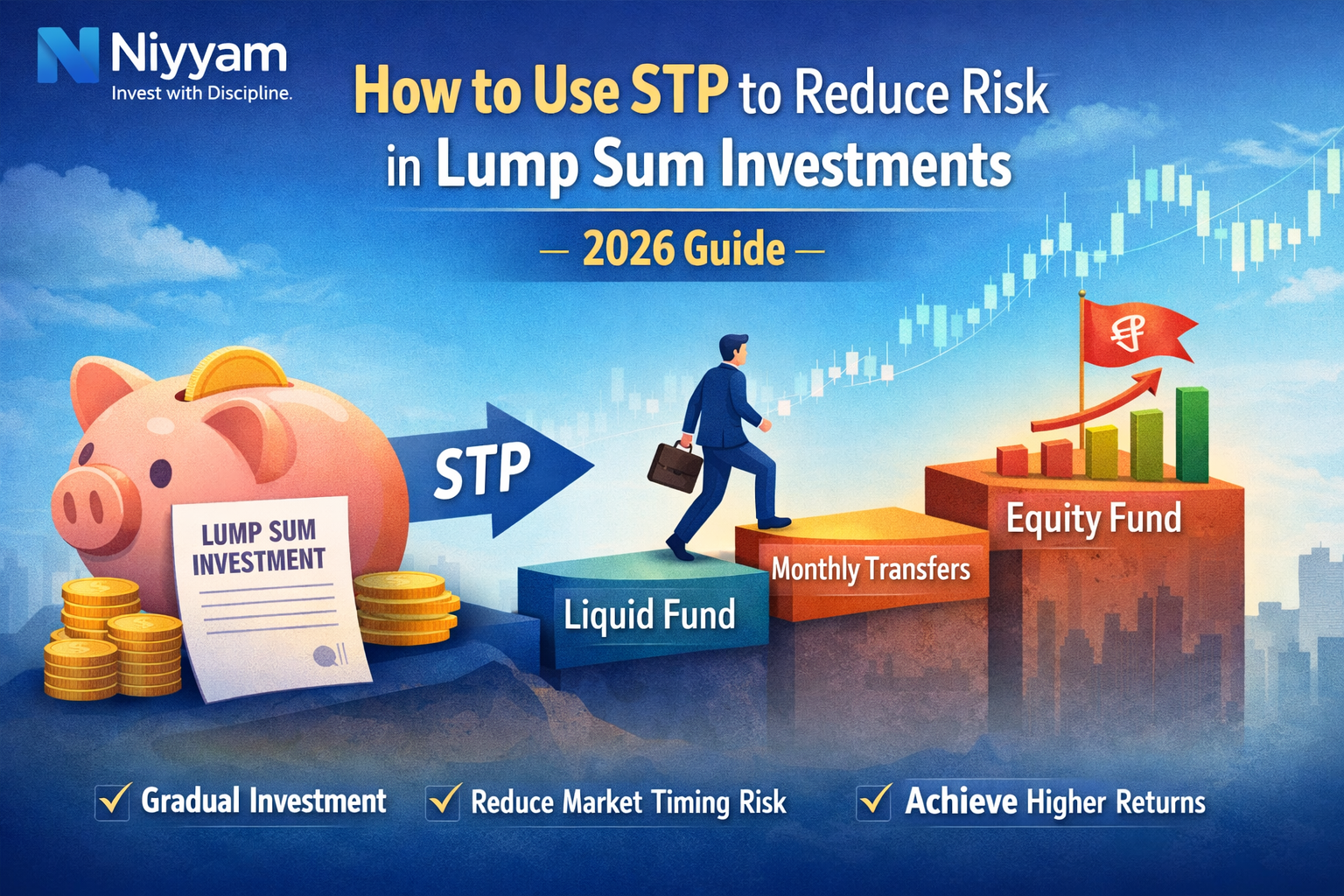
STP is a method where you divide your lump sum investment into smaller parts and invest them over time instead of all at once.
The process works like this:
- First, you invest your lump sum into a liquid or debt fund
- Then, a fixed amount is transferred periodically into an equity fund
- Over time, your entire amount moves into equity
This gradual approach reduces the risk of investing at a single market level.
How STP Works in Practice
Let’s take a simple example.
- Total investment: ₹1,20,000
- Monthly transfer: ₹10,000
- Duration: 12 months
Instead of investing ₹1,20,000 in one go, you invest ₹10,000 every month.
This means:
- If the market falls, you buy at lower prices
- If the market rises, you still participate gradually
This is called cost averaging.
Why STP is Important for Investors
Reduces Timing Risk
Timing the market is extremely difficult.
Even experienced investors get it wrong.
When you invest a lump sum:
- You take full exposure at one price
- If the market falls, your portfolio immediately goes into loss
With STP:
- You spread your investment over time
- You reduce the impact of short-term volatility
Helps Control Emotions
Most investing mistakes are behavioral.
Investors panic when markets fall and get greedy when markets rise.
STP helps remove this problem.
Because:
- Investment happens automatically
- There is no need to predict the market
- Decisions are systematic, not emotional
Balances Safety and Growth
STP works in phases.
- Initial phase: Money stays in liquid fund (low risk)
- Transition phase: Gradual movement into equity
- Final phase: Full equity exposure
This creates a balance between safety and growth.
STP vs SIP vs Lump Sum: Which is Better?
| Strategy | Risk Level | Best For |
|---|---|---|
| Lump Sum | High | Market lows |
| SIP | Low | Regular income |
| STP | Moderate | Lump sum with safety |
STP vs SIP vs Lump Sum
Understanding the difference is important.
- SIP is used when you invest from regular income
- Lump sum is used when you invest everything at once
- STP is used when you want to gradually invest a lump sum
Risk Comparison
- SIP → Low risk
- STP → Moderate risk
- Lump sum → High risk
STP sits in the middle.
When Should You Use STP?
STP is useful in the following situations:
- You have a large lump sum amount
- Markets are volatile or uncertain
- You are not confident about timing
- You want a disciplined approach
It is especially useful for beginners who are uncomfortable with lump sum investing.
When Should You Avoid STP?
STP is not always necessary.
Avoid it when:
- You have a very small investment amount
- Markets are clearly undervalued
- You already have a strong SIP strategy
In some cases, lump sum investing may give better returns, but it comes with higher risk.
STP vs Market Timing
Many investors try to wait for the “perfect time”.
This rarely works.
Market timing:
- Requires prediction
- Creates stress
- Often leads to wrong decisions
STP removes this problem completely.
Instead of guessing, you follow a system.
STP Strategy Based on Investor Type
Different investors should use different durations.
Conservative Investors
- Duration: 12 months
- Focus: Safety
Moderate Investors
- Duration: 6–9 months
- Balanced approach
Aggressive Investors
- Duration: 3–6 months
- Faster deployment
Best STP Duration Based on Market
Market condition plays an important role.
- Highly volatile → 12 months
- Moderate volatility → 6–9 months
- Stable market → 3–6 months
Practical Rule
- ₹50K–₹2L → 6 months
- ₹2L–₹10L → 6–12 months
- ₹10L+ → 12+ months
Step-by-Step: How to Start STP
Step 1: Choose a Liquid Fund
Your lump sum should first go into a low-risk fund.
Look for:
- Low volatility
- High liquidity
- Stable returns
Step 2: Select an Equity Fund
Choose based on your goal.
- Index fund → Stability
- Flexi cap → Balanced
- Mid cap → Growth
You can refer to
How to Choose the Right Mutual Fund in India (A Beginner’s Practical Guide)
Step 3: Decide Transfer Amount
Your transfer amount should match your duration.
Example:
- ₹1,20,000 → ₹10,000 per month
- ₹6,00,000 → ₹50,000 per month
Step 4: Automate the Process
Set up STP through your platform.
Automation ensures:
- Consistency
- Discipline
- No emotional interference
Real-Life Scenario
Let’s consider ₹5 lakh.
Lump Sum Approach
- Full exposure immediately
- High risk if market falls
STP Approach
- Gradual investment over 12 months
- Lower risk
- Better entry price
Common STP Mistakes
- Choosing a very short duration
- Selecting the wrong funds
- Stopping STP midway
If you want to improve discipline, read
Why Most SIP Investors Fail to Build Wealth (And How to Avoid It in 2026)
STP in Different Market Conditions
- Falling market → Helps average cost
- Rising market → Participates gradually
- Volatile market → Most effective
Advanced Strategy: STP + SIP
A powerful approach is combining both.
- STP → Deploy lump sum
- SIP → Continue investing
If you want to structure this better, refer to
How to Build a Core and Satellite Mutual Fund Portfolio (2026 Guide)
Taxation of STP
Each transfer is treated as a redemption.
- Short-term → Tax as per slab
- Long-term → Based on holding period
This should be considered while planning the duration.
Risk Comparison
- Lump sum → High risk
- SIP → Low risk
- STP → Moderate risk
Conclusion
STP is not just a tool.
It is a strategy that solves one of the biggest problems in investing—timing.
Instead of waiting for the perfect moment, you invest gradually.
This reduces fear and improves consistency.
Final Action Plan
- Park a lump sum in a liquid fund
- Start STP (6–12 months)
- Continue SIP
Final Verdict
STP is one of the smartest ways to invest a lump sum.
It:
- Reduces risk
- Improves discipline
- Creates structure
Final Thought
You don’t need perfect timing.
You need a system that works in any market condition.
Frequently Asked Questions (FAQs)
1. Is STP better than a lump sum?
Yes, for reducing timing risk.
2. What is the ideal STP duration?
6–12 months.
3. Can beginners use STP?
Yes.
4. Is STP safe?
Safer than lump sum.
5. Can I stop STP anytime?
Yes, but consistency is important.
6. Should I combine SIP and STP?
Yes.
Disclaimer
This content is for educational purposes only and does not constitute investment advice.
Mutual fund investments are subject to market risks. Investors should read all scheme-related documents carefully before investing and consider their financial goals, risk tolerance, and investment horizon.
Share this guide with your friends, family, and colleagues to help them make better financial decisions.
If this article helped you, share it with at least one person who needs this guidance.
Leave a Reply