
By Ashok Prasad, Founder, Niyyam
Published: March 2026
Introduction
What happens if you miss a SIP installment is a question that almost every mutual fund investor faces at some point in their investment journey.
You start your SIP with discipline. Every month, your investment is automatically deducted, and over time, your portfolio grows steadily through compounding.
But real life is not always predictable.
There can be situations like:
- Low bank balance
- Salary delay
- Unexpected expenses
- Temporary financial stress
And suddenly, one SIP installment gets missed.
This creates immediate confusion:
- Will I be charged a penalty?
- Will my SIP stop automatically?
- Will this affect my long-term wealth?
Some investors panic and overreact. Others ignore it completely.
Both approaches are incorrect.
The right approach is to understand the actual impact of missing a SIP installment and take corrective action if required.
💡 Key Takeaways
- Missing one SIP installment is not a serious issue
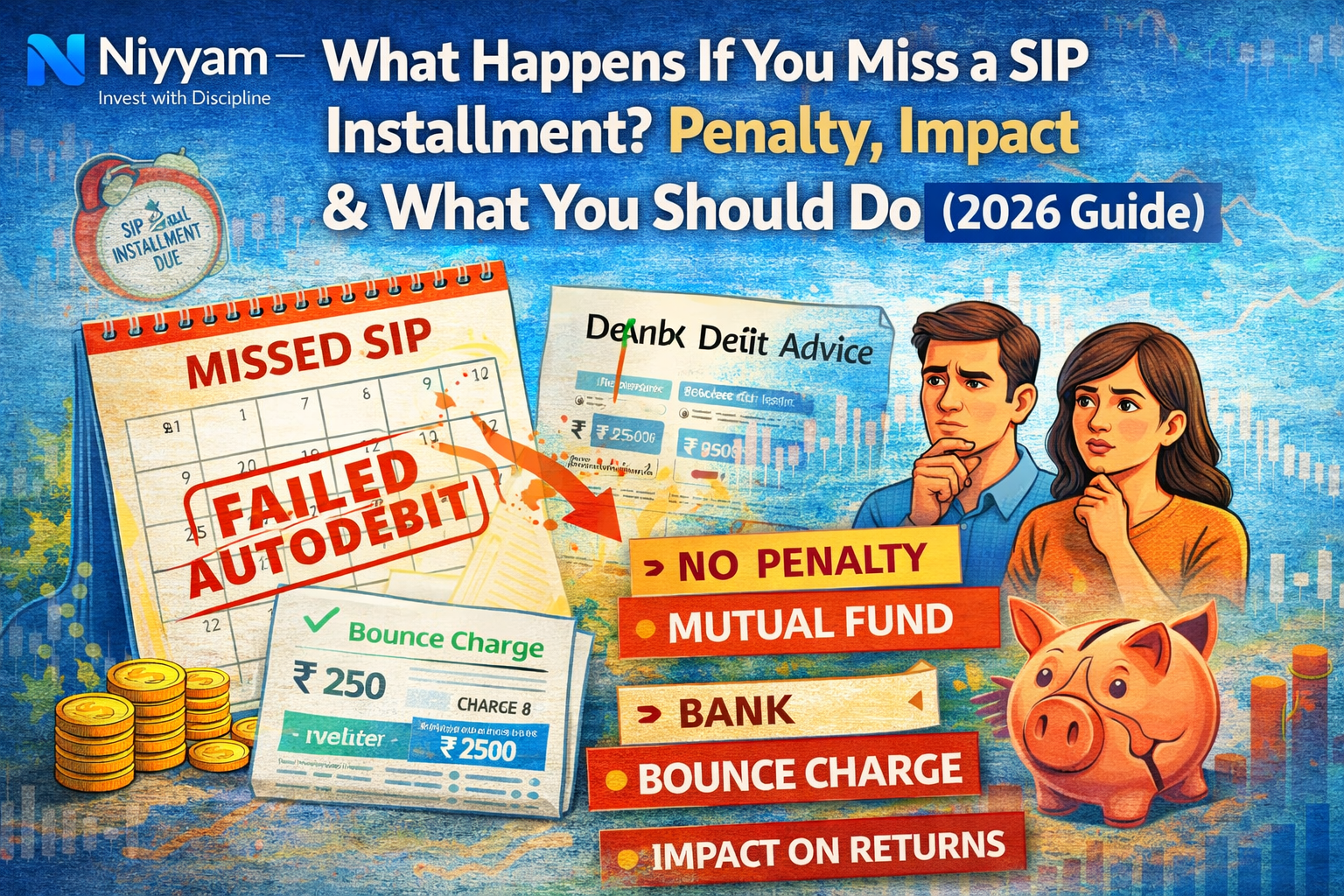
- Mutual funds do not charge penalties
- Banks may charge ₹100–₹500 as bounce fees
- Repeated missed SIPs can lead to cancellation
- The real loss is the missed compounding
- SIPs can be restarted anytime
- Long-term discipline matters more than short-term perfection
Direct Answer
If you miss a SIP installment, your investment for that month is skipped, your SIP usually continues, and there is no penalty from the mutual fund. However, your bank may charge a bounce fee, and your long-term returns may be affected due to missed compounding.
In simple terms:
- SIP does not immediately stop
- No units are allotted for that month
- Your existing investments remain unaffected
What Happens When You Miss a SIP Installment?
When your SIP fails due to insufficient balance, the following sequence occurs:
| Event | Outcome |
|---|---|
| SIP deduction attempt | Fails |
| Investment execution | Skipped |
| Unit allocation | No units allotted |
| Existing investments | Continue as usual |
Your previously invested money remains completely safe and continues to grow.
If you are new to SIPs, refer to What is SIP in Mutual Funds? A Complete Beginner’s Guide (2026).
Is There Any Penalty for Missing SIP?
AMC vs Bank Charges
| Entity | Charges |
|---|---|
| Mutual Fund (AMC) | No penalty |
| Bank | ₹100–₹500 bounce charge |
Mutual fund companies do not penalize investors for missing SIP installments.
However, banks treat it as a failed auto-debit transaction and may charge a bounce fee.
What Happens After Multiple Missed SIPs?
| Missed Installments | Impact |
|---|---|
| 1 missed SIP | No major impact |
| 2–3 missed SIPs | Warning or temporary pause |
| 3–5 missed SIPs | SIP may get cancelled |
Each AMC has its own rules, but repeated failures can result in termination of the SIP mandate.
Does Missing SIP Affect Your Returns?
Yes — but not immediately. The real impact is long-term.
Example
| Detail | Value |
|---|---|
| Monthly SIP | ₹5,000 |
| Duration | 10 years |
| Missed SIPs | 12 months |
| Missed investment | ₹60,000 |
Impact Comparison
| Scenario | Final Corpus |
|---|---|
| Regular SIP | ₹10–12 lakh |
| Missed SIPs | ₹8–10 lakh |
The difference is not just ₹60,000.
It is the future value of that missed investment, which gets amplified through compounding.
To understand this better, refer to How SIP Builds Wealth Through Compounding (With Simple Examples).
Hidden Impact: The Real Cost of Missing SIP
Most investors only see the missed amount.
But the real loss is:
- Loss of compounding
- Missed market opportunities
- Break in investment discipline
For example:
₹5,000 missed today can become:
- ₹12,000–₹15,000 in 10 years
- ₹40,000+ in 15 years
This is why SIP consistency matters far more than most investors realize.
SIP Miss vs SIP Pause vs SIP Stop
| Action | Meaning | Impact |
|---|---|---|
| SIP Miss | One installment skipped | Minor |
| SIP Pause | Temporarily stop SIP | Controlled |
| SIP Stop | Permanently stop SIP | High long-term impact |
Understanding this difference helps you avoid emotional decisions.
Behavioral Insight: Why Missing SIP Becomes Dangerous
The biggest risk is not the missed SIP itself.
It is what happens after that.
Many investors:
- Lose discipline
- Start delaying investments
- Try to “time the market.”
- Eventually stop investing
One missed SIP can trigger a chain reaction if not handled properly.
This is why SIP success is more about behavior than strategy.
Real-Life Practical Example
Case: Rohit’s SIP Journey
| Detail | Value |
|---|---|
| Monthly SIP | ₹10,000 |
| Duration | 5 years |
| Missed SIPs | 6 months |
| Missed total | ₹60,000 |
Outcome Comparison
| Scenario | Final Value |
|---|---|
| Regular SIP | ₹7.5–8 lakh |
| Missed SIP | ₹6.5–7 lakh |
Even small disruptions can create a noticeable gap in wealth.
When Should You Worry About Missing SIP?
| Situation | Action |
|---|---|
| One-time miss | Ignore |
| Occasional miss | Monitor |
| Frequent miss | Review finances |
| Continuous failure | Take immediate action |
When Missing SIP is Acceptable
- Emergency expenses
- Temporary income issues
- Short-term liquidity crunch
These are practical situations and do not require panic.
When Missing SIP is Risky
- Frequent misses
- Missing SIP during market corrections
- Long-term goal disruption
Missing SIP during market dips can actually reduce future gains.
To understand timing, refer to Best SIP Date: Does Timing Really Matter in Mutual Funds? (2026 Guide).
What Should You Do After Missing SIP?
Step-by-Step Recovery Plan
- Check your bank balance immediately
- Ensure the auto-debit mandate is active
- Resume SIP from next cycle
- Maintain a buffer balance
- Track future deductions
Should You Compensate for Missed SIP?
| Option | Recommendation |
|---|---|
| Ignore | Acceptable |
| Increase next SIP | Good approach |
| Lump sum investment | Optional |
If you want to maintain momentum, increasing future SIPs is a practical solution.
For strategy clarity, refer to SIP vs Lump Sum: Which Investment Strategy Is Better for Beginners?.
Advanced Insight: Discipline vs Timing
| Factor | Importance |
|---|---|
| Discipline | Very High |
| Timing | Low |
| Consistency | Critical |
Wealth is created through consistency, not perfect timing.
To understand long-term outcomes, refer to Can SIP Make You Crorepati? Real Numbers, Time & Strategy (2026 Guide).
Common Mistakes Investors Make
- Panicking after one missed SIP
- Stopping SIP completely
- Ignoring repeated failures
- Not maintaining a sufficient bank balance
- Trying to time the market after missing SIP
Decision Framework (Most Important Section)
| Scenario | Action |
|---|---|
| Missed once | Continue SIP |
| Missed twice | Monitor closely |
| Missed multiple times | Fix financial planning |
| SIP cancelled | Restart immediately |
SIP Cancellation Rules (Important)
| Condition | Outcome |
|---|---|
| 1 missed SIP | No cancellation |
| 3 consecutive misses | SIP may stop |
| Mandate expiry | SIP stops automatically |
Always verify with your fund house or investment platform.
Frequently Asked Questions (FAQs)
Is there a penalty for missing a SIP installment?
No, mutual funds do not charge penalties. Banks may charge a bounce fee.
Will my SIP stop after one missed installment?
No, it usually continues.
Can I restart SIP after cancellation?
Yes, anytime.
Does missing SIP affect returns?
Yes, due to the loss of compounding.
Should I invest extra after missing SIP?
Optional, but useful to maintain momentum.
Conclusion
Missing a SIP installment is not a major issue if it happens occasionally.
However, repeated misses can significantly impact your long-term wealth creation.
Final Verdict
- One missed SIP is manageable
- Multiple missed SIPs are harmful
- Consistency is the most important factor
Final Thought
SIP success is not about perfection.
It is about discipline over time.
Even if you miss one installment, stay committed to your long-term investment journey.
Because in investing, consistency always wins over timing.
Disclaimer
This content is for educational purposes only and does not constitute investment advice.
Mutual fund investments are subject to market risks. Investors should read all scheme-related documents carefully before investing and consider their financial goals, risk tolerance, and investment horizon.
Share this guide with your friends, family, and colleagues to help them make better financial decisions.
If this article helped you, share it with at least one person who needs this guidance.
Leave a Reply