By Ashok Prasad, Founder, Niyyam
Published: March 2026
Introduction: Investing is a Journey, Not a One-Time Decision
If you want to become a beginner to advanced mutual fund investor, you need a clear roadmap, disciplined investing approach, and structured portfolio strategy.
Confused. Uncertain. Hesitant.
You hear terms like SIP, NAV, asset allocation, large cap, small cap—but nothing feels clear.
Naturally, questions arise:
- Which mutual fund should I invest in?
- How much should I invest every month?
- What if the market crashes after I invest?
- Am I doing the right thing?
Because of this confusion, most beginners:
- Delay starting
- Start and stop investing
- Chase “best performing funds.”
- React emotionally to market movements
Over time, two types of investors emerge.
First, those who learn, adapt, and grow.
Second, those who remain stuck at the same level for years.
The difference is not intelligence.
It is an evolution of the approach.
Investing is not about knowing everything from day one.
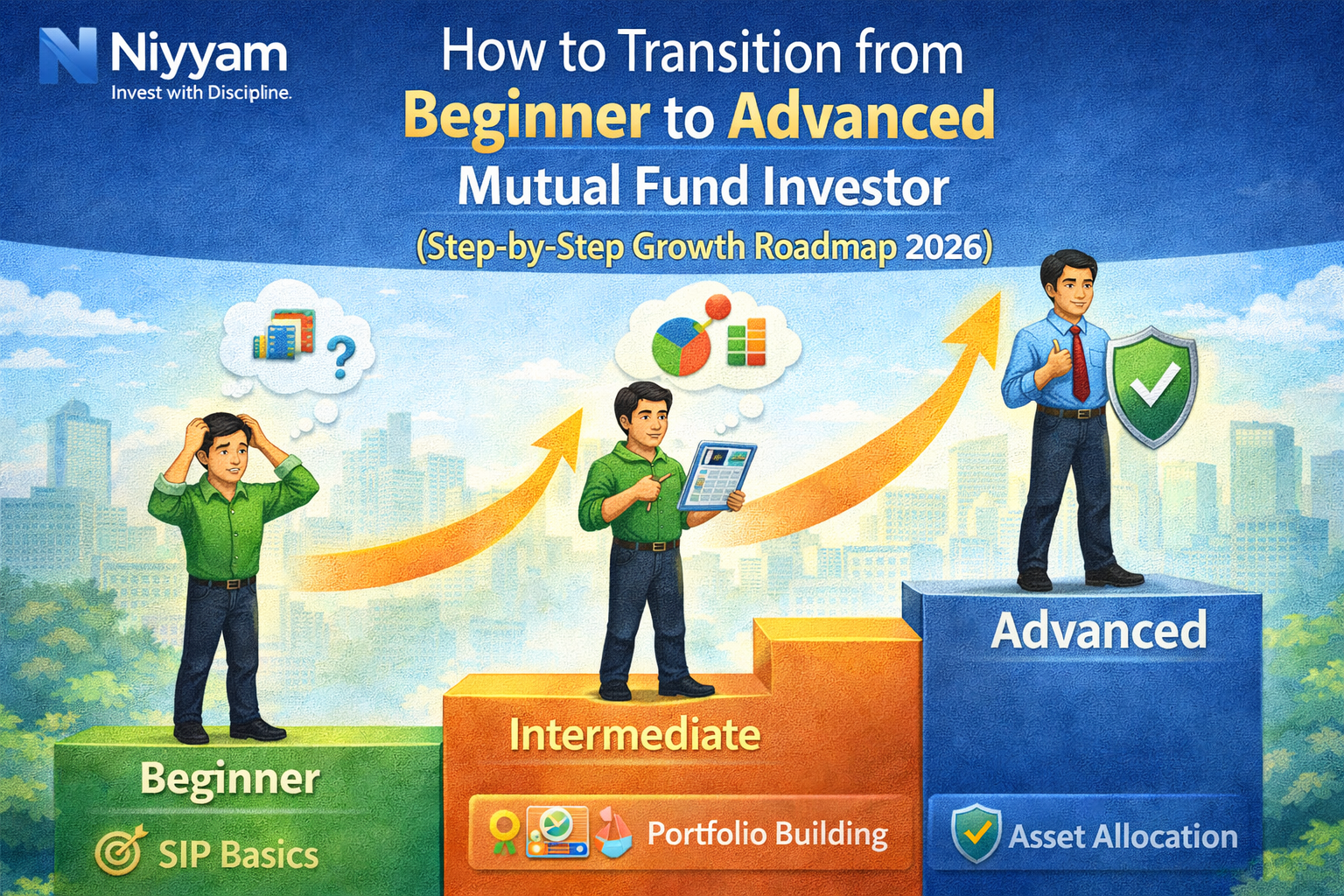
It is about progressing step by step—from beginner to structured investor to optimized investor.
If you follow a clear roadmap, this journey becomes predictable.
💡 Key Takeaways
- Investing evolves in stages, not overnight
- Beginners should focus on simplicity and consistency
- Intermediate investors focus on structure and diversification
- Advanced investors focus on asset allocation and risk
- Portfolio design matters more than individual fund selection
- Discipline and consistency matter more than timing
- Regular review and rebalancing are essential for growth
Direct Answer
To transition from a beginner to an advanced mutual fund investor, start with simple SIP investments, gradually build a structured portfolio, focus on asset allocation, improve risk management, and consistently review and rebalance your investments over time.
Stage 1: Beginner Investor (Foundation Stage)
What Most Beginners Do
At the beginning, most investors behave in predictable ways:
- Searching for “best mutual funds”
- Trying to time the market
- Investing irregularly
- Switching funds frequently
- Getting influenced by news or tips
This leads to confusion and inconsistent results.
The problem is not lack of effort.
The problem is lack of direction.
What You Should Do Instead
At this stage, your goal is not optimization.
Your goal is habit formation.
Focus on:
- Starting a SIP
- Choosing 1–2 good funds
- Investing consistently every month
- Ignoring short-term market movements
SIP works because it removes decision-making.
You invest automatically, regardless of market conditions.
If you are just starting, refer to
How to Start a SIP in India: A Beginner’s Step-by-Step Guide
Key Insight
At the beginner stage:
You don’t need perfect strategy.
You need consistent action.
Stage 2: Early Intermediate (Stability Stage)
Once you invest consistently for a few months, you move to the next stage.
Here, your understanding improves.
You start asking better questions.
Focus Areas
- Building a proper portfolio
- Understanding diversification
- Avoiding concentration risk
- Aligning investments with goals
What Changes at This Stage
Your mindset begins to shift:
- From random investing → structured investing
- From short-term thinking → long-term planning
- From emotional decisions → disciplined approach
What You Should Do
- Increase SIP gradually
- Add 1–2 more funds if required
- Start thinking in terms of a portfolio, not individual funds
To understand the structure better, refer to
Mutual Fund Portfolio Allocation Strategy (Equity vs Debt vs Hybrid – 2026 Guide)
Key Insight
At this stage:
Returns improve not because of better funds—but because of better structure.
Stage 3: Intermediate Investor (Growth Stage)
This is where wealth creation accelerates.
You are no longer experimenting.
You are building seriously.
Key Actions
- Introduce mid-cap and small-cap exposure
- Increase SIP amount regularly
- Track performance periodically
- Avoid unnecessary changes
Example Portfolio
- Large Cap → 50%
- Mid Cap → 30%
- Small Cap → 20%
This allocation balances stability and growth.
Common Mistake at This Stage
Many investors over-diversify.
They add too many funds thinking it reduces risk.
In reality:
- It creates duplication
- Makes tracking difficult
- Reduces portfolio efficiency
To understand this better, refer to
What is Portfolio Overlap in Mutual Funds & Why It Can Reduce Your Returns
Key Insight
Growth does not come from adding more funds.
It comes from consistent investing + proper allocation.
Stage 4: Advanced Investor (Optimization Stage)
This is where your investing approach becomes refined.
You stop chasing returns.
You start managing risk.
Key Focus Areas
- Asset allocation
- Risk management
- Portfolio rebalancing
- Long-term optimization
Advanced Portfolio Structure
- Core Portfolio → 70%
- Satellite Portfolio → 30%
Core funds provide stability.
Satellite funds provide growth opportunities.
To implement this effectively, refer to
How to Build a Core and Satellite Mutual Fund Portfolio (2026 Advanced Strategy Guide)
What Changes at This Stage
- You stop reacting to market noise
- You focus on long-term allocation
- You rebalance instead of switching funds
Key Insight
At this stage:
Your goal is not maximum return.
Your goal is optimal risk-adjusted return.
The Most Important Shift: Investor Mindset
The biggest transformation is not technical.
It is psychological.
Mindset Evolution
- Beginner → “Which fund gives highest return?”
- Intermediate → “How do I build a portfolio?”
- Advanced → “How do I manage risk and allocation?”
Why This Matters
Most investors fail because they remain stuck at the first level.
They keep chasing returns.
They never upgrade their thinking.
Key Insight
Wealth is built by:
- Process
- Discipline
- Consistency
Not by prediction.
How to Know You Are Ready to Move to the Next Stage
Ask yourself:
- Do I invest consistently every month?
- Do I understand basic asset allocation?
- Do I avoid emotional decisions?
- Do I review my portfolio regularly?
If your answer is “yes” to most of these, you are ready to move forward.
How Your SIP Strategy Should Evolve
Your investment approach should grow with you.
Beginner Stage
- Fixed SIP
- Focus on discipline
Intermediate Stage
- Step-up SIP
- Increase investment with income
Advanced Stage
- Strategic allocation
- Dynamic adjustments
To scale your SIP, refer to
How to Increase SIP Amount Over Time (Step-Up SIP Strategy for 2026 Investors)
Common Mistakes During Transition
Many investors slow their progress due to these mistakes:
- Overcomplicating too early
- Chasing high returns
- Ignoring risk management
- Changing strategy frequently
Skill Upgrade Checklist
As you evolve, your priorities should change.
- Fund selection → Moderate importance
- Asset allocation → High importance
- Risk management → Very high importance
- Rebalancing → Critical
Portfolio Evolution Over Time
Your portfolio should evolve gradually.
- Beginner → 1–2 funds
- Intermediate → 3–4 funds
- Advanced → 4–5 structured funds
More funds do not mean better results.
Risk Management Evolution
- Beginner → Ignores risk
- Intermediate → Basic awareness
- Advanced → Active management
To improve this, refer to
How to Reduce Risk in Mutual Fund Investing (Practical Strategies for 2026)
Advanced Insight: What Actually Drives Wealth
Many investors believe returns come from selecting the best fund.
This is not true.
Reality
- Asset allocation → Highest impact
- Consistency → High impact
- Fund selection → Moderate impact
Key Insight
This is why advanced investors focus on structure—not stock picking or fund chasing.
Conclusion: Growth is a Process
You don’t become an advanced investor overnight.
You evolve step by step.
- First, you build discipline
- Then, you build structure
- Finally, you optimize
If you follow this path consistently, wealth creation becomes predictable.
Final Action Plan
- Start with SIP
- Build a structured portfolio
- Increase investments gradually
- Focus on allocation and risk
- Stay consistent
Final Verdict
Every investor must evolve.
- Beginner → Start
- Intermediate → Structure
- Advanced → Optimize
Final Thought
You don’t need to know everything.
You need to do the right things consistently over time.
Frequently Asked Questions (FAQs)
1. How long does it take to become an advanced investor?
Typically 3–5 years of consistent investing.
2. Should beginners focus on returns?
No, focus on discipline and consistency.
3. How many funds should I have?
3–5 funds are ideal.
4. Is diversification important?
Yes, it reduces risk.
5. Should I rebalance regularly?
Yes, once a year.
6. What is the biggest mistake investors make?
Chasing returns instead of building structure.
Disclaimer
This content is for educational purposes only and does not constitute investment advice.
Mutual fund investments are subject to market risks. Investors should read all scheme-related documents carefully before investing and consider their financial goals, risk tolerance, and investment horizon.
Share this guide with your friends, family, and colleagues to help them make better financial decisions.
If this article helped you, share it with at least one person who needs this guidance.
Leave a Reply