
By Ashok Prasad, Founder, Niyyam
Published: March 2026
Introduction: The Hidden Risk Most Mutual Fund Investors Ignore
When investors choose mutual funds, they usually focus on:
- Past returns
- Fund category
- SIP performance
However, there is one important factor that many investors overlook:
Fund house risk in mutual funds
You may have selected good funds, but if all your investments are from a single AMC (Asset Management Company), you are exposed to a hidden concentration risk.
Over time, this leads to important questions:
- What happens if something goes wrong with the AMC?
- Will all your investments be affected?
- Should you diversify across different AMCs?
Before making a decision, it is equally important to understand how to choose the right mutual fund in India, since fund quality remains the primary driver of returns.
Direct Answer
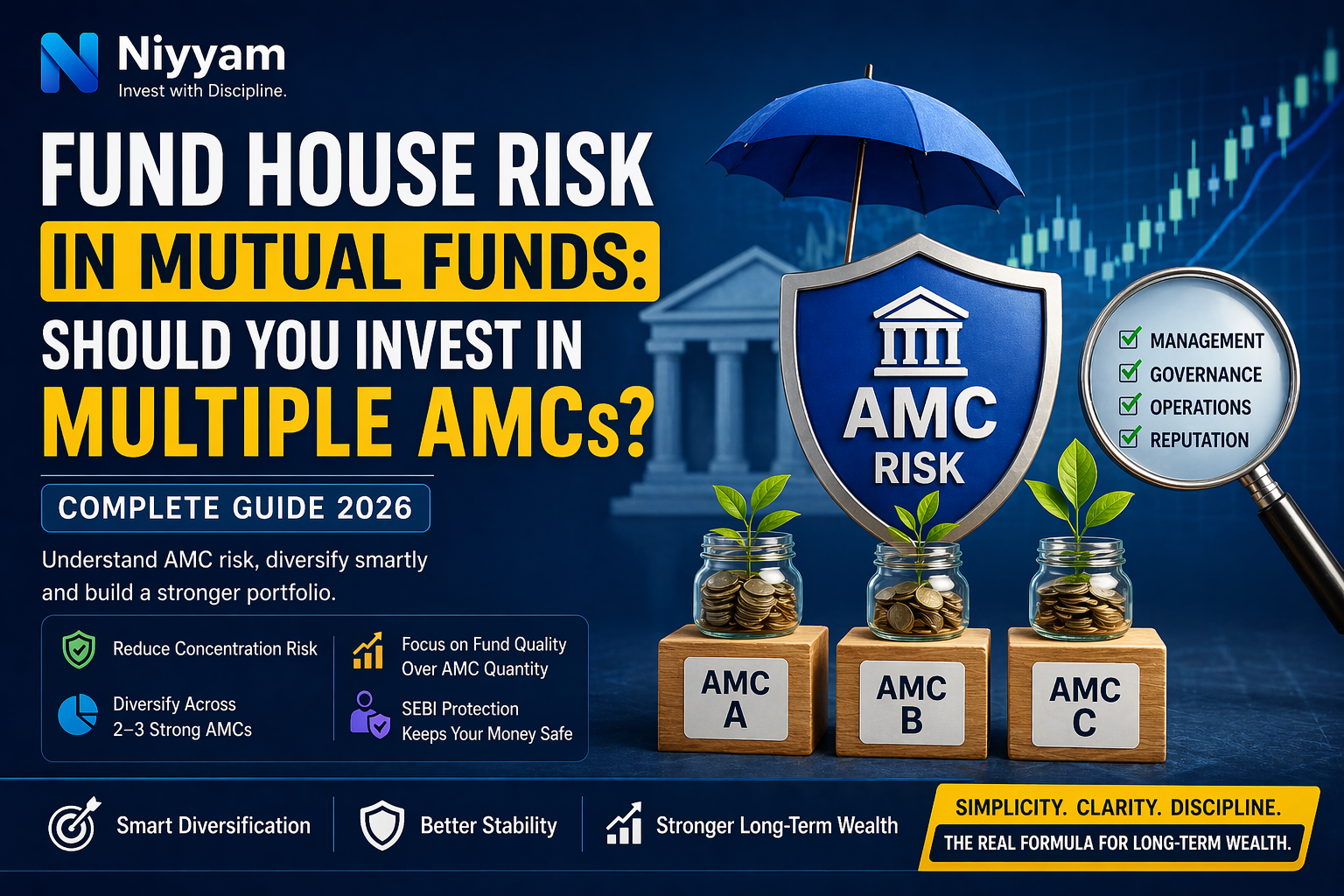
Fund house risk in mutual funds refers to the risk associated with the management, governance, and operational aspects of an AMC.
A balanced approach is recommended:
- Avoid investing entirely in one AMC
- Diversify across 2–3 strong fund houses
- Focus on fund quality over AMC quantity
💡 Key Takeaways
- Fund house risk is real but often ignored
- Diversifying across 2–3 AMCs reduces concentration risk
- Too many AMCs create unnecessary complexity
- Fund selection is more important than AMC selection
- SEBI regulations provide strong investor protection
- AMC issues can impact multiple funds at once
- Balanced diversification improves portfolio stability
What is Fund House Risk?
Fund house risk refers to risks arising from the AMC managing your mutual funds.
Types of AMC Risks
| Risk Type | Explanation | Impact |
|---|---|---|
| Management Risk | Poor decisions by fund managers | Weak performance |
| Governance Risk | Compliance or ethical issues | Loss of trust |
| Operational Risk | System or execution failures | Disruptions |
| Reputation Risk | Negative news or events | Investor panic |
AMC-level problems can impact multiple schemes simultaneously.
How AMC Risk Actually Impacts Investors
| Scenario | What Happens |
|---|---|
| Fund manager exits | Strategy may change |
| AMC faces regulatory issue | Operations may be affected |
| Reputation damage | Investors may panic and exit |
This is why understanding how to review your mutual fund portfolio (when to hold, switch or exit) becomes extremely important.
SEBI Protection: How Safe Are Your Investments?
Many investors worry about safety.
Layers of Protection
| Safety Layer | Role |
|---|---|
| Custodian | Holds securities separately |
| Trustee | Monitors AMC operations |
| SEBI | Regulates the mutual fund industry |
Key Insight
- AMC does not directly hold your money
- Assets are segregated and protected
Even if an AMC faces issues, your investments remain relatively safe.
AMC Risk vs Fund Manager Risk
| Factor | AMC Risk | Fund Manager Risk |
|---|---|---|
| Level | Company-wide | Fund-specific |
| Impact | Multiple funds | Single fund |
| Frequency | Rare | More common |
Fund manager changes are more frequent than AMC issues.
To understand how this impacts performance, you can also explore how to compare mutual funds in India (5 key metrics every investor must check).
Should You Invest in Multiple AMCs?
Ideal AMC Diversification
| Portfolio Size | Number of AMCs |
|---|---|
| Small | 1–2 |
| Medium | 2–3 |
| Large | 3–4 |
For most investors, 2–3 AMCs are ideal.
Benefits of AMC Diversification
- Reduces concentration risk
- Avoids dependency on one AMC
- Improves portfolio stability
- Provides flexibility in fund selection
Risks of Too Many AMCs
| Issue | Impact |
|---|---|
| Too many AMCs | Portfolio complexity |
| Too many funds | Difficult tracking |
| Over-diversification | Lower efficiency |
This is similar to the concept explained in how to identify over-diversification in mutual funds (and fix it in 2026).
AMC Diversification vs Fund Diversification
| Factor | AMC Diversification | Fund Diversification |
|---|---|---|
| Focus | Company risk | Market risk |
| Importance | Moderate | High |
| Priority | Secondary | Primary |
If your portfolio already has overlapping funds, you should also understand what is portfolio overlap in mutual funds and why it reduces returns.
When AMC Risk Becomes Important
| Situation | Action |
|---|---|
| 70%+ investment in one AMC | Diversify |
| Multiple funds from same AMC | Review |
| Negative AMC news | Monitor closely |
At this stage, knowing which mutual funds you should sell first (smart exit strategy) becomes highly useful.
Example: Portfolio Comparison
Case 1: High AMC Concentration
- 5 funds in the same AMC
This creates concentration risk.
Case 2: Balanced AMC Portfolio
- 2 funds in AMC A
- 2 funds in AMC B
- 1 fund in AMC C
This creates better stability and diversification.
Does AMC Really Matter?
| Factor | Importance |
|---|---|
| Fund selection | High |
| Asset allocation | High |
| AMC selection | Moderate |
Choosing the right fund is more important than choosing the AMC.
Real-Life Scenario: What Happens If AMC Faces Trouble?
- Issue arises
- SEBI monitors
- Trustees intervene
- Oversight increases
- Assets remain safe
Investor funds remain protected.
How to Manage Fund House Risk
Step 1: Identify AMC Exposure
| Fund | AMC |
|---|---|
| Fund A | AMC 1 |
| Fund B | AMC 1 |
| Fund C | AMC 2 |
Step 2: Check Concentration
| Scenario | Action |
|---|---|
| More than 60% in one AMC | Reduce exposure |
| Balanced allocation | Continue |
Step 3: Evaluate AMC Quality
Check:
- Long-term track record
- Governance standards
- Reputation
- Fund manager stability
Step 4: Rebalance Portfolio
- Add another AMC if required
- Maintain strong funds
- Avoid unnecessary switching
This process aligns with how to consolidate multiple mutual funds into a clean portfolio (2026 guide).
Why Simplicity Wins in Investing
Many investors believe that more diversification leads to better safety.
However, excessive diversification creates:
- Confusion
- Poor tracking
- Inefficient allocation
A simple structure leads to better outcomes.
Common Mistakes Investors Make
- Ignoring AMC concentration risk
- Choosing funds only based on brand
- Over-diversifying across too many AMCs
- Not reviewing AMC exposure regularly
- Reacting emotionally to AMC news
These behavioral mistakes are similar to those discussed in why most SIP investors fail to build wealth (and how to avoid it in 2026).
Decision Framework
| Scenario | Action |
|---|---|
| Single AMC | Diversify |
| 2–3 AMCs | Ideal |
| 4+ AMCs | Review and simplify |
Before vs After AMC Diversification
| Scenario | Outcome |
|---|---|
| Single AMC portfolio | Concentration risk |
| Balanced AMC portfolio | Stability |
| Too many AMCs | Complexity |
Impact on Long-Term Wealth
| Strategy | Outcome |
|---|---|
| Single AMC exposure | Higher risk |
| Balanced AMC exposure | Stability |
| Excessive diversification | Inefficiency |
A balanced approach delivers the best results.
Frequently Asked Questions (FAQs)
What is fund house risk?
It is the risk associated with the AMC managing your funds.
Should I invest in multiple AMCs?
Yes, 2–3 AMCs are ideal for most investors.
Is AMC diversification necessary?
Yes, to reduce concentration risk.
Is investing in one AMC risky?
It can be risky if company-level issues arise.
Does AMC matter more than the fund?
No, fund selection is more important.
Conclusion: Balance is the Key
Fund house risk is real, but it is manageable.
The goal is not to overcomplicate your portfolio but to maintain a balanced approach.
Final Verdict
- Diversify across 2–3 strong AMCs
- Focus on fund quality first
- Avoid unnecessary complexity
Final Thought
Smart investing is about balance.
Too little diversification increases risk.
Too much diversification reduces efficiency.
A balanced AMC exposure combined with strong fund selection creates a resilient portfolio.
Disclaimer
This content is for educational purposes only and does not constitute investment advice.
Mutual fund investments are subject to market risks. Investors should read all scheme-related documents carefully before investing and consider their financial goals, risk tolerance, and investment horizon.
Share this guide with your friends, family, and colleagues to help them make better financial decisions.
If this article helped you, share it with at least one person who needs this guidance.
Leave a Reply