
By Ashok Prasad, Founder, Niyyam
Published: March 2026
Introduction
Compare mutual funds effectively by understanding the key metrics that truly impact your returns, risk, and long-term investment success.
Many investors choose mutual funds based on recent performance or popularity, but this approach often leads to poor decisions.
Choosing a mutual fund is easy. Choosing the right mutual fund is where most investors fail.
With hundreds of mutual funds available in India, many investors rely on:
- Recent performance
- Popular recommendations
- Online rankings
But this approach often leads to:
- Wrong fund selection
- Poor long-term returns
- Unnecessary risk
The reality is simple:
Not all mutual funds are equal, even within the same category.
To invest wisely, you need a structured and practical comparison framework.
💡 Key Takeaways
- Consistency matters more than high short-term returns
- The expense ratio significantly impacts long-term wealth
- Risk-adjusted returns are more important than raw returns
- Portfolio composition reveals actual risk exposure
- Avoiding mistakes is as important as selecting the right fund
Direct Answer
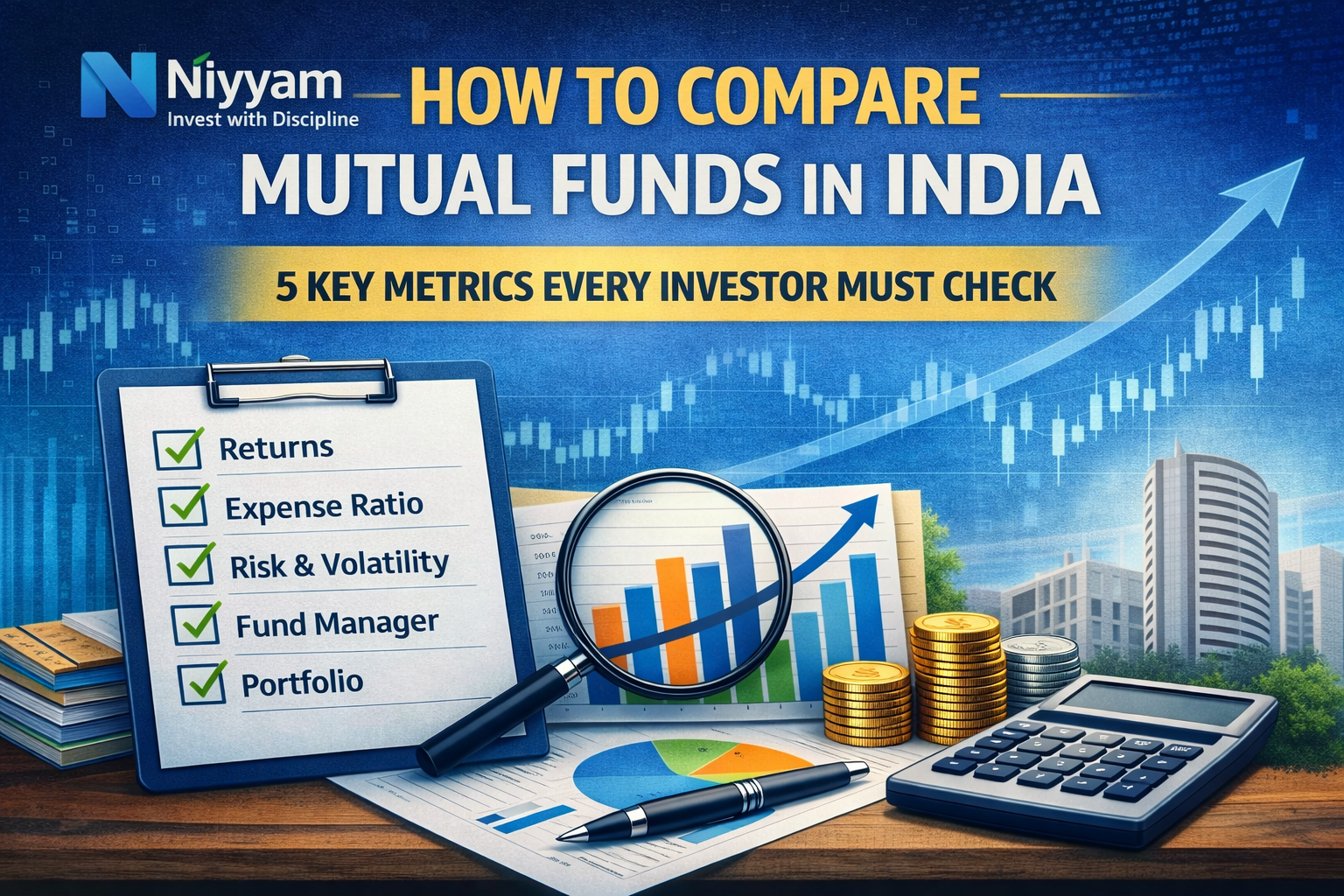
To compare mutual funds effectively, investors should focus on five key metrics: long-term return consistency, expense ratio, risk-adjusted returns (Sharpe ratio), fund manager track record, and portfolio composition. A fund that balances returns, cost, and risk is better than one with high but inconsistent performance.
Why Comparing Mutual Funds is Critical
Many investors assume:
- All large-cap funds perform similarly
- Higher returns mean better funds
- SIP investments will average out the differences
This is not true.
Even within the same category:
- Some funds take higher risks
- Some charge higher costs
- Some are inconsistent performers
Important insight:
If you do not compare mutual funds properly, you are investing blindly.
To build a strong foundation, refer to Complete Guide to Mutual Funds in India for Beginners (2026).
The 5 Key Metrics to Compare Mutual Funds
1. Returns (Focus on Consistency, Not Just High Numbers)
Returns are the most visible metric, but also the most misunderstood.
Many investors focus only on short-term returns like 1-year performance. This approach is misleading because mutual funds are designed for long-term investing.
Instead, compare:
- 3-year returns
- 5-year returns
- Performance across market cycles
A fund that consistently delivers moderate returns is far superior to one that shows occasional spikes.
For example:
- A fund delivering 12% consistently will outperform
- A fund delivering 18% one year and 5% the next
What to check:
- Does the fund beat its benchmark regularly?
- Is performance stable across time periods?
To understand how returns actually work, read How Mutual Funds Generate Returns for Investors (With Simple Examples).
2. Expense Ratio (The Silent Wealth Destroyer)
The expense ratio is the annual fee charged by the fund.
It may seem small, but over time it has a significant impact on your wealth.
Example:
- A 1% difference over 20 years can reduce your final corpus by lakhs
Important point:
Lower expense ratio means higher net returns.
Always compare:
- Expense ratios within the same category
- Direct vs regular plans
To understand this deeply, read What is Expense Ratio in Mutual Funds? How It Affects Your Returns (2026 Guide).
3. Risk Measures (Understanding Volatility)
Returns alone do not tell the full story.
Risk is equally important.
Key metrics include:
- Standard deviation (volatility)
- Beta (market sensitivity)
- Sharpe ratio (risk-adjusted return)
Sharpe ratio is particularly important because it tells you how much return you are earning per unit of risk.
Important insight:
A fund with better risk-adjusted returns is more reliable than one with higher but unstable returns.
4. Fund Manager & Investment Strategy
A mutual fund’s performance depends heavily on the fund manager.
Things to evaluate:
- Experience and track record
- Tenure managing the fund
- Consistency in strategy
Frequent changes in fund management or strategy can lead to instability.
Important point:
Consistency in management leads to consistency in performance.
5. Portfolio Composition (Where Your Money Goes)
Understanding where your money is invested is critical.
Check:
- Top holdings
- Sector allocation
- Market cap distribution
For example:
A large-cap fund should primarily invest in large-cap companies.
If it deviates significantly, it increases risk.
Important insight:
A well-diversified portfolio reduces risk and improves long-term stability.
To understand portfolio building, read How to Build a Mutual Fund Portfolio for Long-Term Wealth Creation (2026 Guide).
Real Example: Comparing Two Mutual Funds
Let’s compare two funds:
Fund A
- 5Y Return: 13%
- Expense Ratio: 1.8%
- Sharpe Ratio: 0.9
- High volatility
Fund B
- 5Y Return: 12%
- Expense Ratio: 0.8%
- Sharpe Ratio: 1.3
- Stable performance
Most investors choose Fund A due to higher returns.
However, Fund B is better because:
- Lower cost
- Better risk-adjusted return
- Higher consistency
Important insight:
The best fund is not the one with the highest return, but the one with balanced performance.
Step-by-Step Framework to Compare Mutual Funds
Follow this process:
- Shortlist 3–5 funds in the same category
- Compare 3-year and 5-year returns
- Check expense ratio
- Compare risk metrics (Sharpe ratio)
- Analyze portfolio composition
Then choose the fund that offers:
- Consistency
- Reasonable cost
- Balanced risk
How to avoid wrong mutual fund selection
Even after comparing funds, many investors still make mistakes.
This happens because:
- They focus on recent performance
- Ignore risk and cost
- Follow recommendations blindly
To avoid this:
- Focus on long-term consistency
- Compare funds within the same category
- Ensure alignment with your goals
- Avoid over-diversification
Another critical factor is investor behavior.
Many investors select the right fund but exit at the wrong time due to fear or impatience.
To understand how behavioral mistakes impact returns and how to avoid them, read Common Mutual Fund Mistakes and Smart Investor Strategies (2026 Guide).
Key point:
Choosing the right fund is important, but staying invested correctly is even more important.
Common Mistakes Investors Make
Investors often:
- Choose funds based on recent returns
- Ignore expense ratios
- Overlook risk metrics
- Invest in too many funds
- Follow random advice
Avoiding these mistakes is critical.
To understand these mistakes deeply, read Common Mutual Fund Mistakes and Smart Investor Strategies (2026 Guide).
Direct vs Regular Funds: A Critical Comparison
Always compare:
- Direct plans → lower expense ratio
- Regular plans → higher cost
Over long periods:
Direct plans generate better returns.
To understand this better, read Direct vs Regular Mutual Funds: Which Should You Choose? (2026 Guide for Investors).
How SIP Investors Should Compare Funds
If you invest via SIP:
Focus on:
- Long-term consistency
- Risk-adjusted returns
- Expense ratio
Avoid:
- Short-term performance
To understand compounding, read How SIP Builds Wealth Through Compounding (With Simple Examples).
Advanced Insight: Alpha (Bonus Metric)
Alpha measures a fund’s ability to outperform its benchmark.
- Positive alpha → strong performance
- Negative alpha → underperformance
Funds with consistent positive alpha are generally more reliable.
Final Checklist Before Investing
Before selecting a fund, ensure:
- Performance is consistent
- The expense ratio is reasonable
- Risk is aligned with your profile
- Portfolio is diversified
- Fund strategy is stable
Conclusion
Comparing mutual funds is not complicated, but it requires focusing on the right factors.
Instead of chasing returns, focus on:
- Consistency
- Cost efficiency
- Risk management
Because the best fund is not the one that performs best today, but the one that helps you stay invested for the long term.
To deepen your understanding, read How to Choose the Right Mutual Fund in India (A Beginner’s Practical Guide).
Frequently Asked Questions (FAQs)
How do I compare mutual funds?
Use returns, cost, risk, and portfolio analysis.
Is a higher return better?
No, consistency matters more.
What is most important?
A combination of return, cost, and risk.
Direct vs regular?
Direct is better for long-term investors.
How many funds should I compare?
3–5 funds.
Disclaimer
This content is for educational purposes only and does not constitute investment advice.
Mutual fund investments are subject to market risks. Investors should read all scheme-related documents carefully before investing and consider their financial goals, risk tolerance, and investment horizon.