
By Ashok Prasad, Founder, Niyyam
Introduction
Got ESOP Money from your startup recently?
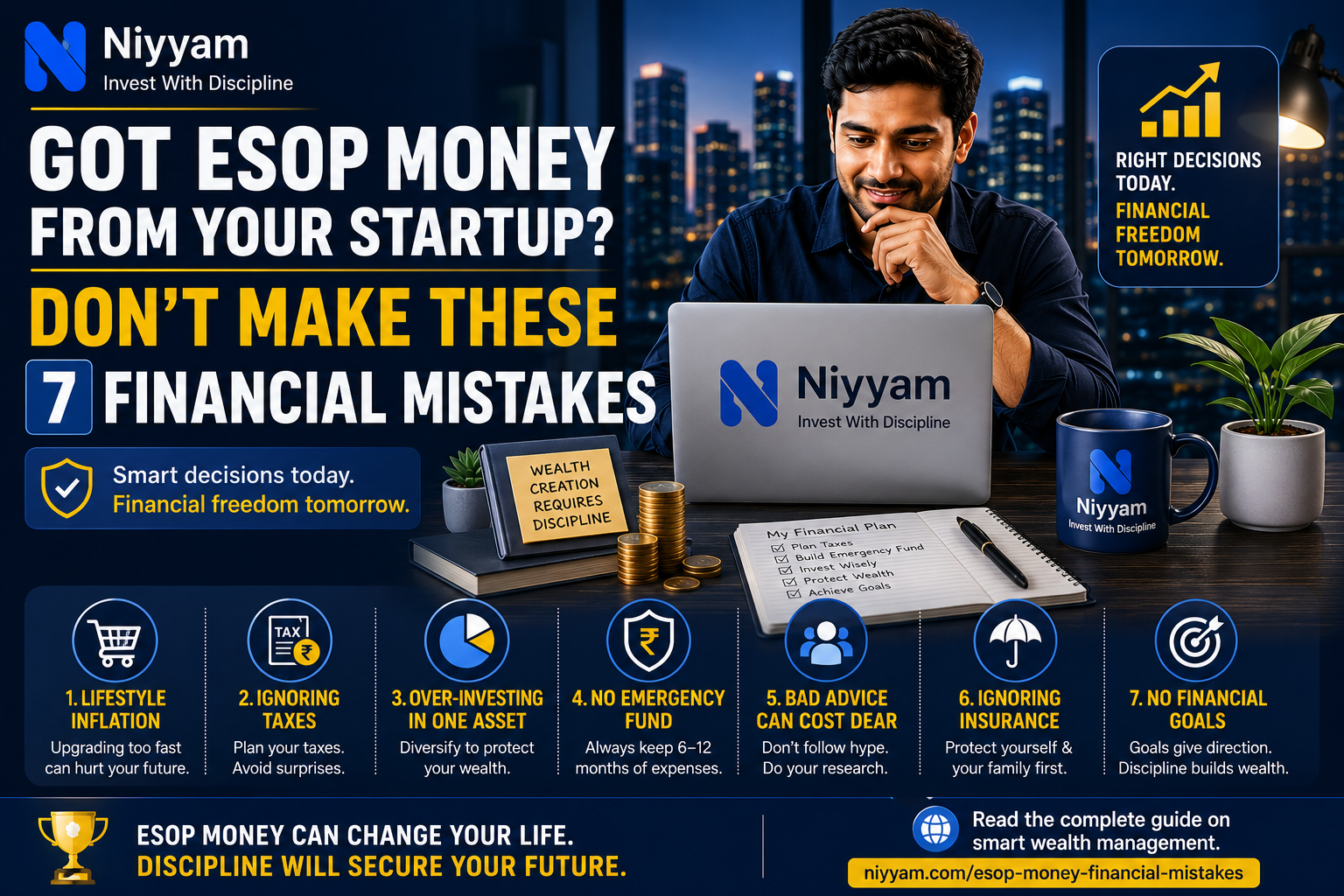
Before spending or investing it emotionally, understand these 7 costly financial mistakes that can silently destroy long-term wealth creation.
For many startup employees in Bangalore, Hyderabad, Pune, Gurgaon, and Mumbai, ESOPs were once considered nothing more than “paper wealth.”
But over the last few years, startup IPOs, acquisitions, buybacks, and liquidity events have changed everything.
Today, many professionals are suddenly receiving:
- ₹10 lakhs
- ₹50 lakhs
- ₹1 crore+
- and sometimes even larger payouts
through ESOP liquidity events.
For first-generation wealth creators, this can become a life-changing financial opportunity.
However, sudden money also creates sudden financial risk.
Because without proper planning, ESOP wealth can disappear surprisingly fast.
Many professionals:
- emotionally overspend
- Rush into luxury purchases
- blindly invest in risky assets
- ignore taxes
- or fail to create long-term financial plans
And within a few years, much of the wealth disappears.
That is why:
Managing ESOP money intelligently is extremely important.
💡 Key Takeaways
- ESOP payouts can become long-term wealth if managed properly
- Lifestyle inflation is one of the biggest dangers after sudden liquidity
- Ignoring taxes on ESOP gains can create major financial problems
- Emergency funds and diversification matter more than luxury spending
- Wealth preservation is as important as wealth creation
- Financial discipline matters more than income size
- Long-term investing should always be prioritized over emotional spending
Direct Answer
If you receive ESOP money from your startup, avoid making emotional financial decisions immediately. Prioritize tax planning, emergency savings, diversified investing, debt reduction, and long-term wealth creation instead of luxury upgrades or speculative investments. Sudden wealth creates opportunity, but without disciplined financial planning, it can disappear surprisingly fast.
Why ESOP Money Feels Emotionally Different
Unlike salary income, ESOP money usually arrives suddenly.
One liquidity event can instantly transfer years of accumulated wealth into your account.
Psychologically, this creates a very different emotional reaction compared to a monthly salary income.
People suddenly feel:
- financially powerful
- emotionally excited
- socially validated
- pressured to “upgrade” life immediately
This is where many financial mistakes begin.
Because sudden wealth often creates:
Sudden lifestyle expansion.
And unfortunately:
Lifestyle inflation silently destroys long-term wealth creation.
Many professionals underestimate how quickly recurring expenses can increase after a sudden liquidity event.
Mistake 1: Upgrading Your Lifestyle Too Fast
This is one of the most common financial mistakes after ESOP payouts.
Many professionals immediately:
- move into expensive apartments
- buy luxury cars
- increase travel spending
- purchase premium gadgets
- dine out excessively
- or dramatically increase monthly lifestyle expenses
The problem is:
Most of these expenses become permanent recurring liabilities.
Once:
- rent increases
- EMI commitments begin
- luxury habits, from which
it becomes psychologically difficult to reverse those expenses later.
This creates long-term financial pressure.
Instead of upgrading lifestyle immediately, it is far smarter to:
- pause emotionally
- create a financial roadmap
- understand taxes
- allocate investments properly
before making major spending decisions.
For better long-term investing discipline, also read:
Complete Guide to SIP Investment in India (2026)
Mistake 2: Ignoring ESOP Taxation
This is one of the biggest and most dangerous mistakes startup employees make.
Many professionals assume:
“The money received is completely mine.”
But ESOP taxation in India can become complicated depending on:
- exercise timing
- share sale timing
- listed vs unlisted shares
- startup structure
- holding period
In many cases:
- perquisite tax applies
- capital gains tax applies
- TDS may apply
And if proper tax planning is ignored, people may later face:
- unexpected tax liabilities
- penalties
- cash flow stress
This is why:
Tax planning should happen BEFORE major spending or investing decisions.
Ideally, consult:
- a qualified CA
- tax professional
- financial advisor
before deploying large ESOP payouts.
Understanding taxation and wealth structure becomes very important for long-term financial stability.
You can also read:
Mutual Fund Taxation in India (Complete 2026 Guide)
Mistake 3: Investing Everything Into One Asset
Many professionals move from:
“startup concentration”
to
“another concentration risk.”
For example:
- investing everything into crypto
- heavily buying one stock
- speculative trading
- overexposure to real estate
- F&O trading behavior
This creates dangerous risk exposure.
Remember:
Diversification protects wealth.
A balanced wealth strategy usually includes:
- emergency savings
- equity mutual funds
- debt allocation
- retirement planning
- insurance protection
- goal-based investing
Putting everything into one asset may create massive volatility.
Especially for first-generation wealth creators, protecting capital matters enormously.
For a better understanding of diversification, read:
Mutual Fund Portfolio Allocation Strategy (Complete Guide 2026)
Mistake 4: Forgetting Emergency Funds
Many startup employees focus only on:
- returns
- investing aggressively
- maximizing growth
while ignoring emergency liquidity.
This becomes risky because startup ecosystems are highly uncertain.
Today’s startup ecosystem faces:
- layoffs
- funding slowdowns
- AI disruption
- hiring freezes
- sudden shutdowns
An emergency fund creates:
- mental peace
- financial continuity
- lifestyle stability
Ideally:
Maintain at least 6–12 months of expenses separately as emergency reserves.
Emergency money should remain highly liquid and easily accessible.
This protects long-term investments from being disturbed during financial emergencies.
Mistake 5: Taking Financial Advice From Friends & Social Media
After liquidity events, suddenly everyone becomes a “financial expert.”
Friends recommend:
- crypto coins
- intraday trading
- speculative stocks
- risky startup investments
- “guaranteed returns”
Social media creates:
- FOMO
- greed
- unrealistic expectations
- emotional investing behavior
This often pushes professionals toward impulsive financial decisions.
Remember:
Preserving wealth is harder than creating wealth.
The goal after ESOP liquidity should not be:
“getting rich quickly.”
The goal should be:
building sustainable long-term financial freedom.
Avoid:
- herd mentality
- greed-driven investing
- emotionally reactive decisions
For smarter investing behavior, also read:
Common Mutual Fund Mistakes and Smart Investor Strategies (2026 Guide)
Mistake 6: Ignoring Insurance & Financial Protection
Many people focus entirely on investment returns but ignore financial protection.
This includes:
- health insurance
- term insurance
- family protection planning
- medical emergency preparedness
One unexpected medical emergency without proper insurance can damage years of wealth creation.
Financial planning is not only about growing wealth.
It is also about:
Protecting financial stability.
This becomes even more important for:
- married professionals
- parents
- sole earners
- startup employees with financial dependents
Insurance planning creates long-term financial resilience.
Mistake 7: Not Creating Long-Term Financial Goals
Sudden money without clear goals usually disappears slowly over time.
Without financial goals:
- spending becomes random
- investing becomes inconsistent
- wealth creation loses direction
But disciplined investing tied to clear goals creates financial structure.
Good financial goals may include:
- retirement planning
- home purchase planning
- child education planning
- financial independence
- long-term wealth corpus creation
This creates:
- clarity
- consistency
- investment discipline
The real power of ESOP wealth is not receiving money.
It is:
Using it wisely for future financial freedom.
Why Many High Earners Still Feel Financially Stressed
Interestingly, many professionals receiving ESOP payouts still feel financially anxious after a few years.
Why?
Because:
- lifestyle costs rise rapidly
- liabilities increase
- investing lacks structure
- financial planning gets ignored
This is becoming increasingly common in Bangalore’s startup ecosystem.
If you missed our previous article, also read:
Why Even ₹30 LPA Salaries Feel Poor in Bangalore in 2026
It explains how:
- rising living costs
- urban inflation
- lifestyle expansion
- financial pressure
are impacting even high-income professionals today.
What Financially Smart Professionals Usually Do With ESOP Money
Professionals who manage ESOP wealth successfully usually focus on:
- reducing bad debt
- building emergency reserves
- disciplined SIP investing
- tax-efficient investing
- diversification
- retirement planning
- avoiding unnecessary lifestyle inflation
The goal is not temporary luxury.
The goal is:
Long-term financial freedom.
Because real wealth creation is rarely about excitement.
It is usually about:
- patience
- discipline
- consistency
- and long-term thinking
Final Thoughts
Receiving ESOP money from your startup can become a life-changing financial opportunity.
But sudden wealth also creates sudden financial risk.
Without discipline:
- spending rises
- liabilities increase
- pressure increases
- wealth disappears
The people who truly benefit from ESOP wealth are usually not the ones spending the fastest.
They are the ones planning the smartest.
Because ultimately:
Wealth is not about how much money comes in once.
It is about how intelligently it is managed over the decades.
Frequently Asked Questions (FAQs)
Is ESOP money taxable in India?
Yes. ESOP taxation may involve:
- perquisite tax
- capital gains tax
- TDS implications
depending on exercise timing and share sale structure.
Should I invest all my ESOP money immediately?
No. First:
- understand tax liabilities
- build emergency reserves
- create diversification
- Prepare a financial roadmap
before aggressively investing.
Is buying a luxury car after ESOP payout a bad idea?
Not necessarily. But major lifestyle upgrades immediately after sudden wealth can create long-term financial pressure if not planned carefully.
What is the smartest use of ESOP money?
Generally:
- reducing bad debt
- disciplined SIP investing
- retirement planning
- emergency savings
- diversified investing
are considered healthier long-term financial approaches.
Disclaimer
This article is intended purely for educational and informational purposes and should not be considered financial, investment, tax, or legal advice.
Investment decisions should always be made after consulting a qualified financial advisor, CA, or tax professional based on your personal financial situation and risk profile. Mutual fund investments are subject to market risks. Please read all scheme-related documents carefully before investing.
Share this guide with your friends, family, and colleagues to help them make better financial decisions.
If this article helped you, share it with at least one person who needs this guidance.
Leave a Reply