
By Ashok Prasad, Founder, Niyyam
Published: March 2026
Introduction: Your First Line of Financial Defense
Emergency fund mutual funds India is one of the most important concepts in personal finance that every investor should understand.
Life is unpredictable.
You may face:
- Job loss
- Medical emergencies
- Unexpected expenses
- Sudden financial obligations
Without an emergency fund, you may be forced to:
- Break long-term investments
- Take high-interest loans or use credit cards
- Delay important financial goals
This leads to long-term financial instability.
That’s why an emergency fund is not optional—it is essential.
But the key question is:
Should you keep your emergency fund in a savings account, or can you use mutual funds?
The answer is:
You can use mutual funds—but only with the right strategy.
💡 Key Takeaways
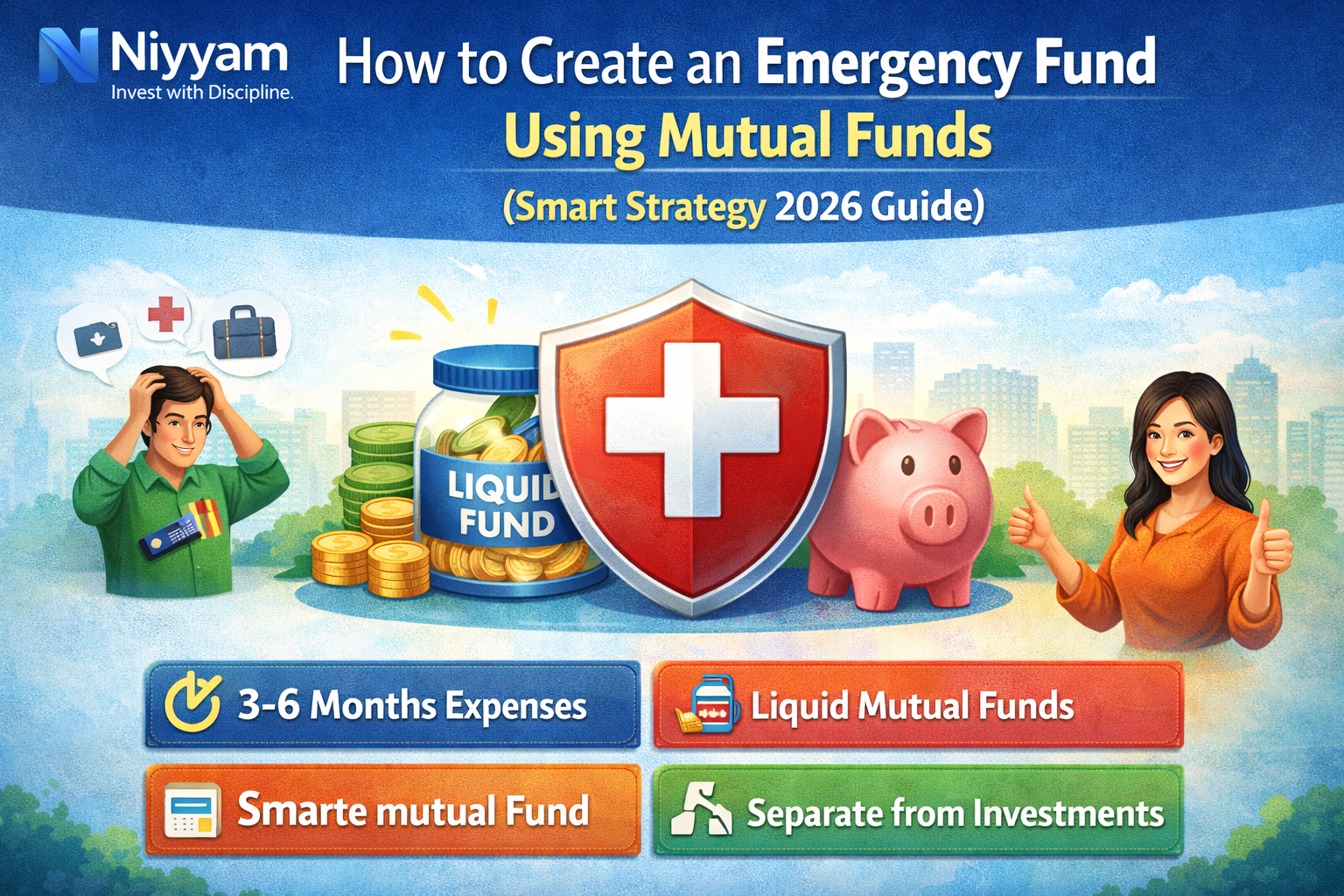
- An emergency fund should cover 3–6 months of expenses
- Liquid mutual funds are the best option for emergency funds
- Avoid equity funds completely for this purpose
- Maintain a mix of savings accounts and liquid funds
- Liquidity is more important than returns
- Use SIP to build the fund gradually
- Keep your emergency fund separate from your investments
Direct Answer
You can build an emergency fund using liquid mutual funds along with a savings account. Ideally, keep:
- 20–30% in savings for instant access
- 70–80% in liquid mutual funds for better returns and flexibility
What is an Emergency Fund?
An emergency fund is money set aside specifically for unexpected financial situations.
It acts as a safety net that protects your financial life.
Common Emergency Situations
- Job loss → Income stops
- Medical emergency → Sudden expenses
- Urgent repairs → Immediate spending
- Family emergencies → Unplanned costs
The purpose of an emergency fund is simple:
It protects your financial stability—not to generate high returns.
Why Emergency Funds Are Important
Most people focus only on investing.
But without a safety net, investing alone is not enough.
If an emergency occurs and you don’t have a fund:
- You may withdraw investments at the wrong time
- You may incur losses due to market conditions
- You may rely on loans or credit cards
This can delay your financial progress significantly.
An emergency fund ensures your investments remain untouched.
How Much Emergency Fund Do You Need?
The required amount depends on your income stability.
Basic Rule
- Salaried individuals → 3–6 months of expenses
- Self-employed individuals → 6–12 months of expenses
Example
If your monthly expenses are ₹40,000:
- Minimum fund → ₹1,20,000
- Ideal fund → ₹2,40,000
If your income is uncertain, always maintain a higher buffer.
Where Should You Keep Emergency Funds?
Your emergency fund must be:
- Safe
- Liquid
- Easily accessible
Options Comparison
- Savings Account → Instant access, low returns
- Liquid Mutual Funds → Best balance of safety and returns
- Debt Funds → Secondary option
- Equity Funds → Not suitable
Emergency funds should never be exposed to high volatility.
Why Liquid Mutual Funds Are Ideal
Liquid mutual funds are designed for short-term parking of money.
They invest in low-risk instruments like treasury bills and short-term debt.
Benefits of Liquid Funds
- High liquidity → Easy redemption
- Low risk → Capital protection
- Better returns than a savings account
- Suitable for short-term needs
If you want a deeper understanding, explore:
Debt Mutual Funds vs Liquid Funds vs Fixed Deposits: Where Should You Park Short-Term Money?
Ideal Emergency Fund Structure
Do not keep all your money in one place.
Recommended Allocation
- Savings Account → 20–30%
- Liquid Mutual Funds → 70–80%
Example
If your total emergency fund is ₹3 lakh:
- Savings → ₹75,000
- Liquid Funds → ₹2,25,000
This ensures:
- Instant access
- Better returns
- Financial flexibility
Step-by-Step: How to Build Your Emergency Fund
Step 1: Calculate Monthly Expenses
Include:
- Rent
- Food
- Utilities
- Insurance
- EMIs
Step 2: Set Your Target
Multiply your expenses by 3–6 months.
Step 3: Start SIP in Liquid Funds
Instead of waiting to save a lump sum:
- Start a monthly SIP
- Build gradually
- Stay consistent
Step 4: Maintain Savings Buffer
Always keep part of your fund in savings for immediate needs.
Where NOT to Keep Emergency Funds
Avoid these options:
- Equity mutual funds → High volatility
- Stocks → Unpredictable
- Real estate → Illiquid
- Long-term FDs → Restricted access
Emergency funds must always be:
Low risk + Highly liquid
Common Mistakes Investors Make
1. Not Having an Emergency Fund
- Leads to financial stress
- Forces poor decisions
2. Investing Emergency Money in Equity
- High risk
- Possible losses when money is needed
3. Keeping Everything in Savings
- Very low returns
- Loss of purchasing power over time
To improve risk management, explore:
How to Reduce Risk in Mutual Fund Investing
Monthly Plan to Build an Emergency Fund
You don’t need a large amount to start.
Example Plan
- Month 1 → ₹15,000
- Month 2 → ₹30,000
- Month 3 → ₹45,000
- Month 4 → ₹60,000
- Month 5 → ₹75,000
- Month 6 → ₹90,000
Consistency matters more than amount.
Emergency Fund Strategy by Life Stage
In Your 20s
- Start small
- Focus on discipline
In Your 30s
- Increase fund size
- Stabilize finances
In Your 40s and Above
- Maintain a higher buffer
- Focus on financial protection
Emergency Fund vs Investment
- Emergency fund → Safety
- Investment → Growth
Both are important, but they serve different purposes.
Without an emergency fund, your investments are at risk.
When Should You Use an Emergency Fund?
Use it only for genuine emergencies:
- Job loss → Yes
- Medical emergency → Yes
- Unexpected repairs → Yes
Do NOT use for:
- Vacations
- Shopping
- Lifestyle expenses
How Emergency Fund Supports SIP Investing
One major benefit:
It helps you continue investing during tough times.
Without an emergency fund:
- You stop SIP
- You panic
- You lose long-term gains
With an emergency fund:
- You stay invested
- You benefit from market dips
For better SIP planning, explore:
How Much Should You Invest in SIP Every Month?
Advanced Insight: Financial Stability Framework
Smart investors follow this order:
- Emergency fund
- Insurance
- Investments
If you want better portfolio structure, explore:
Mutual Fund Portfolio Allocation Strategy (Equity vs Debt vs Hybrid)
Conclusion: Protect First, Then Grow
An emergency fund is the foundation of financial planning.
Before chasing returns, secure your base.
- Liquidity matters more than returns
- Consistency matters more than amount
Final Action Plan
- Calculate your monthly expenses
- Build a 3–6 month emergency fund
- Use savings + liquid funds
- Start SIP to build gradually
- Review your fund regularly
Final Verdict
An emergency fund is essential for financial stability.
- Savings account → Immediate access
- Liquid funds → Efficient parking
Final Thought
Wealth is not just about growing money.
It is also about protecting it.
An emergency fund is your financial safety shield.
Frequently Asked Questions (FAQs)
1. Can I use mutual funds for an emergency fund?
Yes, you can use mutual funds for an emergency fund, but only liquid mutual funds. They offer better returns than savings accounts while maintaining high liquidity and low risk.
2. Should I invest my emergency fund in equity mutual funds?
No, equity mutual funds are not suitable for emergency funds. They are volatile and can lead to losses when you need money urgently.
3. How much emergency fund is enough?
An ideal emergency fund should cover 3–6 months of expenses for salaried individuals and 6–12 months for self-employed individuals.
4. Can I keep my entire emergency fund in liquid mutual funds?
No, you should not keep everything in liquid funds. Maintain 20–30% in a savings account for instant access and the rest in liquid funds.
5. Is a fixed deposit better than a liquid mutual fund?
Fixed deposits are safer, but they offer less flexibility. Liquid mutual funds provide better liquidity and slightly higher returns, making them more suitable for emergency funds.
6. How can I build an emergency fund quickly?
You can build an emergency fund faster by:
- Starting a monthly SIP
- Adding a lump sum whenever possible
- Reducing unnecessary expenses
Consistency is more important than the amount.
Disclaimer
This content is for educational purposes only and does not constitute investment advice.
Mutual fund investments are subject to market risks. Investors should read all scheme-related documents carefully before investing and consider their financial goals, risk tolerance, and investment horizon.
Share this guide with your friends, family, and colleagues to help them make better financial decisions.
If this article helped you, share it with at least one person who needs this guidance.
Leave a Reply