
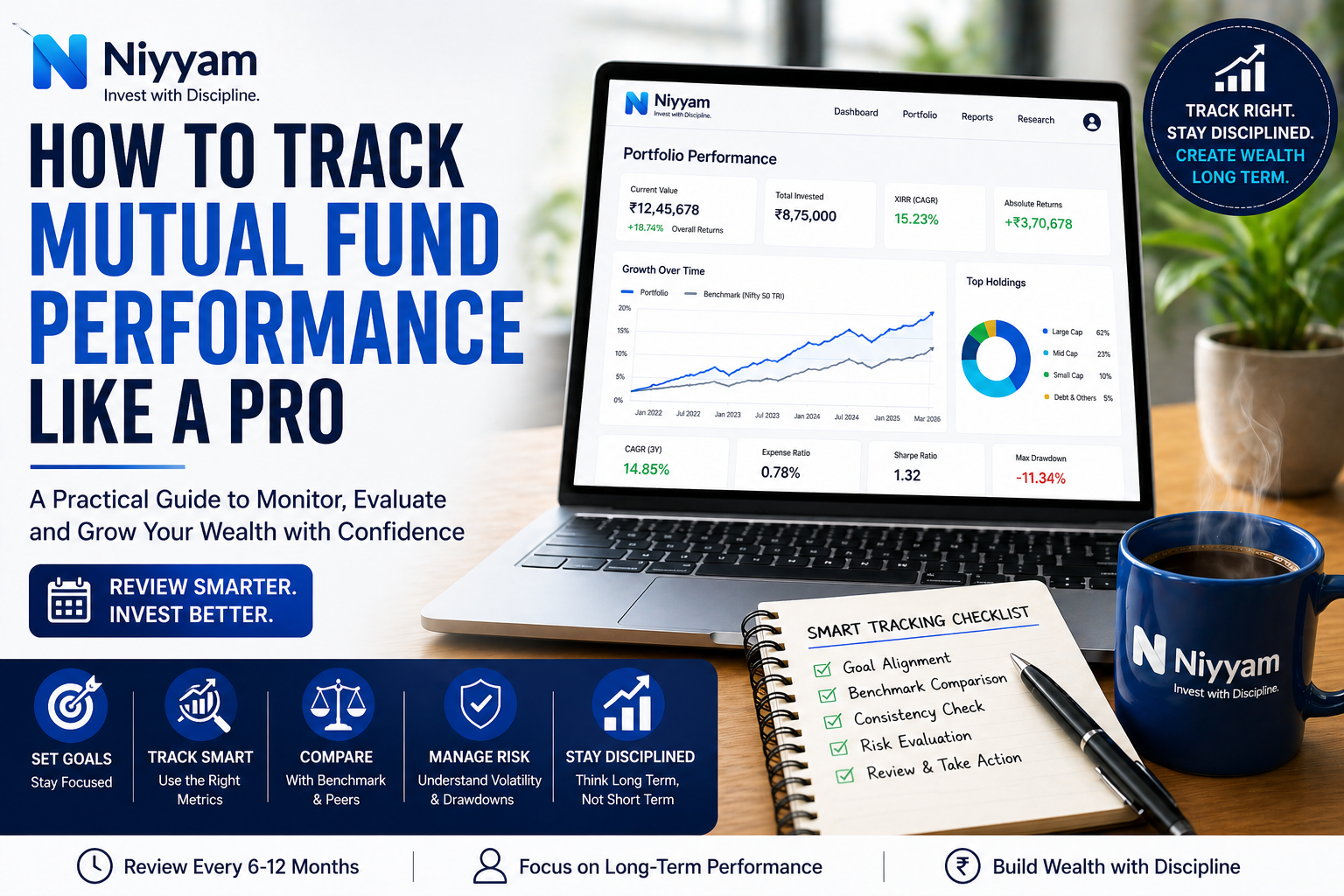
By Ashok Prasad, Founder, Niyyam
Published: March 2026
Introduction
How to track mutual fund performance is one of the most important skills every investor must learn after starting their investment journey.
Most investors focus heavily on selecting mutual funds, but very few understand how to track them properly.
After investing, they usually fall into one of these patterns:
- Checking returns too frequently
- Panicking during market corrections
- Ignoring performance completely
All three approaches are flawed.
Tracking mutual fund performance is not about reacting to short-term changes — it is about evaluating long-term progress in a structured and disciplined way.
If you get this right, you can:
- Stay confident during market volatility
- Avoid unnecessary switching
- Improve long-term wealth creation
Before going deeper, it helps to understand the basics:
How to Invest in Mutual Funds for Beginners in India (2026 Step-by-Step Guide)
💡 Key Takeaways
- Tracking mutual funds is about long-term evaluation, not daily monitoring
- CAGR, consistency, and benchmark comparison matter more than short-term returns
- Over-tracking leads to emotional decisions
- Risk-adjusted returns and drawdowns are critical metrics
- SIP investors should focus on long-term performance
- Portfolio-level tracking is more important than individual fund tracking
- Discipline in tracking leads to better outcomes
Direct Answer
To track mutual fund performance effectively:
- Review your portfolio every 6–12 months
- Compare fund performance with benchmarks
- Focus on CAGR and consistency
- Evaluate risk using volatility and drawdown
- Avoid reacting to short-term market movements
Tracking is about checking the right data at the right time.
What Does Tracking Mutual Fund Performance Really Mean?
Tracking is not about frequent checking.
It means:
- Evaluating performance vs expectations
- Comparing with benchmarks
- Monitoring consistency
- Ensuring alignment with goals
Key Insight
Tracking is analysis, not reaction.
How Often Should You Track Your Mutual Funds?
Ideal Frequency
- Once every 6 months
- Or annually
Avoid
- Daily NAV tracking
- Weekly return checking
- Emotional reactions
Key Insight
Over-tracking leads to poor decisions.
Key Metrics to Track Mutual Fund Performance
1. CAGR (Compounded Annual Growth Rate)
Measures long-term growth rate.
Why It Matters
- Shows real performance
- Enables comparison
Insight
CAGR is more useful than absolute returns.
2. Benchmark Comparison
Compare fund performance with index.
Rule
Underperformance for 2–3 years → review needed
3. Consistency of Returns
Stable returns are better than volatile high returns.
Insight
Consistency builds wealth.
4. Expense Ratio
Lower cost = higher returns.
To understand:
What is Expense Ratio in Mutual Funds? How It Affects Your Returns (2026 Guide)
5. Risk-Adjusted Returns
Sharpe Ratio helps evaluate efficiency.
6. Drawdown
Shows fall during market crashes.
Insight
Lower drawdown = better holding comfort.
Real-Life Example
Fund A
- 15% CAGR
- High volatility
Fund B
- 12% CAGR
- Stable
Conclusion
Fund B is better for most investors.
Step-by-Step Framework to Track Mutual Funds
Step 1: Check Goal Alignment
Ensure fund matches your goal.
For deeper clarity:
Goal-Based Investing in Mutual Funds: How to Plan SIPs for Financial Goals (2026 Guide)
Step 2: Compare with Benchmark
Check relative performance.
Step 3: Evaluate Consistency
Focus on 3–5 year data.
Step 4: Check Risk
Evaluate volatility and drawdown.
Step 5: Take Action
- Continue
- Monitor
- Replace
What NOT to Track
Avoid:
- Daily NAV
- Market noise
- Short-term returns
Insight
Wrong tracking = wrong decisions.
How SIP Investors Should Track Performance
Focus On
- Long-term CAGR
- Total value vs investment
Avoid
- Monthly returns
- Short-term losses
To understand:
How SIP Builds Wealth Through Compounding (With Simple Examples)
Common Mistakes
- Over-tracking
- Chasing top funds
- Switching frequently
- Ignoring risk
Insight
Behavior matters more than market.
Advanced Strategy: Portfolio-Level Tracking
Track entire portfolio:
- Allocation
- Diversification
- Returns
Rebalance every 1–2 years.
When Should You Exit or Replace a Mutual Fund?
Tracking also helps you decide when to act.
Review or Exit If:
- Underperformance for 2–3 years
- Major strategy change
- High risk without extra return
- Goal mismatch
Do NOT Exit If:
- Short-term decline
- Market correction
Key Insight
Review logically, not emotionally.
Simple Tracking Checklist (Use Every 6 Months)
Before making decisions, check:
- Is fund beating benchmark?
- Is performance consistent?
- Is risk acceptable?
- Is it aligned with your goal?
Key Insight
A checklist prevents emotional mistakes.
Psychology of Smart Investors
Smart Investors
- Track periodically
- Stay disciplined
Average Investors
- Panic
- Overreact
Truth
Discipline matters more than strategy.
Frequently Asked Questions (FAQs)
1. How often should I track mutual funds?
Every 6–12 months is sufficient.
2. What is the most important metric?
CAGR and consistency.
3. Should I exit underperforming funds?
Only after consistent underperformance for 2–3 years.
4. Is daily tracking useful?
No. It leads to emotional decisions.
5. What should SIP investors focus on?
Long-term growth and consistency.
Final Thoughts
Tracking mutual funds is a skill.
If done right, it helps you:
- Stay disciplined
- Avoid mistakes
- Build wealth
Always remember:
You don’t need to track more — you need to track better.
Soft CTA
If you want to build a mutual fund portfolio with clarity and discipline, structure matters.
Niyyam is designed to simplify investing and help you stay consistent with your financial goals.
Start your wealth creation journey with confidence.
Disclaimer
This content is for educational purposes only and does not constitute investment advice.
Mutual fund investments are subject to market risks. Investors should read all scheme-related documents carefully before investing and consider their financial goals, risk tolerance, and investment horizon.
Share this guide with your friends, family, and colleagues to help them make better financial decisions.
If this article helped you, share it with at least one person who needs this guidance.
Leave a Reply