
By Ashok Prasad, Founder, Niyyam
Published: March 2026
Introduction
Invest at market peak is one of the biggest fears every investor faces when starting mutual fund investing.
Many investors worry:
“What if I invest at the wrong time?”
“What if I invest at the market peak?”
This fear often leads to hesitation, delayed investing, or emotional decisions during market corrections.
Even those who invest often:
- Panic during market corrections
- Exit at a loss
- Lose confidence in mutual funds
But here is the truth:
Every long-term investor will face this situation at least once. Markets move in cycles. Peaks, corrections, and recoveries are natural. The real difference between successful and unsuccessful investors is not timing.
It is how they respond after investing at the peak.
To understand why long-term strategy matters more than timing, refer to How to Achieve Financial Freedom Using SIP (Step-by-Step FIRE Strategy 2026).
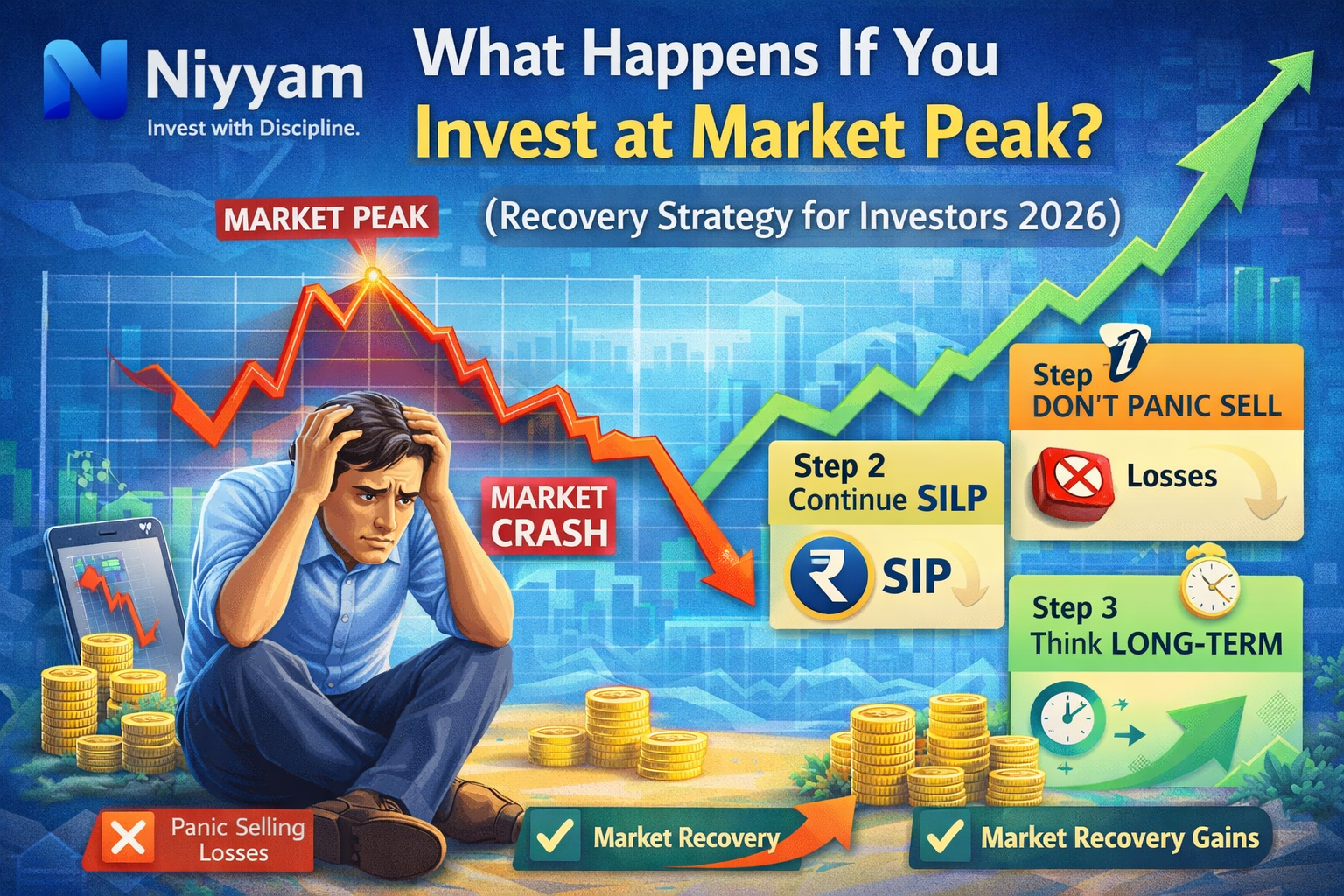
What happens if you invest at the market peak? (Direct Answer)
If you invest at the market peak, your portfolio may decline in the short term due to a market correction. However, with continued SIP, proper asset allocation, and a long-term approach, markets typically recover and generate positive returns over time.
💡 Key Takeaways
- Investing at the peak is common and unavoidable
- Short-term losses are temporary
- SIP reduces timing risk
- Staying invested is critical
- Recovery depends on the time horizon
- Asset allocation reduces downside risk
- Panic selling leads to permanent loss
What does market peak mean?
A market peak refers to a stage where:
- Prices are at their highest levels
- Valuations are stretched
- Investor optimism is extremely high
At this stage, most investors feel confident and expect markets to continue rising.
Market cycle simplified
| Phase | Description |
|---|---|
| Bull Market | Rising prices |
| Peak | Maximum optimism |
| Correction | Decline begins |
| Recovery | Stabilization |
Key point:
Market peaks are only identified after a fall.
What actually happens after investing at the peak
Let’s understand this practically.
Immediate impact
| Situation | Outcome |
|---|---|
| Market falls 10–20% | Mild correction |
| Market falls 20–30% | Strong volatility |
| Market falls 30%+ | Panic phase |
Example
| Investment | Market Fall | Value |
|---|---|---|
| ₹1,00,000 | -20% | ₹80,000 |
At this stage, most investors feel regret and anxiety.
Investor reactions
| Reaction | Result |
|---|---|
| Panic selling | Permanent loss |
| Staying invested | Recovery potential |
Key point:
Loss is temporary unless you sell.
Real investor case study
Consider two investors who invest ₹5 lakh at market peak.
Investor A
- Market falls 30%
- Portfolio drops to ₹3.5 lakh
- Sells investment
- Books ₹1.5 lakh loss
Investor B
- Faces same market fall
- Continues SIP
- Holds investment
- Market recovers in 2–3 years
- Portfolio grows beyond ₹6–7 lakh
Key point:
Behavior determines outcome, not timing.
How long does recovery take?
Recovery depends on market conditions.
Recovery timeline
| Market Fall | Recovery Time |
|---|---|
| 10–20% | 6–12 months |
| 20–40% | 1–3 years |
| 40%+ | 3–5 years |
Important insight
Markets have historically recovered from every major fall.
Key point:
Time is the biggest recovery tool.
Step 1: Do not panic sell
Panic selling converts temporary loss into permanent loss.
Impact
| Action | Result |
|---|---|
| Sell during fall | Loss locked |
| Stay invested | Recovery possible |
Why panic happens
- Fear
- Negative news
- Short-term mindset
Key point:
Emotions destroy returns.
What should you do immediately after investing at the market peak
If you realize that you invested at the peak, follow these steps immediately:
- Do not check the portfolio daily
- Avoid reacting to market news
- Continue SIP without interruption
- Review asset allocation calmly
- Focus on long-term goals
These actions help you stay disciplined and avoid emotional mistakes.
Step 2: Continue SIP
SIP works best during market downturns.
Why SIP works
- Buys more units at lower prices
- Reduces average cost
- Improves long-term returns
Example
| Month | NAV | Units |
|---|---|---|
| Month 1 | ₹100 | 10 |
| Month 2 | ₹80 | 12.5 |
| Month 3 | ₹70 | 14.2 |
Key point:
Market fall + SIP = wealth creation opportunity.
To understand this better, refer to SIP vs Lump Sum: Which Investment Strategy Is Better for Beginners?.
Step 3: Maintain asset allocation
A balanced portfolio reduces risk.
Example
| Asset | Allocation |
|---|---|
| Equity | 60–70% |
| Debt | 20–30% |
| Hybrid | 10% |
Why it works
- Equity drives recovery
- Debt stabilizes portfolio
To understand allocation better, refer to How to Build a Mutual Fund Portfolio for Long-Term Wealth Creation (2026 Guide).
Key point:
Allocation protects your portfolio.
Step 4: Avoid lump sum mistakes
Investing all the money at once increases risk.
Better strategy
| Situation | Approach |
|---|---|
| Volatile market | SIP |
| Large investment | STP |
Key point:
Phased investing reduces timing risk.
Step 5: Use corrections as an opportunity
Market corrections create opportunities.
Strategy
| Market Fall | Action |
|---|---|
| 10% fall | Continue SIP |
| 20% fall | Increase SIP |
| 30% fall | Aggressive investing |
Key point:
Wealth is created during market downturns.
Step 6: Think long term
Short-term results are unpredictable.
Return comparison
| Duration | Outcome |
|---|---|
| 1 year | Volatile |
| 5 years | Stable |
| 10+ years | Strong growth |
To understand this deeply, refer to SIP for 5 Years vs 10 Years vs 20 Years: How Time Impacts Your Wealth (2026 Guide).
Key point:
Time reduces risk significantly.
Step 7: Review portfolio, not exit
Corrections are the best time to review.
Checklist
- Fund performance
- Asset allocation
- Risk exposure
For structured review, refer to Mutual Fund Portfolio Review Checklist (Monthly, Quarterly, Yearly Strategy 2026).
Key point:
Review improves outcomes; exit destroys them.
Psychology of investing at market peak
Understanding investor psychology is critical.
Common emotions
- Fear
- Regret
- Anxiety
Successful investor behavior
- Stays disciplined
- Ignores noise
- Follows strategy
Key point:
Mindset drives success.
Since investor behavior plays a crucial role during market peaks and corrections, it is important to understand these patterns in detail. You can explore this further in our Common Mutual Fund Mistakes and Smart Investor Strategies (2026 Guide).
Step-by-step recovery strategy
- Do not panic sell
- Continue SIP
- Maintain allocation
- Avoid lump sum mistakes
- Invest more during corrections
- Stay long-term focused
Common mistakes investors make
- Panic selling
- Stopping SIP
- Following market noise
- Ignoring allocation
- Emotional decisions
Impact
| Mistake | Result |
|---|---|
| Panic selling | Loss |
| No SIP | Missed growth |
| Emotional investing | Poor returns |
To understand these mistakes in depth and how they impact long-term returns, it is important to go beyond surface-level errors and focus on investor behavior and decision-making patterns. For a complete breakdown of common mistakes and practical strategies to avoid them, read our Common Mutual Fund Mistakes and Smart Investor Strategies (2026 Guide).
Advanced insight
Most investors believe timing matters most.
Reality:
Consistency matters more.
Wealth formula
| Factor | Importance |
|---|---|
| Timing | Low |
| Discipline | High |
| Time | Maximum |
Key point:
You cannot control markets, but you can control behavior.
Conclusion
Investing at the market peak is not a mistake.
It is part of the journey.
What matters is:
- Your discipline
- Your strategy
- Your patience
Markets reward long-term investors.
Final verdict
- Stay calm
- Continue investing
- Avoid emotional decisions
- Focus on long-term wealth
Final thought
You don’t lose money by investing at the peak.
You lose money by reacting incorrectly.
Frequently Asked Questions (FAQs)
Is it bad to invest at the market peak?
No, if you stay invested long term.
Should I stop SIP during a crash?
No, continue SIP.
How long does recovery take?
1–5 years, depending on conditions.
Should I invest more during a crash?
Yes, if financially comfortable.
Can timing risk be avoided?
Yes, through SIP and allocation.
Disclaimer
This content is for educational purposes only and does not constitute investment advice.
Mutual fund investments are subject to market risks. Investors should read all scheme-related documents carefully before investing and consider their financial goals, risk tolerance, and investment horizon.
Share this guide with your friends, family, and colleagues to help them make better financial decisions.
If this article helped you, share it with at least one person who needs this guidance.
Leave a Reply