By Ashok Prasad, Founder, Niyyam
Published: March 2026
Introduction
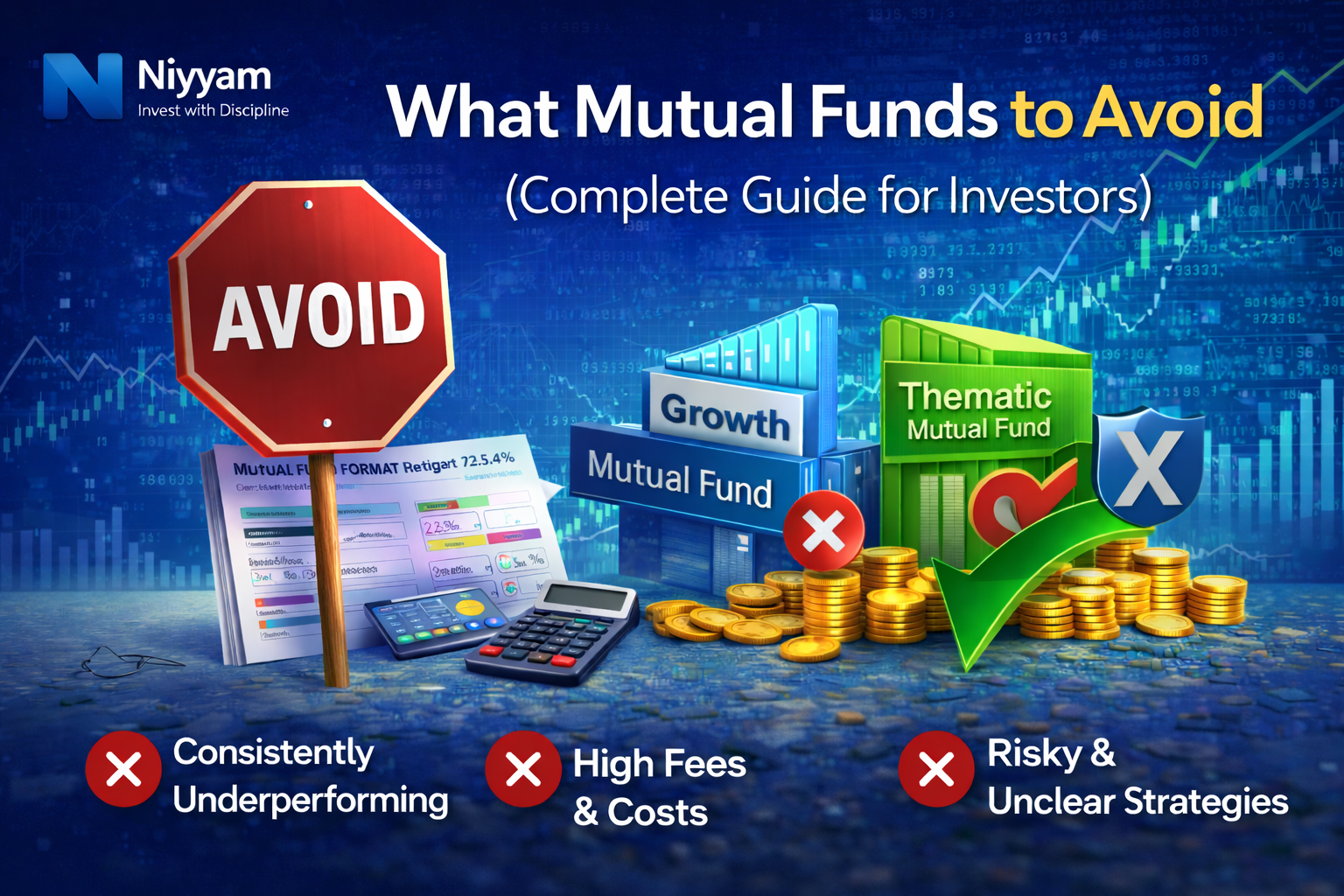
What mutual funds should you avoid in 2026? This is one of the most important questions investors should ask before selecting any fund.
But the smarter question is:
Which mutual funds should you avoid?
Because in investing, your returns are not just decided by what you choose —
they are heavily impacted by what you avoid.
A single poor mutual fund can:
- Pull down your overall portfolio
- Reduce long-term compounding
- Increase unnecessary risk
- Delay your financial goals
In fact, many investors who believe that “mutual funds don’t work” are often holding poor-quality funds, not bad asset classes.
If you understand how to filter out weak funds, your investing journey becomes significantly smoother and more predictable.
Before selecting any fund, it is equally important to understand How to Choose the Best Mutual Fund in India (2026 Guide), because selection and rejection go hand in hand.
💡 Key Takeaways
- Avoid funds that consistently underperform their benchmark
- High expense ratio without strong returns is a major red flag
- Frequent fund manager changes indicate instability
- Inconsistent returns are riskier than low returns
- Very small and very large AUM funds both carry risks
- Thematic funds are high-risk and not suitable for most investors
- Avoiding bad funds improves returns more than chasing top performers
Direct Answer
You should avoid mutual funds in 2026 that consistently underperform, charge high fees without delivering returns, show frequent management changes, or follow unclear and risky strategies. Focus on consistency, cost efficiency, and long-term stability instead of chasing short-term returns.
Why Avoiding Bad Mutual Funds is Critical
Most investors assume that even an average fund will generate decent returns over time.
But the reality is different.
| Fund Type | Outcome |
|---|---|
| Strong fund | Consistent compounding |
| Average fund | Slow wealth creation |
| Poor fund | Wealth erosion |
The biggest problem with a weak fund is not just low returns —
it breaks the compounding cycle.
For example:
A fund underperforming by just 3–4% annually can lead to massive wealth loss over 15–20 years.
If you are investing through SIP, understanding How SIP Builds Wealth Through Compounding (2026 Guide) will help you see how poor fund selection directly impacts long-term wealth.
Red Flag 1: Consistent Underperformance
The most important signal to avoid a mutual fund is consistent underperformance.
Example
| Period | Fund Return | Benchmark |
|---|---|---|
| 1 Year | 8% | 12% |
| 3 Years | 10% | 14% |
| 5 Years | 11% | 15% |
This indicates:
- Weak stock selection
- Poor strategy
- Inefficient management
What You Should Do
- Check 3-year and 5-year performance
- Compare with benchmark and category
- Ignore short-term noise
Key Point:
One bad year is acceptable. Consistent underperformance is not.
Red Flag 2: High Expense Ratio Without Justification
Every mutual fund charges a fee — but not every fund deserves it.
| Fund Type | Expense Ratio |
|---|---|
| Index Funds | 0.1% – 0.5% |
| Active Funds | 1% – 2% |
Danger Scenarios
- High cost + low return → Avoid
- High cost + strong return → Acceptable
- Low cost + stable return → Ideal
Over time, even a 1% higher cost can significantly reduce your wealth.
To understand cost impact in detail, refer to What is Expense Ratio in Mutual Funds? How It Affects Your Returns (2026 Guide).
Key Point:
Higher cost must always be justified by performance.
Red Flag 3: Frequent Fund Manager Changes
A mutual fund is actively managed — and management matters.
Frequent changes lead to:
- Strategy inconsistency
- Portfolio reshuffling
- Increased risk
Example
| Year | Manager |
|---|---|
| 2022 | Manager A |
| 2023 | Manager B |
| 2024 | Manager C |
What You Should Do
- Check fund manager tenure
- Prefer long-term consistency
- Avoid frequent changes
Key Point:
Stable management often leads to stable performance.
Red Flag 4: Very Small or Very Large AUM
AUM (Assets Under Management) affects fund flexibility.
| AUM Size | Risk |
|---|---|
| Below ₹100 Cr | Low stability |
| ₹500 Cr – ₹20,000 Cr | Balanced |
| Above ₹50,000 Cr | Limited flexibility |
Why It Matters
- Small funds may struggle to survive
- Large funds may struggle to outperform
To understand how fund size impacts strategy, refer to How to Compare Mutual Funds in India (5 Key Metrics Every Investor Must Check).
Key Point:
Avoid extremes unless justified.
Red Flag 5: Inconsistent Returns
Many investors chase funds with high short-term returns.
But inconsistency is a bigger risk.
Example
| Year | Return |
|---|---|
| 2021 | 25% |
| 2022 | -5% |
| 2023 | 18% |
| 2024 | 2% |
This creates:
- Uncertainty
- Emotional decisions
- Poor planning
Key Point:
Consistency is more valuable than spikes.
Red Flag 6: Poor Portfolio Construction
A fund’s structure reveals its quality.
| Structure | Risk |
|---|---|
| 100+ stocks | Diluted returns |
| <15 stocks | High concentration |
Ideal Fund
- Balanced diversification
- Clear strategy
- Category alignment
To understand allocation better, refer to Mutual Fund Portfolio Allocation Strategy (Complete Guide 2026).
Key Point:
Balance is more important than extremes.
Red Flag 7: Thematic and Trend-Based Funds
Thematic funds focus on specific sectors like:
- Technology
- Pharma
- Infrastructure
These funds are highly cyclical.
| Phase | Outcome |
|---|---|
| Boom | High returns |
| Slowdown | Sharp losses |
To understand category differences, refer to Large Cap vs Mid Cap vs Small Cap Funds Explained (2026 Guide).
Key Point:
Thematic funds are not suitable for most investors.
Red Flag 8: Blindly Following Past Returns
This is one of the biggest mistakes.
Example
| Year | Top Fund | Next Year |
|---|---|---|
| 2022 | Fund A | Underperformed |
| 2023 | Fund B | Average |
Why It Happens
- Market cycles change
- Strategies stop working
- Valuations shift
To understand this better, read How Market Cycles Impact Mutual Fund Selection (2026 Guide).
Key Point:
Past performance is useful — but not reliable alone.
Common Mistakes Investors Make
- Chasing high returns
- Ignoring costs
- Not reviewing portfolio
- Following trends
- Investing without understanding
| Mistake | Outcome |
|---|---|
| Poor selection | Low returns |
| No monitoring | Holding weak funds |
| Emotional decisions | Loss of discipline |
To understand these behavioral mistakes in depth, refer to Common Mutual Fund Mistakes and Smart Investor Strategies (2026 Guide). This guide explains how poor decisions and emotional investing can significantly impact long-term returns.
Advanced Insight: Filtering is More Important Than Selection
The biggest difference between average and smart investors:
Smart investors eliminate bad options first.
Framework
- Remove underperformers
- Check consistency
- Evaluate cost
- Analyze portfolio
- Review management
| Portfolio Type | Result |
|---|---|
| Includes weak funds | Lower returns |
| Filters bad funds | Strong growth |
Key Point:
Avoiding mistakes improves returns more than chasing winners.
Conclusion
Mutual fund investing is not just about finding the best funds.
It is about avoiding the wrong ones.
If you can filter out weak funds:
- Your portfolio becomes stronger
- Your returns become more stable
- Your financial journey becomes smoother
Final Verdict
- Avoid inconsistent and underperforming funds
- Focus on cost efficiency and stability
- Do not chase trends or short-term performance
- Review your investments regularly
A strong portfolio is built through smart filtering, not just smart selection.
Final Thought
You don’t need the best mutual fund to succeed.
You just need to avoid the worst ones consistently.
Frequently Asked Questions (FAQs)
1. How often should I review mutual funds?
Every 6–12 months is sufficient.
2. Should I exit after one year of poor performance?
No, focus on long-term trends.
3. Are high-expense funds always bad?
No, but they must justify the cost.
4. Are thematic funds completely avoidable?
Not completely, but exposure should be limited.
5. Can a poor fund recover?
Yes, but relying on that is risky.
Disclaimer
This content is for educational purposes only and does not constitute investment advice.
Mutual fund investments are subject to market risks. Investors should read all scheme-related documents carefully before investing and consider their financial goals, risk tolerance, and investment horizon.
Share this guide with your friends, family, and colleagues to help them make better financial decisions.
If this article helped you, share it with at least one person who needs this guidance.
Leave a Reply