
By Ashok Prasad, Founder, Niyyam
Published: March 2026
Introduction
Mutual fund asset allocation strategy is one of the most important yet most overlooked aspects of investing.
Most investors spend a lot of time selecting the “best” mutual funds. They compare returns, ratings, and past performance. But what many fail to realize is this:
Even the best mutual funds cannot deliver consistent results if your portfolio allocation is wrong.
The real driver of long-term investment success is not fund selection — it is how you allocate your investments across equity, debt, and hybrid funds.
A well-structured portfolio helps you:
- Manage risk effectively
- Stay invested during market volatility
- Achieve long-term financial goals
If you are new to investing, it is important to first understand What is a Mutual Fund? A Simple Explanation for Beginners, as it builds the foundation for all allocation decisions.
💡 Key Takeaways
- Asset allocation matters more than fund selection
- Equity, debt, and hybrid funds serve different purposes
- Proper allocation reduces risk and improves consistency
- Portfolio must align with goals and risk tolerance
- Rebalancing is essential for long-term discipline
Direct Answer
Mutual fund portfolio allocation refers to how you distribute your investments across equity, debt, and hybrid funds. A well-balanced allocation helps reduce risk, improve return consistency, and align investments with your financial goals.
What is Portfolio Allocation in Mutual Funds?
Portfolio allocation means dividing your investments across different asset classes:
- Equity mutual funds
- Debt mutual funds
- Hybrid mutual funds
Each asset class behaves differently under market conditions.
A proper allocation helps:
- Reduce overall portfolio risk
- Avoid concentration in one asset class
- Improve long-term stability
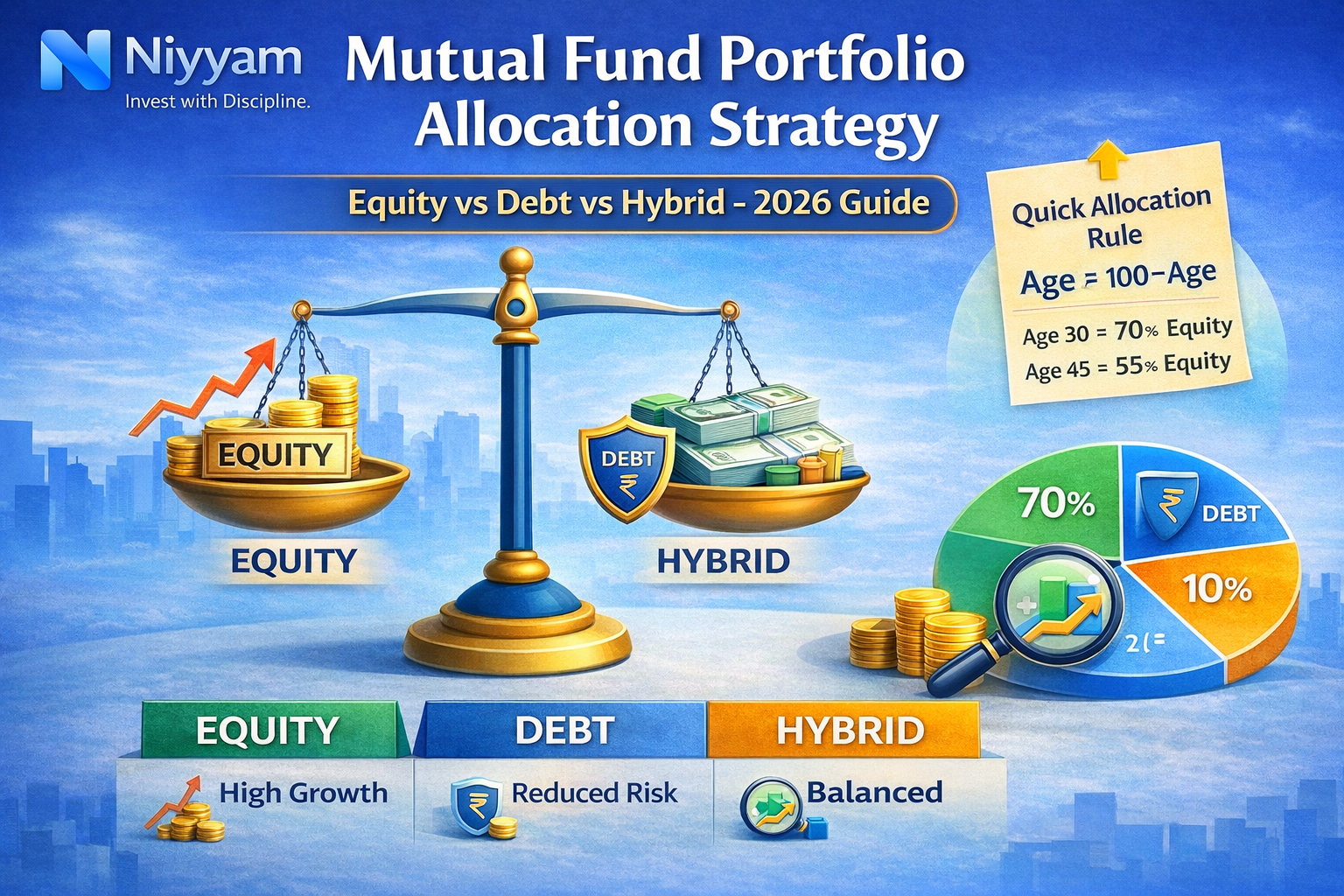
A proper mutual fund asset allocation strategy helps investors balance equity, debt, and hybrid investments effectively.
Understanding the Three Core Asset Classes
Equity Mutual Funds
Equity funds invest in stocks and are primarily used for long-term wealth creation.
They offer:
- High return potential
- High volatility
- Best suited for long-term goals
Debt Mutual Funds
Debt funds invest in bonds and fixed-income instruments.
They offer:
- Lower risk
- Stable returns
- Capital preservation
Hybrid Mutual Funds
Hybrid funds combine equity and debt.
They offer:
- Balanced risk
- Moderate returns
- Stability during market fluctuations
Why Asset Allocation is Critical
Many investors underestimate asset allocation.
In reality, allocation determines:
- Risk level
- Volatility control
- Return consistency
Even a top-performing fund cannot fix a poorly structured portfolio.
To understand how risk works in mutual funds, refer to How to Reduce Risk in Mutual Fund Investing (Practical Strategies for 2026).
How to Decide Your Portfolio Allocation
There is no single formula. Allocation depends on multiple factors.
Investment Horizon
- Short-term (0–3 years): More debt
- Medium-term (3–5 years): Balanced
- Long-term (5+ years): More equity
Risk Tolerance
- Conservative: Higher debt
- Moderate: Balanced
- Aggressive: Higher equity
To better understand this, refer to How to Select Mutual Funds Based on Risk Profile in India (Beginner to Advanced Guide 2026).
Financial Goals
Different goals require different allocation strategies:
- Wealth creation → Equity
- Capital protection → Debt
- Balanced growth → Hybrid
You can explore this further in Goal-Based Investing in Mutual Funds: How to Plan SIPs for Financial Goals (2026 Guide).
Sample Portfolio Allocation Strategies
Conservative Investor
- Equity: 20–30%
- Debt: 60–70%
- Hybrid: 10–20%
Moderate Investor
- Equity: 40–60%
- Debt: 30–50%
- Hybrid: 10–20%
Aggressive Investor
- Equity: 70–80%
- Debt: 10–20%
- Hybrid: 5–10%
Real-World Scenario: Allocation Impact
Consider two investors:
Investor A invests 100% in equity.
Investor B follows a structured allocation of equity, debt, and hybrid funds.
During market corrections:
- Investor A faces high volatility and panic
- Investor B experiences controlled decline
Over time:
- Investor B stays invested
- Investor A may exit early
This highlights the importance of proper allocation.
How to Maintain Your Allocation
Rebalancing
Market movements can distort your allocation.
Rebalancing helps restore balance and maintain risk levels.
For a detailed framework, refer to How to Rebalance Your Mutual Fund Portfolio (When, Why & How – 2026 Guide).
SIP-Based Allocation
You can adjust allocation through SIP:
- Increase investment in underweighted assets
- Reduce the overweight assets
Avoid Frequent Changes
Frequent changes:
- Increase costs
- Reduce consistency
Stick to a disciplined strategy.
Common Mistakes in Portfolio Allocation
- Investing only in equity
- Ignoring debt allocation
- Over-diversification
- Not aligning with goals
- Reacting to market movements
To understand these mistakes in depth and how they impact long-term returns, it is important to focus on investor behavior and decision-making patterns. For a complete breakdown of common mistakes and practical strategies to avoid them, read our Common Mutual Fund Mistakes and Smart Investor Strategies (2026 Guide).
Advanced Insight: Allocation vs Behavior
Many investors believe strategy alone is enough.
But the reality is:
Behavior matters more than strategy.
Even a perfect allocation fails if you:
- Panic during market falls
- Stop SIP
- Chase short-term returns
How Allocation Impacts Long-Term Returns
Returns are influenced by:
- Asset allocation
- Market cycles
- Investment discipline
A balanced portfolio delivers:
- Stable returns
- Lower volatility
- Better long-term outcomes
To understand how returns are calculated, refer to SIP Return Calculator Explained: How to Calculate Your Mutual Fund Returns (With Examples).
Conclusion
Portfolio allocation is the foundation of mutual fund investing.
It determines your risk, stability, and long-term success.
If your allocation is right:
- You stay invested
- You avoid emotional decisions
- You achieve your financial goals
Final Thought
Investing is not about choosing the best fund.
It is about building the right structure and staying disciplined.
Frequently Asked Questions (FAQs)
What is ideal allocation?
Depends on goals, risk tolerance, and time horizon.
Should I invest only in equity?
No, diversification is essential.
How often should I rebalance?
Once or twice a year.
Disclaimer
This content is for educational purposes only and does not constitute investment advice.
Mutual fund investments are subject to market risks. Investors should read all scheme-related documents carefully before investing and consider their financial goals, risk tolerance, and investment horizon.
Share this guide with your friends, family, and colleagues to help them make better financial decisions.
If this article helped you, share it with at least one person who needs this guidance.
Leave a Reply