
By Ashok Prasad, Founder, Niyyam
Published: March 2026
Introduction
Mutual funds vs fixed deposits is one of the most important financial decisions for Indian investors.
For decades, Fixed Deposits (FDs) have been the default investment choice because they offer:
- Safety
- Predictable returns
- Simplicity
At the same time, mutual funds have become increasingly popular due to:
- Higher return potential
- Flexibility
- Better tax efficiency
This creates confusion for investors:
Should you invest in mutual funds or fixed deposits?
The answer depends on your goals, time horizon, and risk tolerance.
Choosing the wrong option can significantly reduce your long-term wealth.
💡 Key Takeaways
- Fixed deposits provide safety, but struggle to beat inflation
- Mutual funds offer higher return potential with market-linked risk
- Taxation significantly affects actual returns
- Inflation reduces real FD returns
- Mutual funds are ideal for long-term wealth creation
- A combination of both provides balance and diversification
Direct Answer
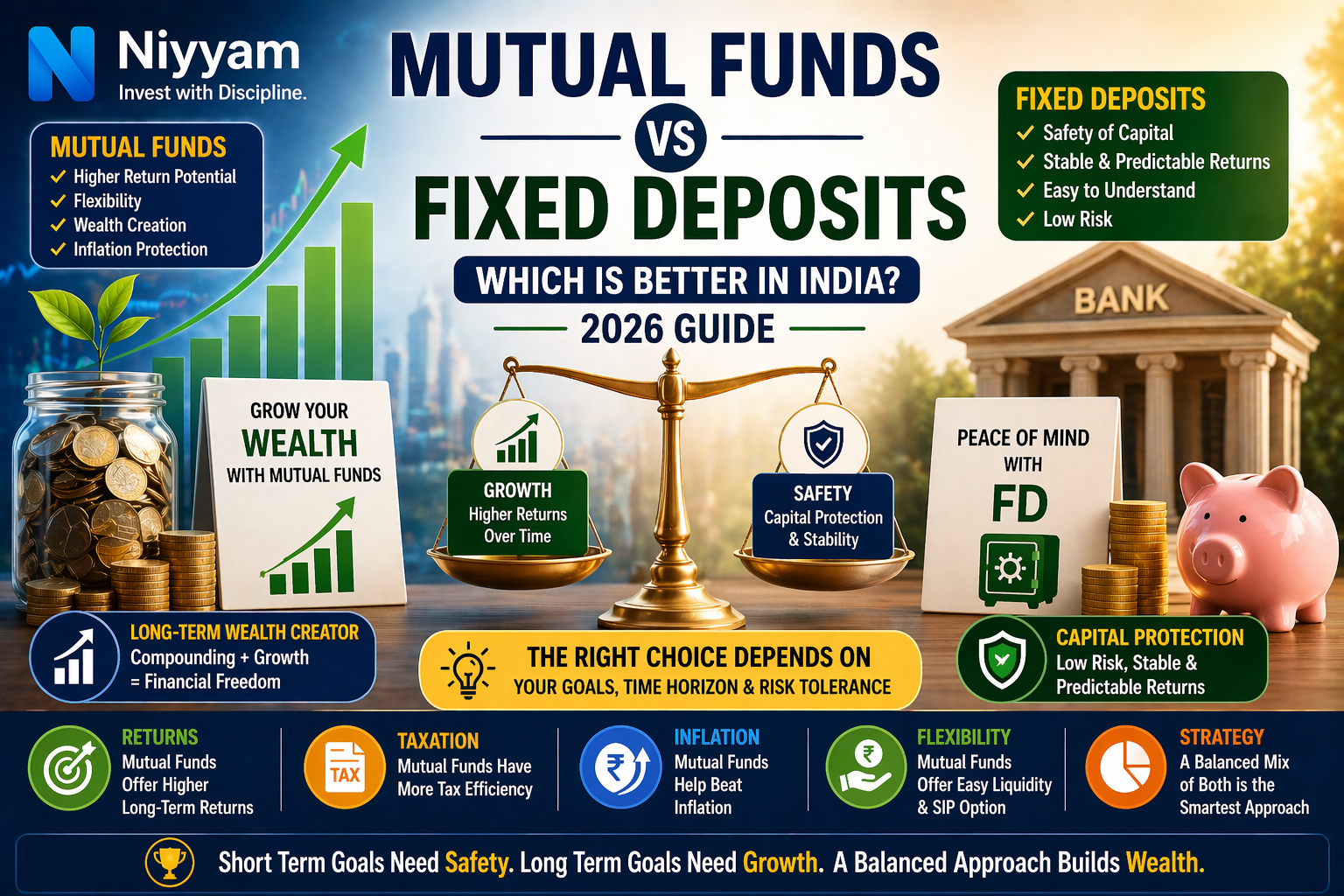
Mutual funds are better for long-term wealth creation and inflation protection, while fixed deposits are better for capital safety and short-term stability.
If you are new, start with
What is a Mutual Fund and How It Works (Beginner Guide)
to understand the foundation.
What Is a Fixed Deposit (FD)?
A Fixed Deposit is a traditional investment instrument where:
- You invest a lump sum amount
- Earn a fixed interest rate
- For a defined tenure
Key Features
- Guaranteed returns
- Very low risk
- Fixed tenure
- Interest taxed as per your income slab
Limitation
Returns are predictable but often fail to beat inflation over the long term.
What Are Mutual Funds?
Mutual funds pool money from investors and invest in:
- Equity (stocks)
- Debt instruments
- Hybrid portfolios
Key Features
- Market-linked returns
- No guarantee of returns
- Higher growth potential
- Flexible investment options
To understand categories, refer to
Types of Mutual Funds in India: Equity, Debt, and Hybrid Explained
Mutual Funds vs Fixed Deposits: Detailed Comparison
1. Returns Comparison (Expanded Insight)
Fixed Deposits
- 5% to 7% returns
- Stable and predictable
- No upside potential
Mutual Funds
- Equity: 10% to 14% (long term)
- Debt: 5% to 7%
- Hybrid: 7% to 10%
Deeper Insight
Over short periods, returns may look similar.
But over long periods:
- FD returns remain linear
- Mutual fund returns become exponential due to compounding
For realistic expectations, refer to
How Much Return Can You Expect from Mutual Funds in India?
2. What Happens Over 15–20 Years (Compounding Impact)
This is where the real difference becomes visible.
Scenario
- Investment: ₹10 lakh
- Duration: 20 years
Fixed Deposit (6%)
- Value: ~₹32 lakh
Equity Mutual Fund (12%)
- Value: ~₹96 lakh
Key Insight
Mutual funds create nearly 3x more wealth due to compounding.
3. Risk Comparison
Fixed Deposits
- Very low risk
- Capital protection
- No volatility
Mutual Funds
- Market risk present
- Short-term volatility
- Long-term stability
Insight
FDs reduce risk but also limit growth.
Mutual funds increase volatility but improve wealth potential.
4. Liquidity Comparison
Fixed Deposits
- Premature withdrawal penalty
- Limited flexibility
Mutual Funds
- Easy redemption
- Higher flexibility
5. Investment Flexibility
Fixed Deposits
- Lump sum only
Mutual Funds
- Lump sum
- SIP option
To understand SIP, refer to
What is SIP in Mutual Funds? Complete Beginner Guide
Taxation Comparison (Expanded)
Fixed Deposits
- Interest is taxed every year
- Taxed as per the income slab
- No tax efficiency
Mutual Funds
- Tax only on gains
- Different tax rates for equity and debt
- More efficient structure
To understand this in detail, refer to
Mutual Fund Taxation in India Explained
Post-Tax Return Comparison (Detailed View)
Scenario
- Investment: ₹10 lakh
- FD return: 6%
- Tax slab: 30%
FD Outcome
- Pre-tax return: ₹60,000
- Post-tax return: ₹42,000
- Effective return: 4.2%
Mutual Fund (Hybrid)
- Return: ~9%
- Tax applied only on gains
Key Insight
Mutual funds generate higher after-tax effective returns.
Inflation Impact (Critical Section)
Inflation is the biggest hidden risk.
Example
- FD return: 6%
- Inflation: 6%
Real Return
0%
What This Means
Your wealth is not increasing in real terms.
To understand this better, refer to
How Inflation Impacts Your Mutual Fund Returns
What Happens If You Rely Only on FDs?
Many investors prefer FDs for safety.
Long-Term Impact
- Wealth grows slowly
- Purchasing power declines
- Compounding benefits are missed
Insight
Safety without growth reduces long-term financial strength.
Real-Life Scenarios (Expanded)
Scenario 1: Short-Term Investor
- Investment: ₹10 lakh
- Duration: 2 years
FD
- Stable returns
- No volatility
Debt Fund
- Similar returns
- Slight fluctuations
Conclusion
FD or debt mutual fund is suitable.
Scenario 2: Long-Term Investor
- Investment: ₹10 lakh
- Duration: 10 years
FD Outcome
- ~₹17.9 lakh
Equity Mutual Fund
- ~₹31 lakh
Conclusion
Mutual funds significantly outperform.
Scenario 3: Monthly Income Investor
- Investment: ₹40 lakh
FD
- Fixed income
- Fully taxable
Mutual Funds (SWP)
- Flexible withdrawals
- Better tax efficiency
To understand this, refer to
SWP in Mutual Funds Explained: How to Create Monthly Income
Scenario 4: Wealth Builder (Long-Term Discipline)
- Investment: ₹10,000 SIP
- Duration: 20 years
FD Equivalent (6%)
- Limited growth
Mutual Fund SIP (12%)
- Creates substantial wealth
Insight
Consistency + compounding outperform fixed returns.
Time Horizon: The Most Important Factor
| Duration | Best Option |
|---|---|
| < 1 year | FD |
| 1–3 years | FD / Debt funds |
| 3–5 years | Hybrid funds |
| 5+ years | Equity mutual funds |
Decision Framework (Very Important)
Ask yourself:
1. What is your investment duration?
- Short-term → FD
- Long-term → Mutual funds
2. What is your risk tolerance?
| Risk Level | Choice |
|---|---|
| Low | FD |
| Moderate | Hybrid |
| High | Equity |
3. What is your goal?
- Stability → FD
- Growth → Mutual funds
4. Do you want inflation protection?
- Yes → Mutual funds
5. Do you need a regular income?
- FD → Fixed but taxed
- Mutual funds → Flexible and efficient
Smart Strategy: Combine Both
Instead of choosing one, combine both.
Example Allocation
- 50% mutual funds
- 50% fixed deposits
Or:
- 70% mutual funds
- 30% fixed deposits
Benefits
- Stability
- Growth
- Diversification
To refine this, refer to
Mutual Fund Portfolio Allocation Strategy (Equity vs Debt vs Hybrid)
Common Mistakes to Avoid
- Using FD for long-term wealth
- Avoiding mutual funds due to fear
- Ignoring tax impact
- Frequent switching
- No goal-based investing
Behavioral Insight: Why Investors Prefer FDs
Many investors prefer FDs because:
- They feel safe
- Returns are predictable
- No market volatility
Reality
Predictability often comes at the cost of growth.
Advanced Insight: Why Mutual Funds Are Growing in India
More investors are shifting to mutual funds because:
- Better long-term returns
- Inflation protection
- Tax efficiency
- Flexibility
However, FDs still play an important role in financial planning.
Frequently Asked Questions (FAQs)
Are mutual funds better than fixed deposits?
Depends on your goal and risk tolerance.
Are fixed deposits safe?
Yes, but they may not beat inflation.
Can mutual funds guarantee returns?
No, returns are market-linked.
Which is better for short-term investment?
FD or debt mutual funds.
Which is better for long-term wealth?
Equity mutual funds.
Can I invest in both?
Yes, that is often the best strategy.
Conclusion
Mutual funds and fixed deposits are not competitors.
They serve different purposes.
Final Verdict
- Fixed Deposits → Safety
- Mutual Funds → Growth
Final Thought
The real question is not:
“Mutual funds vs fixed deposits?”
The real question is:
What is the right mix for your financial goals?
If used correctly:
Both can work together to build a strong and balanced financial future.
Disclaimer
This content is for educational purposes only and does not constitute investment advice.
Mutual fund investments are subject to market risks. Investors should read all scheme-related documents carefully before investing and consider their financial goals, risk tolerance, and investment horizon.
Share this guide with your friends, family, and colleagues to help them make better financial decisions.
If this article helped you, share it with at least one person who needs this guidance.
Leave a Reply