
By Ashok Prasad, Founder, Niyyam
Published: March 20026
Introduction
Risk in mutual funds is one of the most common concerns for investors in India.
Many investors hesitate to invest because they believe risk means loss. However, this is a misunderstanding.
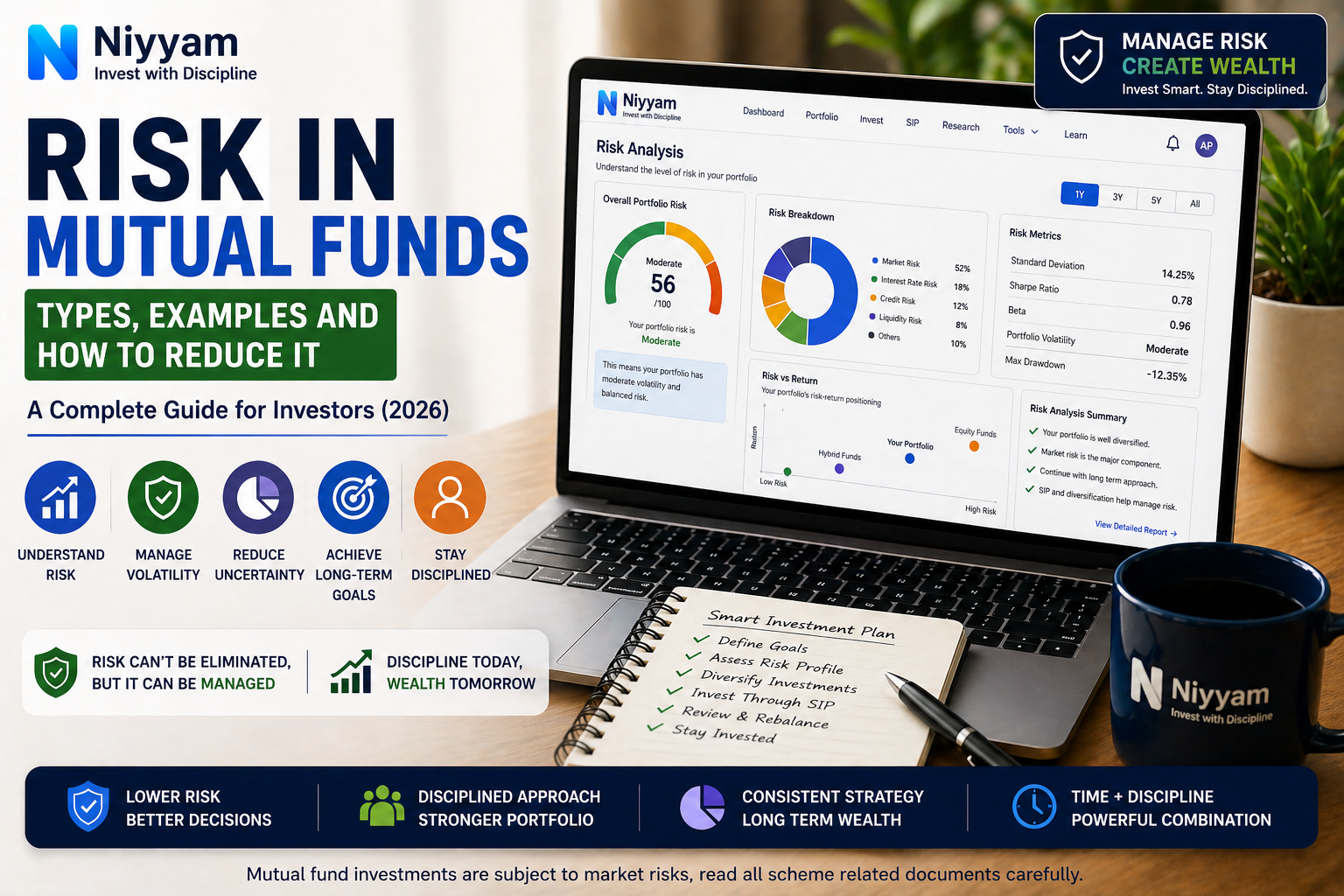
Risk in mutual fund investing cannot be eliminated. But it can be:
- Controlled
- Managed
- Significantly reduced
Successful investing is not about avoiding risk completely. It is about understanding risk and managing it intelligently over time.
💡 Key Takeaways
- Risk is a natural part of investing
- Higher returns usually come with higher risk
- Diversification reduces overall risk
- SIP helps reduce timing risk
- Discipline is the most important factor
Direct Answer
Risk in mutual funds refers to the possibility of fluctuations in investment value due to market conditions. It can be reduced through diversification, proper asset allocation, disciplined investing through SIP, and maintaining a long-term approach.
What Does Risk Mean in Mutual Funds?
Risk in mutual funds refers to the possibility that the value of your investment may fluctuate or decline.
Important Points
- Risk is unavoidable in market-linked investments
- Short-term volatility does not mean permanent loss
- Long-term investing reduces the impact of risk
Key Insight
Risk and return are directly related. Higher potential returns come with higher volatility.
If you are new to mutual funds, refer to
What is a Mutual Fund? A Simple Explanation for Beginners
Types of Risks in Mutual Fund Investing
Understanding different types of risks is the first step to managing them.
1. Market Risk
- Caused by overall market movements
- Impact equity funds the most
2. Interest Rate Risk
- Affects debt mutual funds
- Rising interest rates reduce bond prices
3. Credit Risk
- Risk of default by issuers
- Relevant in certain debt funds
4. Liquidity Risk
- Difficulty in selling investments quickly
- More visible during stressed markets
5. Behavioral Risk
- Caused by investor emotions
- Includes panic selling and chasing returns
Important Insight
Behavioral risk is often the biggest risk investors face.
Why Managing Risk is More Important Than Maximizing Returns
Many investors focus only on returns.
This is a mistake.
Reality
- High returns with high volatility are not sustainable
- Consistent returns with controlled risk create long-term wealth
Key Insight
Risk management is more important than return chasing.
Practical Strategies to Reduce Risk in Mutual Fund Investing
1. Diversify Your Portfolio
Avoid concentrating your investment in one fund or category.
Best Practice
- Spread across equity, debt, and hybrid funds
- Avoid sector concentration
Key Insight
Diversification reduces the impact of poor performance.
To understand portfolio building, refer to
How to Build a Mutual Fund Portfolio for Long-Term Wealth Creation (2026 Guide)
2. Align Investments with Your Risk Profile
Your investment should match:
- Age
- Income stability
- Financial goals
- Time horizon
Important Insight
Mismatch between risk profile and investment leads to panic decisions.
To understand this, refer to
How to Select Mutual Funds Based on Risk Profile in India (2026 Guide)
3. Invest Through SIP Instead of Lump Sum
SIP helps reduce risk by:
- Spreading investments
- Reducing timing risk
- Smoothing volatility
Key Insight
SIP reduces the impact of market timing mistakes.
To compare strategies, refer to
SIP vs Lump Sum: Which Investment Strategy Is Better?
4. Maintain Proper Asset Allocation
Asset allocation is one of the most powerful risk management tools.
Example
- Equity → Growth
- Debt → Stability
Key Insight
Correct allocation reduces portfolio volatility significantly.
5. Rebalance Your Portfolio Regularly
Market changes impact your allocation.
Solution
Rebalance every 6–12 months.
Important Insight
Rebalancing protects gains and controls risk.
To understand rebalancing, refer to
How to Rebalance Your Mutual Fund Portfolio (2026 Guide)
6. Avoid Chasing Past Performance
Investors often select funds based on recent returns.
Why This is Dangerous
- Markets are cyclical
- Top performers keep changing
Key Insight
Past performance does not guarantee future returns.
7. Focus on Long-Term Investing
Short-term volatility is unavoidable.
Reality
- Markets fluctuate
- The long-term trend is upward
Key Insight
Time reduces risk.
8. Understand Fund Categories Before Investing
Different funds carry different risk levels.
Categories
- Equity → High risk, high return
- Debt → Lower risk
- Hybrid → Balanced
Important Insight
Understanding categories improves decision-making.
To understand categories, refer to
Types of Mutual Funds in India Explained
9. Monitor Your Investments Periodically
Best Practice
- Review every 6–12 months
- Avoid daily tracking
Key Insight
Over-monitoring leads to emotional decisions.
10. Avoid Emotional Decisions
Emotions increase investment risk.
Common Mistakes
- Panic selling
- Buying during hype
Important Insight
Discipline reduces behavioral risk.
11. Use Proper Evaluation Metrics
Instead of only returns, use:
- Rolling returns
- XIRR
To understand these metrics, refer to
What are Rolling Returns in Mutual Funds? (2026 Guide)
and
What is XIRR in Mutual Funds? (2026 Guide)
12. Invest Based on Financial Goals
Goal-based investing provides:
- Clarity
- Discipline
- Better allocation
To understand this, refer to
Goal-Based Investing in Mutual Funds (2026 Guide)
Risk vs Strategy (Quick Framework)
| Risk Type | Strategy |
|---|---|
| Market Risk | Diversification + long-term investing |
| Interest Rate Risk | Invest across durations |
| Credit Risk | Choose high-quality instruments |
| Liquidity Risk | Avoid illiquid exposure |
| Behavioral Risk | Follow disciplined SIP |
Real-Life Scenario
Investor A
- Invests lump sum
- Concentrates in equity
- Panics during fall
Investor B
- Uses SIP
- Diversifies portfolio
- Stays disciplined
Outcome
- Investor A exits at a loss
- Investor B benefits from the recovery
Key Insight
Discipline reduces risk more than strategy alone.
Common Mistakes That Increase Risk
- Investing without a plan
- Ignoring asset allocation
- Over-diversification
- Reacting to market movements
- Frequent buying and selling
Important Insight
Mistakes increase risk more than markets do.
Advanced Insight: Risk Cannot Be Eliminated
Investors often try to avoid risk completely.
This leads to:
- Low returns
- Inflation loss
Reality
Risk can only be managed, not removed.
Frequently Asked Questions (FAQs)
Can mutual fund risk be eliminated?
No. It can only be reduced.
Is SIP risk-free?
No. It reduces timing risk but not market risk.
How often should I review?
Every 6–12 months.
Conclusion
Risk is not the enemy of investing.
Lack of understanding is.
Final Thought
Wealth is not created by avoiding risk.
It is created by managing it intelligently.
If you:
- Diversify properly
- Stay disciplined
- Invest long-term
You can reduce risk and build stable wealth through mutual funds.
Disclaimer
This content is for educational purposes only and does not constitute investment advice.
Mutual fund investments are subject to market risks. Investors should read all scheme-related documents carefully before investing and consider their financial goals, risk tolerance, and investment horizon.
Share this guide with your friends, family, and colleagues to help them make better financial decisions.
If this article helped you, share it with at least one person who needs this guidance.
Leave a Reply