
By Ashok Prasad, Founder, Niyyam
Published: March 2026
Introduction
What happens if a mutual fund company shuts down?
This is one of the most common fears among mutual fund investors, especially beginners.
Many people worry:
- Will I lose all my money?
- Is my investment safe?
- What happens if the fund house disappears?
This concern is completely understandable.
However, this fear is largely based on misunderstanding how mutual funds actually work.
The reality is:
Your money is far more protected than most investors think.
Mutual funds in India operate under a structured and regulated framework where your investments are not directly owned by the Asset Management Company (AMC).
Once you understand this structure, this fear reduces significantly.
💡 Key Takeaways
- SEBI regulates mutual funds with strict investor protection
- Your money is held separately from the AMC
- Investors own the underlying assets
- Funds are transferred or liquidated in case of shutdown
- Loss due to AMC closure alone is extremely unlikely
Direct Answer
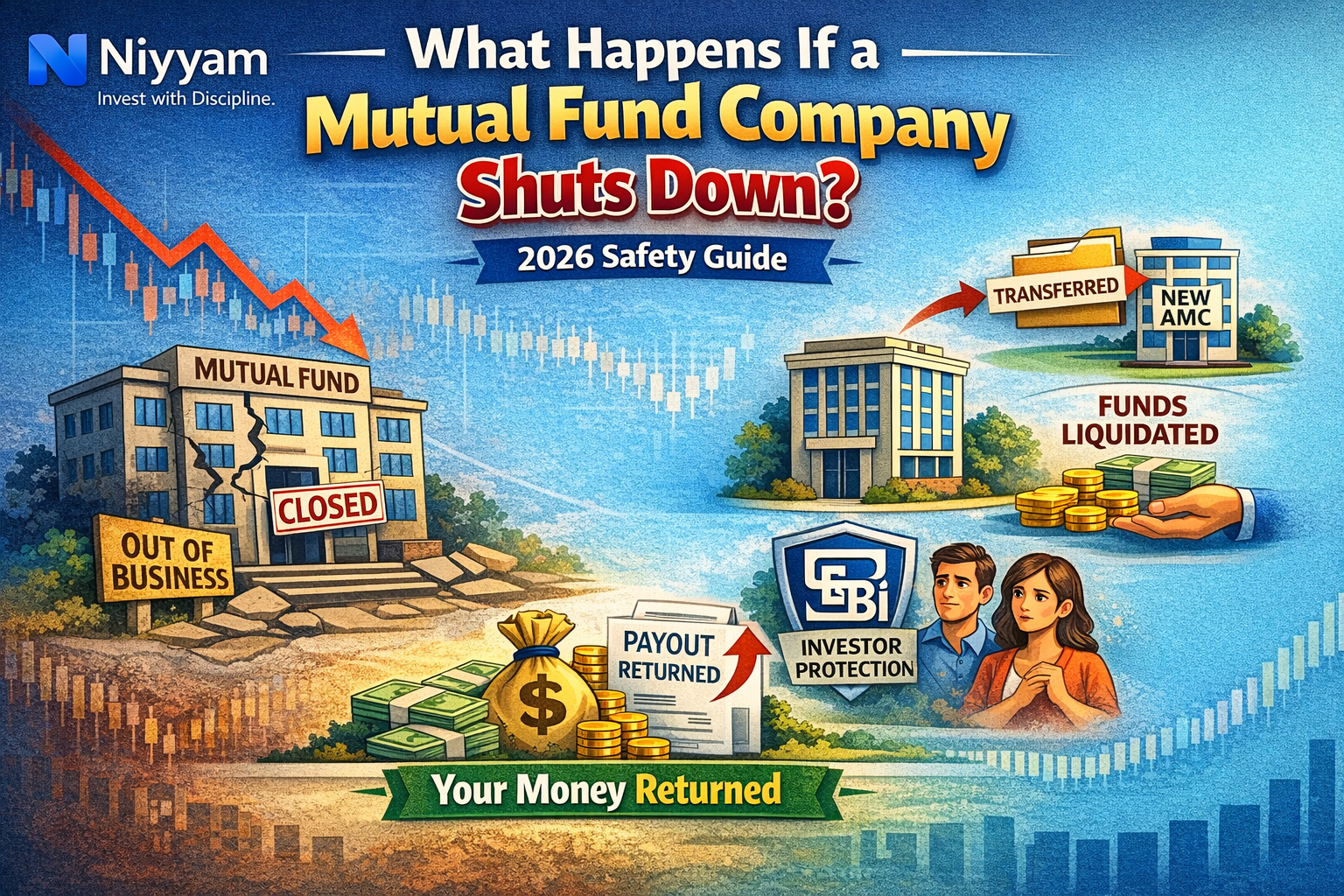
If a mutual fund company shuts down, your money does not disappear. Your investments are either transferred to another fund house or returned to you based on the value of the underlying assets.
How Mutual Funds Are Structured in India
To understand safety, you must first understand the structure behind mutual funds.
Mutual Fund Structure
| Entity | Role |
|---|---|
| AMC (Asset Management Company) | Manages investments |
| Trustee | Protects investor interests |
| Custodian | Holds securities independently |
| SEBI | Regulates the entire ecosystem |
Key Insight
The AMC only manages your money.
It does not own it.
Your investments are legally held in a trust structure designed to protect investors.
For a deeper understanding, refer to
What is a Mutual Fund? A Simple Explanation for Beginners
Why Your Money Is Safe
There are multiple layers of protection built into the mutual fund system.
Key Protection Mechanisms
| Factor | Explanation |
|---|---|
| Separate ownership | Investors own assets |
| Trustee oversight | Ensures fairness |
| Custodian system | Independent asset holding |
| SEBI regulation | Strict monitoring |
Insight
Even if the AMC shuts down, your investments remain protected because they are not part of the AMC’s balance sheet.
What Exactly Happens If an AMC Shuts Down?
There are three possible scenarios.
Scenario 1: AMC Gets Acquired
| Event | Outcome |
|---|---|
| AMC shuts down | Another AMC takes over |
| Your investment | Continues normally |
| Impact | Minimal |
This is the most common outcome in the industry.
Scenario 2: Scheme Transfer
| Event | Outcome |
|---|---|
| Scheme transferred | Managed by new AMC |
| Your units | Remain unchanged |
| Impact | Smooth transition |
Your investment journey continues without disruption.
Scenario 3: Fund Liquidation (Rare Case)
| Event | Outcome |
|---|---|
| Fund closed | Assets sold |
| Investors | Paid based on NAV |
| Impact | Depends on market conditions |
Important Insight
Even in the worst-case scenario, you receive the value of your investments.
Your money does not become zero.
Hidden Reality: Your Money Is Never With the AMC
This is the most misunderstood concept among investors.
When you invest in a mutual fund:
- Your money is held by a custodian (independent entity)
- Managed by AMC
- Overseen by trustees
The AMC acts only as a manager.
It does not have ownership over your investment.
How Often Do Mutual Fund Companies Shut Down?
This event is extremely rare in India.
Industry Reality
| Factor | Reality |
|---|---|
| Frequency of shutdowns | Very low |
| Regulatory strength | Very high |
| Transparency | Strong |
| Investor protection | Well established |
India’s mutual fund ecosystem is mature and continuously monitored by regulators.
Real-Life Example: Franklin Templeton Case
One of the most discussed cases in India is the Franklin Templeton debt fund issue (2020).
What Happened
- Six debt schemes were closed due to liquidity issues
- Investors could not withdraw funds immediately
- Assets were gradually liquidated over time
Outcome
- Investors received repayments in phases
- The majority of the capital was returned
- Losses, if any, were due to market conditions, not closure
Key Insight
Even in extreme cases, investors do not lose everything.
Can You Lose Money in This Situation?
Let’s clarify this.
Risk Breakdown
| Risk Type | Impact |
|---|---|
| Market risk | Yes |
| AMC shutdown risk | Very low |
| Fraud risk | Extremely low |
Key Insight
Losses in mutual funds happen because of market movements, not because the AMC shuts down.
To understand this better, refer to
Can You Lose Money in SIP in Mutual Funds? Explained Simply
What Happens to Your SIP If AMC Shuts Down?
If you are investing through SIP, here is what happens:
SIP Scenarios
| SIP stops, and funds are returned | Outcome |
|---|---|
| AMC acquired | SIP continues automatically |
| Scheme transferred | SIP continues under new AMC |
| Scheme closed | SIP stops and funds are returned |
Insight
Your SIP does not disappear.
It either continues or gets settled properly.
For a long-term perspective, refer to
Can SIP Make You Crorepati? Real Numbers, Time & Strategy (2026 Guide)
Behavioral Reality: The Real Risk Is Investor Behavior
Most investors worry about the AMC shutdown.
But the real risk is:
- Panic selling
- Emotional reactions
- Lack of understanding
Investors often lose money not because of events like a shutdown, but because they react incorrectly during uncertainty.
What Should You Do If This Happens?
Action Plan
- Stay calm
- Check official communication
- Track developments
- Take informed decisions
Should You Exit Immediately?
Decision Framework
| Situation | Recommended Action |
|---|---|
| AMC acquired | Stay invested |
| Scheme transferred | Monitor performance |
| Fund liquidated | Redeem after payout |
Avoid panic-based decisions.
How to Reduce Your Risk Further
Even though the system is strong, smart investors take additional precautions.
Risk Reduction Strategies
| Strategy | Benefit |
|---|---|
| Diversify across AMCs | Reduces dependency |
| Choose large fund houses | Higher stability |
| Avoid over-concentration | Balanced risk |
To structure your investments better, refer to
How Many Mutual Funds Should You Have in Your Portfolio? (2026 Guide)
Best Practices for Investors
- Avoid panic decisions
- Focus on long-term goals
- Diversify investments
- Review periodically
For a broader strategy, refer to
Active vs Passive Investing in India: Which Strategy Wins in the Long Run
Psychological Reality: Fear vs Facts
| Fear | Reality |
|---|---|
| AMC shuts down = total loss | Not true |
| Money disappears | Not possible |
| Entire investment lost | Extremely unlikely |
Understanding facts helps eliminate unnecessary fear.
SIP vs Panic: What Matters More?
SIP investors are generally safer because:
- Long-term investing reduces volatility
- Market averaging improves outcomes
- Discipline builds wealth
However, panic decisions can destroy even good investments.
Decision Snapshot
Quick Summary
| Situation | What You Should Do |
|---|---|
| AMC shuts down | Stay calm |
| Fund transferred | Continue |
| Fund liquidated | Redeem |
Frequently Asked Questions (FAQs)
What happens if a mutual fund company shuts down?
Your investments are transferred or returned based on asset value.
Will I lose all my money?
No, your investments are protected by structure and regulation.
Is mutual fund investment safe in India?
Yes, due to SEBI regulations and multi-layer protection.
Should I withdraw immediately?
Not necessarily. Evaluate before acting.
Conclusion
A mutual fund company shutting down is rare.
Even if it happens:
- Your money is protected
- Your investments continue or are settled fairly
- You do not lose everything
Final Verdict
The fear of AMC shutdown is largely psychological.
The real risks in investing are:
- Market volatility
- Poor decisions
- Lack of discipline
Final Thought
Successful investing is not about avoiding rare events.
It is about:
- Understanding the system
- Staying disciplined
- Avoiding emotional reactions
If you stay informed, you can invest with confidence.
Disclaimer
This content is for educational purposes only and does not constitute investment advice.
Mutual fund investments are subject to market risks. Investors should read all scheme-related documents carefully before investing and consider their financial goals, risk tolerance, and investment horizon.
Share this guide with your friends, family, and colleagues to help them make better financial decisions.
If this article helped you, share it with at least one person who needs this guidance.
Leave a Reply