
By Ashok Prasad, Founder, Niyyam
Published: March 2026
Introduction
What is exit load in mutual funds is a question many investors only notice when they redeem their investment and receive less money than expected.
You invest with a long-term goal.
You choose a fund carefully, start your SIP, and stay disciplined.
Everything looks fine — until the day you decide to withdraw.
The redemption amount seems slightly lower than expected.
That is when you encounter a commonly ignored concept:
Exit Load
This leads to confusion:
- Is this a penalty?
- Why has money been deducted?
- Could this have been avoided?
Most investors focus only on returns while ignoring costs.
But in reality, costs like exit load directly reduce your actual profit, especially when you exit early or frequently switch funds.
Understanding exit load is critical because even a small percentage can impact long-term wealth significantly.
💡 Key Takeaways
- Exit load is a fee, not a tax
- It applies only on early redemption
- Long-term investors usually avoid it
- Even 1% can significantly reduce returns
- Each SIP installment has a separate exit load period
- It directly impacts exit decisions
- Understanding it improves investment discipline
Direct Answer
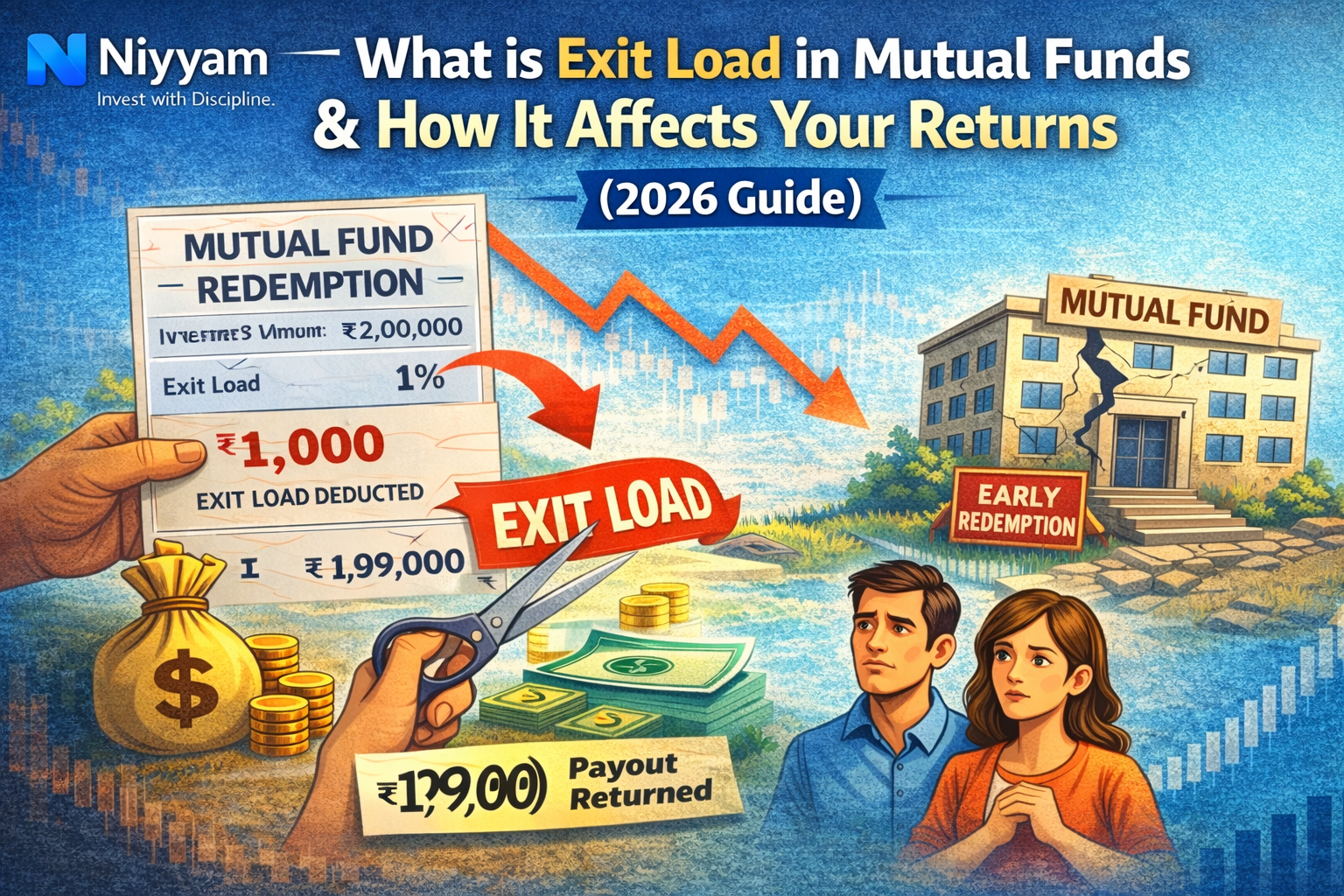
Exit load is a fee charged by a mutual fund when you redeem your investment before a specified holding period. It reduces your final redemption value and is designed to discourage early withdrawals.
Key points:
- Discourages short-term investing behavior
- Typically ranges between 0.5% to 1%
- Applies only within a defined time window
What is Exit Load in Mutual Funds?
Exit load is a charge deducted when an investor withdraws money before a predefined holding period set by the mutual fund.
| Factor | Details |
|---|---|
| Type | Fee |
| Charged by | Asset Management Company (AMC) |
| Purpose | Discourage early exit |
| Applicability | Early redemption only |
It ensures that investors stay invested for the intended duration and do not disrupt the fund’s strategy.
For basics, refer to What is a Mutual Fund? A Simple Explanation for Beginners.
Why Do Mutual Funds Charge an Exit Load?
Exit load plays an important role in maintaining portfolio stability.
| Reason | Explanation |
|---|---|
| Prevent frequent trading | Reduces short-term churn |
| Protect long-term investors | Ensures fairness |
| Maintain fund strategy | Avoids sudden outflows |
If too many investors exit suddenly, fund managers may be forced to sell assets prematurely, affecting performance.
How Exit Load is Calculated
Basic Example
| Component | Value |
|---|---|
| Investment Value | ₹1,00,000 |
| Exit Load | 1% |
| Deduction | ₹1,000 |
| Amount Received | ₹99,000 |
Multiple Scenarios
| Investment | Exit Load % | Deduction | Final Amount |
|---|---|---|---|
| ₹50,000 | 1% | ₹500 | ₹49,500 |
| ₹1,50,000 | 1% | ₹1,500 | ₹1,48,500 |
| ₹2,00,000 | 0.5% | ₹1,000 | ₹1,99,000 |
Even a small percentage leads to a direct reduction in your redemption value.
Exit Load Rules Across Fund Types
| Fund Type | Typical Rule |
|---|---|
| Equity Funds | 1% if redeemed within 1 year |
| Debt Funds | 0%–0.5% based on duration |
| Liquid Funds | Usually 0% |
| ELSS Funds | No exit load (3-year lock-in) |
Always check scheme-specific details before investing.
Exit Load vs Lock-in Period
| Factor | Exit Load | Lock-in Period |
|---|---|---|
| Meaning | Fee for early exit | Withdrawal restriction |
| Flexibility | Exit allowed with fee | Exit not allowed |
| Example | Equity fund | ELSS fund |
Many investors confuse exit load with lock-in, which leads to incorrect assumptions.
How Exit Load Affects Your Returns
Exit load directly reduces your gains.
Example
| Detail | Value |
|---|---|
| Investment | ₹1,00,000 |
| Gain | ₹12,000 |
| Exit Load (1%) | ₹1,120 |
| Final Gain | ₹10,880 |
Impact Comparison
| Scenario | Without Exit Load | With Exit Load |
|---|---|---|
| Investment | ₹1,00,000 | ₹1,00,000 |
| Value | ₹1,12,000 | ₹1,12,000 |
| Deduction | ₹0 | ₹1,120 |
| Final Value | ₹1,12,000 | ₹1,10,880 |
Even small exit loads can meaningfully reduce returns.
For return expectations, refer to Mutual Fund Returns in India: कितना Return मिलता है? (2026 Guide).
Hidden Impact: Exit Load and Compounding
Most investors think exit load is a one-time deduction.
But the real impact is deeper:
- Reduced reinvestment capital
- Lower compounding base
- Long-term wealth erosion
For example, if ₹5,00,000 is reduced by exit load:
- Future returns compound on a lower amount
- Over 10–15 years, this creates a significant difference
This is why avoiding unnecessary exit load is important for long-term investors.
Exit Load in SIP Investments (Critical Section)
This is where most investors make mistakes.
Each SIP installment is treated separately.
| SIP Month | Investment | Exit Load Status |
|---|---|---|
| January | ₹5,000 | No exit load (after 1 year) |
| February | ₹5,000 | Exit load applies |
| March | ₹5,000 | Exit load applies |
Key Rules
- Each SIP has its own holding period
- Exit load is calculated individually
- Partial withdrawals can trigger mixed exit loads
For clarity, refer to What Happens When You Stop SIP? Complete Impact Explained (2026 Guide).
Behavioral Insight: Exit Load and Investor Mistakes
Exit load is often triggered due to behavioral mistakes:
- Panic selling during market corrections
- Frequent switching between funds
- Chasing recent top performers
- Lack of long-term planning
The problem is not exit load itself.
The problem is investor behavior that triggers exit load unnecessarily.
When Should You Avoid Exit Load?
| Situation | Action |
|---|---|
| Close to exit load expiry | Wait |
| No urgent need | Stay invested |
| Minor underperformance | Hold |
Patience often saves unnecessary costs.
When Paying Exit Load is Acceptable
| Scenario | Reason |
|---|---|
| Long-term underperformance | Better to switch |
| Goal achieved early | Exit justified |
| Portfolio rebalancing | Strategic decision |
For structured exits, refer to When to Exit a Mutual Fund? 7 Clear Signals Every Investor Should Know (2026 Guide).
Exit Load vs Expense Ratio
| Factor | Exit Load | Expense Ratio |
|---|---|---|
| Type | One-time fee | Recurring cost |
| Charged when | Redemption | Throughout holding |
| Impact | Immediate | Long-term |
Also refer to What is Expense Ratio in Mutual Funds? How It Affects Your Returns (2026 Guide).
Hidden Cost Impact Over Time
| Scenario | Without Exit Load | With Exit Load |
|---|---|---|
| Investment | ₹5,00,000 | ₹5,00,000 |
| Gain (10%) | ₹50,000 | ₹50,000 |
| Exit Load | ₹0 | ₹5,500 |
| Final Gain | ₹50,000 | ₹44,500 |
Small costs compound into large differences.
Common Mistakes Investors Make
- Ignoring exit load before investing
- Redeeming funds too early
- Frequent switching
- Confusing exit load with tax
- Not understanding SIP-wise exit load
Decision Framework (Most Important Section)
| Scenario | Action |
|---|---|
| Within exit load period | Avoid exit |
| Short-term loss | Hold |
| Long-term underperformance | Switch |
| Goal achieved | Exit |
Tax vs Exit Load (Important Difference)
| Factor | Exit Load | Tax |
|---|---|---|
| Charged by | AMC | Government |
| Type | Fee | Tax |
| Applicability | Early exit | On gains |
Frequently Asked Questions (FAQs)
What is exit load in mutual funds?
It is a fee charged when you redeem your investment before a specified duration.
Can an exit load be avoided?
Yes, by holding investments beyond the defined period.
Is it charged on profit or the total amount?
On total redemption value.
Does SIP have an exit load?
Yes, each installment is treated separately.
Is exit load a tax?
No, it is a fee.
Conclusion
Exit load is a small but powerful factor that directly affects your returns.
Ignoring it can reduce your profits unnecessarily.
Final Verdict
- Avoid unnecessary early exits
- Understand fund rules clearly
- Align investments with your time horizon
Smart investing is not just about earning returns — it is also about controlling costs.
Final Thought
Most investors focus only on returns.
But successful investors focus on both returns and costs.
Exit load is a small detail that creates a meaningful difference in long-term wealth.
Understanding it today will help you make smarter decisions tomorrow.
Disclaimer
This content is for educational purposes only and does not constitute investment advice.
Mutual fund investments are subject to market risks. Investors should read all scheme-related documents carefully before investing and consider their financial goals, risk tolerance, and investment horizon.
Share this guide with your friends, family, and colleagues to help them make better financial decisions.
If this article helped you, share it with at least one person who needs this guidance.
Leave a Reply