
By Ashok Prasad, Founder, Niyyam
Published: March 2026
Introduction
When to exit mutual fund is one of the most important yet overlooked questions in investing. Most investors spend a lot of time deciding when to invest, which funds to choose, and how much to invest, but very few have a clear strategy for exiting.
Understanding when to exit mutual fund investments is just as important as knowing when to invest.
As a result, investors often make two critical mistakes. They either exit too early during market volatility and miss long-term growth, or they stay invested in underperforming funds for too long, hoping for recovery.
A well-defined exit strategy ensures that your investments remain aligned with your financial goals, risk tolerance, and market conditions.
Exiting a mutual fund should never be an emotional reaction. It should always be a structured decision based on clear signals and long-term planning.
To build a strong foundation in long-term investing and understand why patience matters, refer to How SIP Builds Wealth Through Compounding (With Simple Examples).
💡 Key Takeaways
- Exit decisions should be based on strategy, not emotions
- Consistent underperformance is a major warning signal
- Financial goals and time horizon should drive exit decisions
- Tax implications play a critical role in exits
- Rebalancing is different from exiting
- Discipline is more important than timing
Direct Answer
You should exit a mutual fund when it consistently underperforms, no longer aligns with your financial goals, disrupts your asset allocation, or becomes inefficient due to costs or tax impact. Exit decisions should always be structured and aligned with a long-term investment strategy.
Why an Exit Strategy is Important
Mutual fund investing is not a “buy and forget” activity. Markets change, economic conditions evolve, and fund performance fluctuates over time. More importantly, your own financial goals and risk tolerance also change.
Without a clear exit strategy, investors may unknowingly stay invested in poor-performing funds or take excessive risks.
A structured exit approach ensures that your portfolio remains aligned with your goals, maintains proper risk balance, and avoids unnecessary losses.
Another critical factor that investors often ignore while planning exits is taxation. Every exit decision can trigger capital gains tax, which directly affects your final returns.
Investors who focus only on returns without considering post-tax outcomes may end up making suboptimal decisions.
To understand how taxation impacts your investments in detail, read Mutual Fund Taxation in India (Complete 2026 Guide).
When Should You NOT Exit a Mutual Fund
Before identifying exit signals, it is equally important to understand when not to exit.
Many investors panic during short-term market corrections and exit their investments prematurely. This is one of the biggest mistakes in investing.
Market volatility is normal, especially in equity investments. Short-term fluctuations do not indicate poor performance.
You should not exit a mutual fund based on:
- Temporary market decline
- Short-term underperformance
- News or market noise
- Emotional reactions
Long-term investing requires patience and discipline.
To understand why staying invested matters, refer to How SIP Builds Wealth Through Compounding (With Simple Examples).
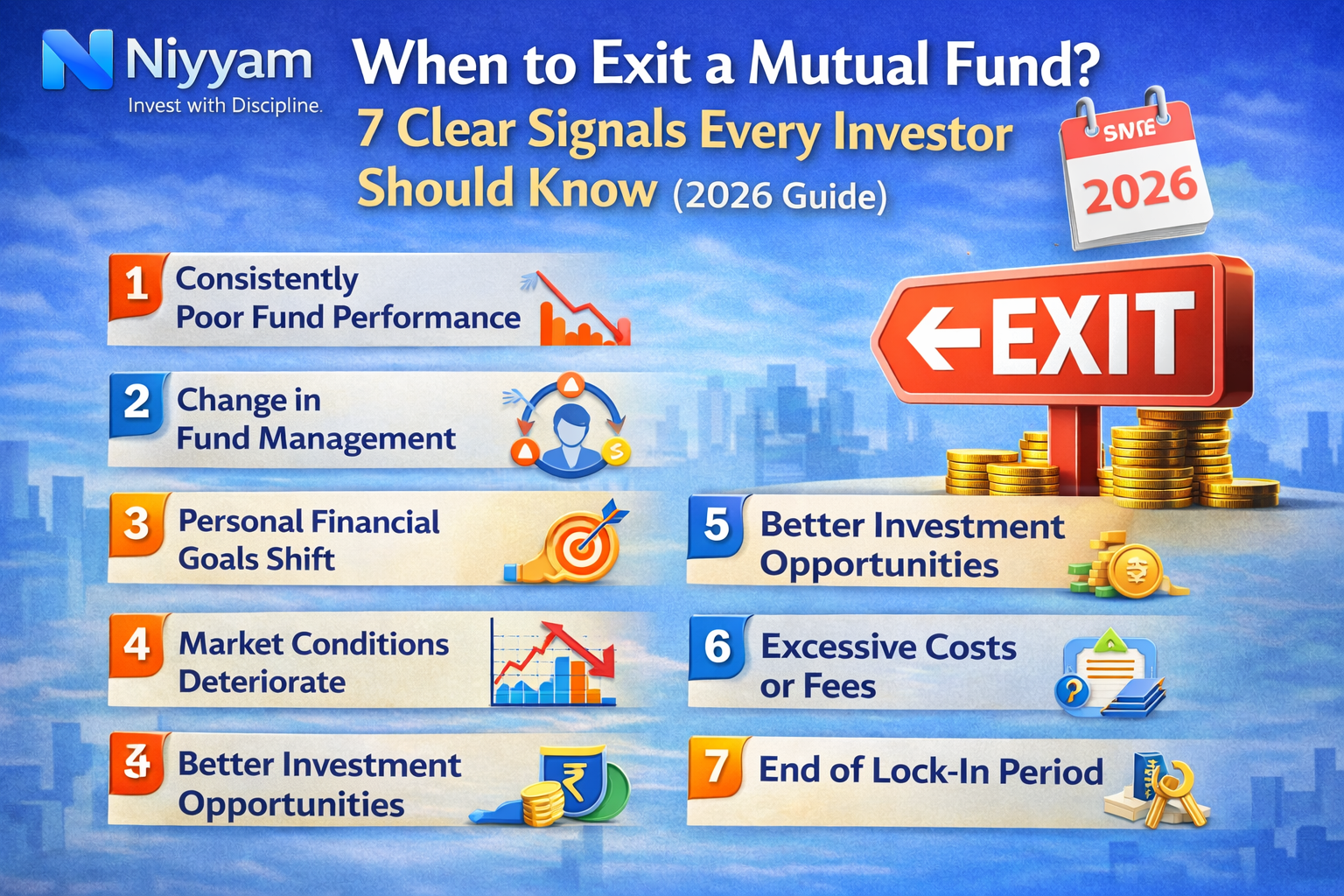
7 Clear Signals to Exit a Mutual Fund
1. Consistent Underperformance
If a fund consistently underperforms its benchmark and peers over a period of 2–3 years, it may indicate deeper issues such as poor fund management or a flawed strategy.
Occasional underperformance is normal, but consistent lag is a warning sign.
To evaluate performance effectively, refer to How to Compare Mutual Funds in India (5 Key Metrics Every Investor Must Check).
2. Change in Fund Strategy
If a mutual fund changes its investment approach, asset allocation, or risk profile, it may no longer align with your investment goals.
Such changes should prompt a review of your investment.
3. Fund Manager Change
A change in fund manager does not automatically require an exit. However, if it leads to a significant change in investment style or a decline in performance, it should be monitored closely.
4. Change in Financial Goals
Your investment should always align with your financial goals.
If your time horizon shortens or your priorities change, your investment strategy must also change.
For a structured approach to investing, refer to Goal-Based Investing in Mutual Funds: How to Plan SIPs for Financial Goals (2026 Guide).
5. Portfolio Allocation Imbalance
Over time, market movements can distort your portfolio allocation.
If one asset class becomes overexposed, it increases overall risk.
In such cases, rebalancing or partial exit may be required.
To understand portfolio structuring, refer to Mutual Fund Portfolio Allocation Strategy (Complete Guide 2026).
6. Better Alternatives Available
If there are consistently better-performing funds within the same category with similar risk levels, switching may be considered.
However, avoid frequent switching based on short-term rankings.
7. High Expense Ratio
Expense ratio directly impacts your returns over time.
If a fund has high costs without delivering consistent performance, it reduces your long-term wealth.
To understand this better, read What is Expense Ratio in Mutual Funds? How It Affects Your Returns (2026 Guide).
Real-World Scenario
Consider two investors with identical portfolios.
Investor A reacts emotionally to market changes, exits during corrections, and frequently switches funds.
Investor B follows a structured approach, reviews performance periodically, and exits only when necessary.
Over time, Investor B achieves better results due to disciplined decision-making.
Another important difference between these investors is their understanding of taxation.
Frequent exits lead to higher tax liability, reducing overall returns. Investors who manage taxation efficiently are able to retain more wealth.
To understand this in detail, refer to Mutual Fund Taxation in India (Complete 2026 Guide).
How to Exit a Mutual Fund Properly
Exiting a mutual fund should be done carefully to minimize losses and maximize efficiency.
First, avoid lump sum exits during volatile markets. Gradual exit reduces timing risk.
Second, always consider tax implications before exiting.
Third, ensure that you have a reinvestment plan so that funds are not left idle.
Finally, avoid frequent switching as it increases costs and reduces returns.
Common Mistakes Investors Make
Many investors make avoidable mistakes while exiting.
These include exiting during panic, following herd behavior, ignoring tax implications, and switching frequently.
To understand these mistakes in depth and how they impact long-term wealth creation, it is important to focus on investor behavior and decision-making patterns. For a complete breakdown of common mistakes and practical strategies to avoid them, read our Common Mutual Fund Mistakes and Smart Investor Strategies (2026 Guide).
Avoiding these mistakes improves long-term outcomes significantly.
Advanced Insight: Exit Strategy and Wealth Creation
Exit strategy has a direct impact on long-term wealth creation.
Poorly timed exits can destroy compounding benefits, while staying invested in underperforming funds can limit growth.
Successful investors strike a balance between patience and action. They do not react to short-term noise but act based on structured evaluation.
This difference in outcomes is largely driven by investor behavior rather than strategy alone. Understanding behavioral mistakes such as panic selling, overconfidence, and frequent switching is critical for long-term success. You can explore this further in our Common Mutual Fund Mistakes and Smart Investor Strategies (2026 Guide).
Taxation also plays a major role here. Frequent exits increase tax liability, reducing net returns.
Disciplined investors focus on post-tax returns and long-term consistency.
Exit vs Rebalance
Exiting and rebalancing are not the same.
Exiting means completely withdrawing from a fund, while rebalancing involves adjusting allocation within your portfolio.
To understand this clearly, refer to How to Rebalance Your Mutual Fund Portfolio (When, Why & How – 2026 Guide).
Final Thoughts
Exiting a mutual fund is not about reacting to the market. It is about making informed, structured decisions aligned with your long-term strategy.
A disciplined investor focuses on consistency, not timing.
Knowing when to exit is just as important as knowing when to invest.
Disclaimer
This content is for educational purposes only and does not constitute investment advice.
Mutual fund investments are subject to market risks. Investors should read all scheme-related documents carefully before investing and consider their financial goals, risk tolerance, and investment horizon.
Share this guide with your friends, family, and colleagues to help them make better financial decisions.
If this article helped you, share it with at least one person who needs this guidance.
Leave a Reply